The Best Apps for Managing Retail Staff Schedules and Shifts
For larger and multi-location retailers, StoreForce is our top choice because it connects intelligent scheduling with task management, labor optimization, store communications and performance visibility.

The best apps for managing retail staff schedules and shifts make it easier to put the right employees in the right place at the right time while giving managers and employees a simpler way to manage the workweek.
For retailers, however, scheduling can involve much more than filling open shifts.
Customer traffic can change throughout the day. Labor budgets need to be considered. Employees have different availability, skills and performance levels. Stores also have tasks and operational priorities that require employee time alongside serving customers.
That means the best retail scheduling app depends on the size and complexity of the retail operation.
For larger and multi-location retailers, StoreForce is our top choice because it connects intelligent scheduling with task management, labor optimization, store communications and performance visibility. Other platforms may be a better fit for businesses primarily looking for straightforward shift scheduling, broader HR capabilities or workforce management across industries.
Here are eight of the best apps for managing retail staff schedules and shifts.
Rank | App | Best For |
|---|---|---|
1 | Multi-location retail scheduling and store execution | |
2 | Zebra Workcloud | Large retail workforce and store operations |
3 | Legion | AI-powered workforce optimization |
4 | UKG | Broad enterprise workforce management and HCM |
5 | Deputy | Straightforward shift scheduling |
6 | Connecteam | Scheduling and managing deskless teams |
7 | Homebase | Small retail businesses |
8 | When I Work | Simple scheduling for smaller shift-based teams |
How We Chose the Best Retail Scheduling Apps
Retail scheduling software should be evaluated based on what retailers actually need from their workforce once a schedule is published.
For this list, we considered capabilities such as schedule creation and management, employee availability, shift flexibility, labor planning, demand forecasting, employee self-service, multi-location scalability and the ability to connect scheduling with the broader work happening inside stores.
Not every retailer needs all of those capabilities.
A small independent store may primarily need an easier way to create a weekly schedule and communicate shifts to employees. A retailer operating hundreds of locations may need to understand expected customer demand, determine how much labor each store requires and coordinate work across an entire store network.
Those differences are reflected in our rankings.
1. StoreForce
StoreForce takes our top position because retail employees are not scheduled simply to fill shifts. They are scheduled to serve customers, complete work and help stores perform.
That distinction is important.
A traditional scheduling application can answer a relatively straightforward question:
Who is working and when?
StoreForce is designed to help retailers answer a much broader set of questions:
When do we need people? Who should be working? What needs to get done while they are there? And how is the store performing?
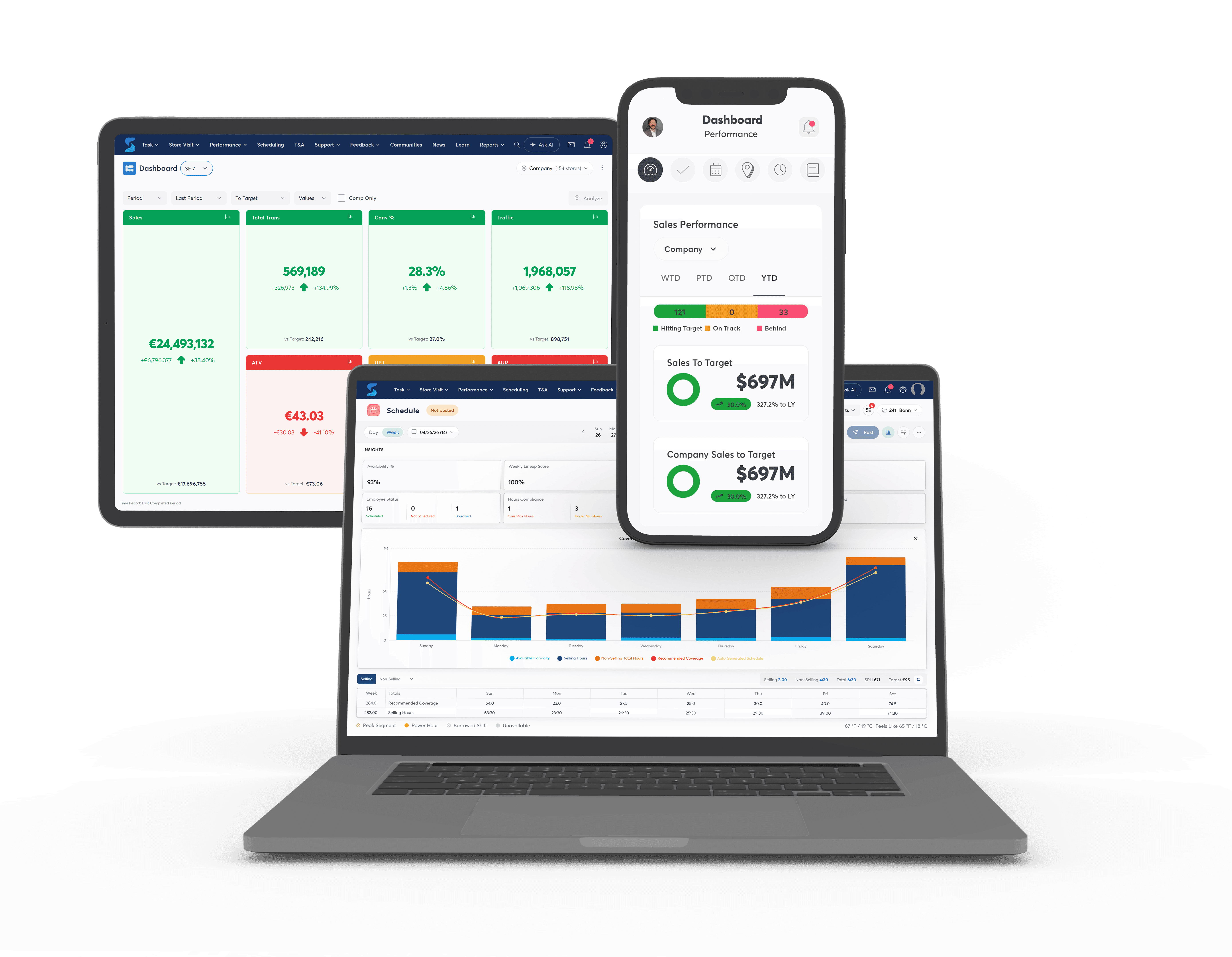
StoreForce brings intelligent scheduling, labor optimization, task management, store communications and KPI visibility together within a platform built specifically around retail operations.
Build Schedules Around When Customers Are Shopping
Retail traffic is rarely distributed evenly throughout the day or week.
A store may be relatively quiet during one part of the day and significantly busier several hours later. Scheduling the same amount or quality of coverage throughout the day can mean having too much labor available during quieter periods and not enough when customers are ready to buy.
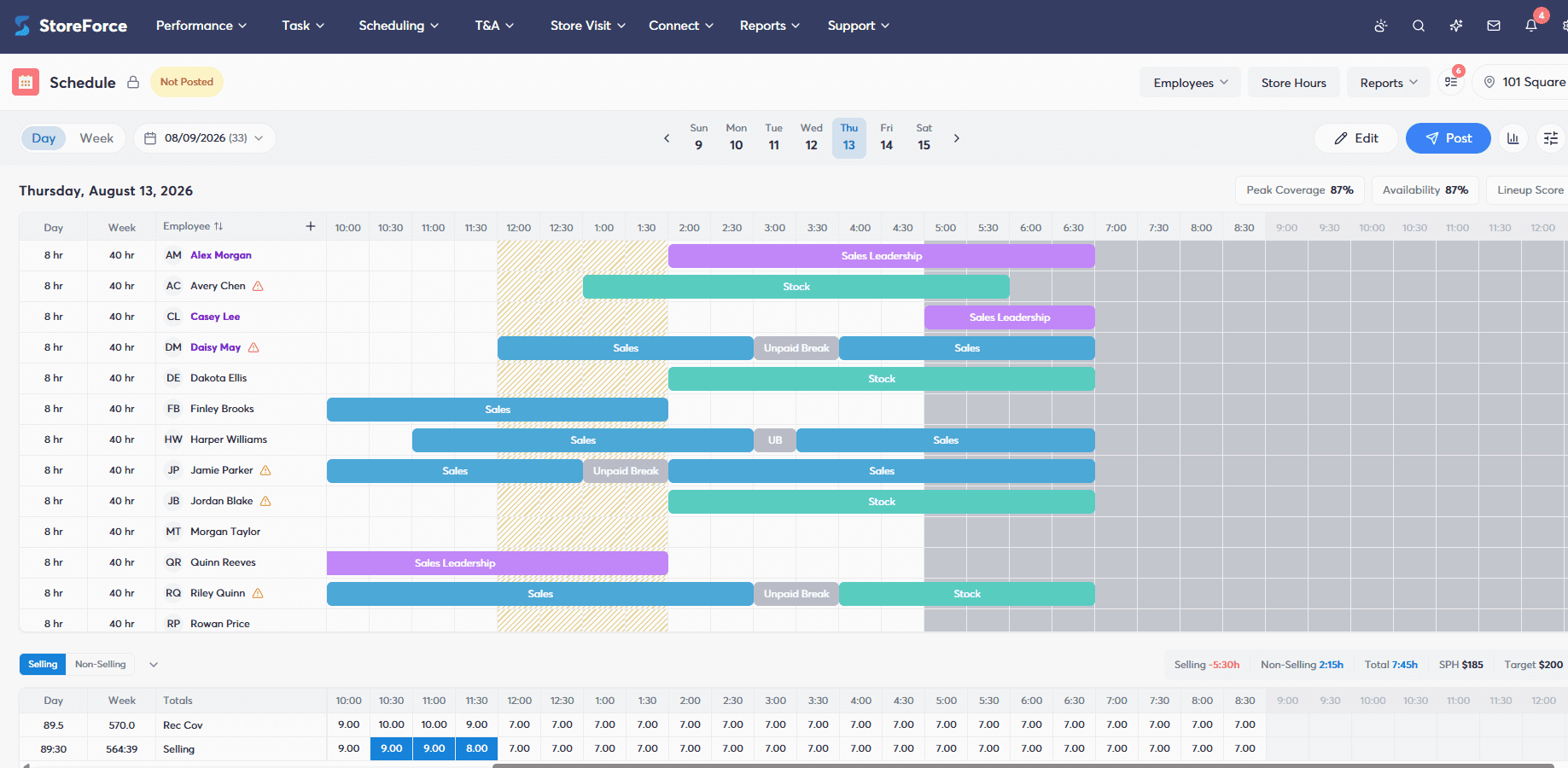
StoreForce helps retailers build schedules around expected customer demand and peak selling periods.
That gives managers more information than simply knowing which employees are available. They can think about when the store is expected to need coverage and which employees can have the greatest impact during those periods.
For retailers focused on improving the productivity of the labor they already have, that connection between traffic and scheduling is an important advantage.
Connect Scheduling With Task Management
This is one of the biggest reasons StoreForce earns the top position on our list.
A schedule tells an employee when they are working, but that is only part of what determines whether a store has a successful day.
Employees also have work to complete.
That might include receiving shipments, completing inventory counts, setting up promotions, changing merchandising displays, conducting audits, completing training or handling other operational priorities.
StoreForce brings task management into the same broader retail operations platform as workforce management.
Retailers can plan, assign and track work across their store network, distribute tasks based on role and location, establish priorities and monitor execution. Tasks can also be considered alongside schedules so retailers have greater visibility into both the people available and the work those people are expected to complete.
That creates a more useful question than simply:
Do we have enough employees scheduled?
Retailers can begin asking:
Do we have the right people and enough time available to handle the work our stores need to complete?
That connection becomes particularly valuable as a retailer grows and more operational priorities need to be coordinated across locations.
See Whether the Plan Is Actually Working
Scheduling the right employees is important, but ultimately retailers need stores to perform.
StoreForce includes KPI dashboards and performance visibility alongside scheduling and execution. Retailers can monitor measures such as sales, conversion, traffic and other store KPIs and use that information to better understand performance across locations.
That closes an important loop.
Retailers can consider when customers are coming into the store, how labor is being scheduled, what work teams are executing and what results stores are producing.
Instead of scheduling existing as a separate administrative process, it becomes connected to the broader performance of the store.
Keep Store Teams Connected
Managing shifts also requires communication between employees, store managers, field leaders and head office.
StoreForce brings communication into the same retail operations environment, helping organizations distribute relevant information to stores and keep teams aligned around what needs to happen.
For a multi-location retailer, this reduces the need to treat schedules, tasks, communications and store performance as completely separate processes.
Why StoreForce Ranks #1
There are several strong scheduling and workforce management platforms on this list. StoreForce ranks first because of the breadth of the retail operating environment it brings together.
The difference can be summarized simply:
Scheduling helps determine who is working.
Labor and demand planning help determine when they are needed.
Task management helps determine what needs to get done.
KPI visibility helps retailers understand how stores are performing.
Bringing those areas together gives retailers a way to manage more of the store day through one connected platform rather than treating scheduling as an isolated function.
For a small business that simply needs to publish shifts, that level of capability may not be necessary.
For multi-location retailers trying to optimize labor, coordinate execution and improve performance across a large store network, it can make a significant difference.
Best for: Multi-location and enterprise retailers that want scheduling connected with labor optimization, task management, store communications and performance.
2. Zebra Workcloud
Zebra Workcloud provides workforce management capabilities designed for large retail environments, including employee scheduling and self-service.
Its retail offering can also connect workforce scheduling with store workload and task management, making it particularly relevant for retailers looking to coordinate labor and store execution across a sizable operation.
The platform is well suited to organizations that want an established enterprise retail technology ecosystem and need to manage scheduling alongside other frontline operations.
Best for: Large retailers looking for enterprise scheduling and store operations capabilities.
3. Legion
Legion focuses heavily on AI-powered workforce management, forecasting and scheduling.
Its platform can use demand, labor requirements, employee skills and preferences to help organizations create optimized schedules. Employees can also use mobile capabilities to manage scheduling activities such as shift swaps and work preferences.
Its emphasis on automation and forecasting makes Legion a strong option for retailers particularly interested in applying AI to workforce planning and labor optimization.
Best for: Retailers prioritizing AI-driven forecasting, scheduling and workforce optimization.
4. UKG
UKG combines workforce management with a much broader suite of human capital management capabilities.
For retailers, its workforce management offering includes scheduling, time and attendance, workforce planning, compliance and employee self-service alongside broader HR, payroll and talent capabilities.
That breadth can make UKG particularly attractive to large enterprises looking for workforce scheduling as one part of a wider HR technology ecosystem.
Best for: Large organizations looking to connect retail workforce management with broader HR, payroll and HCM requirements.
5. Deputy
Deputy provides scheduling and workforce management tools for shift-based businesses, including retailers.
Managers can create schedules around employee availability, labor budgets and expected demand, while employees can access schedules, manage availability and swap shifts through the app. Deputy also provides time tracking, payroll and workplace communication capabilities.
Its focus on making shift management relatively straightforward makes it a strong option for retailers that want capable scheduling without necessarily requiring a retail-specific store operations platform.
Best for: Retailers primarily looking for straightforward scheduling, shift management and time tracking.
6. Connecteam
Connecteam is designed around deskless workforces and combines scheduling with time tracking, communication, training and task management.
For retail teams, schedules can account for availability and roles, while employees can receive updates and manage work through a mobile-first environment. Its broader frontline capabilities can also help businesses standardize routines and communicate with distributed employees.
Because Connecteam serves multiple deskless industries, its approach is broader than a platform designed specifically around retail performance.
Best for: Businesses looking to combine scheduling with broader deskless employee management.
7. Homebase
Homebase is geared toward small businesses with hourly employees and provides scheduling alongside time clocks, payroll, hiring and team communication.
Retail managers can create and publish schedules, track availability and time off, manage shift swaps and monitor labor costs. Sales forecasting and POS integrations can also help smaller businesses make more informed staffing decisions.
For an independent retailer or relatively small team, its straightforward approach can provide many of the capabilities needed to move away from spreadsheets or manually managed schedules.
Best for: Small and independent retailers managing hourly employees.
8. When I Work
When I Work provides employee scheduling tools that can be used by individual stores as well as businesses managing multiple locations.
Managers can create and publish schedules, organize employees by positions or locations and communicate shifts directly to employees. Mobile access also allows employees to keep track of their schedules away from the workplace.
Its relatively focused approach makes it a practical option for businesses whose primary requirement is making employee scheduling and shift communication easier to manage.
Best for: Smaller shift-based teams looking for a straightforward way to create, publish and communicate schedules.
What Should You Look for in a Retail Staff Scheduling App?
The best retail scheduling app is not necessarily the one with the longest feature list.
It is the one that matches the complexity of the retail operation.
Smaller retailers may want to prioritize ease of use, schedule creation, employee availability, shift swaps and mobile access. Those capabilities can eliminate much of the manual work involved in managing an hourly team without introducing functionality the business does not need.
For larger retailers, the requirements can change significantly.
Managers may need to consider customer traffic, sales forecasts, labor budgets, employee performance, workload and other factors before deciding who should be scheduled.
Retail leaders should therefore consider whether a scheduling app can answer four increasingly important questions:
Who is available to work?
When does the store actually need them?
What work needs to be completed during those hours?
Can we see whether our staffing and execution are producing the results we expected?
The more locations a retailer operates, the more valuable it becomes to have those decisions connected rather than managed through separate systems and processes.
Which App Is Best for Managing Retail Staff Schedules and Shifts?
The right choice depends on what you are trying to manage.
Small retailers primarily looking to replace spreadsheets and simplify shift scheduling may find that platforms such as Homebase or When I Work provide the functionality they need.
Businesses looking for broader shift management may consider Deputy or Connecteam, while large enterprises requiring extensive workforce management or HCM capabilities may look toward platforms such as Legion, UKG or Zebra Workcloud.
For multi-location retailers specifically, StoreForce is our top choice because scheduling is connected to a larger question: what does each store need to succeed that day?
StoreForce helps retailers consider when employees are needed, build schedules around demand, manage the work teams need to execute and monitor how stores are performing.
Because ultimately, the goal of retail scheduling is not simply to fill every box on a schedule.
It is to make sure stores have the right people available at the right times, focused on the right work, to make the most of every customer opportunity.

See How StoreForce Can Work for Your Stores
See how StoreForce brings employee scheduling, labor optimization, task management, and store execution together in one retail workforce management platform. Book a demo today to see what StoreForce can do for your teams.
Speak To A Retail Expert


