A Complete Guide to Retail Operations in 2026
This guide explains what retail operations are, why they matter, the challenges retailers face today, and practical ways to improve performance across every location.

Behind every successful retail business is something customers rarely think about: retail operations.
Retail operations are the systems, processes, and daily activities that keep stores running efficiently. They influence everything from inventory and scheduling to merchandising, customer service, and employee performance. When operations run smoothly, customers enjoy a better experience, employees work more efficiently, and businesses become more profitable.
When operations break down, the opposite happens. Shelves sit empty, checkout queues grow longer, tasks are missed, employees become frustrated, and sales begin to suffer.
Whether you manage a single location or oversee hundreds of stores, understanding retail operations is essential for building a successful business. This guide explains what retail operations are, why they matter, the challenges retailers face today, and practical ways to improve performance across every location.
What Are Retail Operations?
Retail operations are the day-to-day activities required to keep a retail business running efficiently. They include everything that happens behind the scenes to deliver a consistent customer experience, from scheduling employees and managing inventory to assigning daily tasks, tracking performance, maintaining store standards, and helping customers on the shop floor.
Think of retail operations as the foundation of your business.
Customers rarely notice great operations directly. Instead, they notice the results. They find the products they need, receive friendly service, move through checkout quickly, and leave with a positive impression of your brand.
Poor operations are just as noticeable. Empty shelves, long queues, inaccurate pricing, disorganized stores, and associates who don't know today's priorities all create frustration that can send customers to a competitor.
Every retail store, regardless of size or industry, depends on strong operations to deliver consistent results.
Take control of your store's performance
Book a demo with StoreForce today and run your retail operations better tomorrow.
Book a Demo
Why Retail Operations Matter
Retail operations influence almost every business outcome a retailer cares about.
Better Customer Experiences
Customers judge a store within minutes of walking through the door. They notice whether products are available, whether associates are helpful, whether the store feels clean and organized, and whether checkout is quick and efficient.
None of those experiences happen by chance. They are the result of consistent operational processes that are followed every day.
Higher Sales
Well-run stores typically sell more.
Products are available when customers want them, promotional displays are completed on time, associates spend more time helping customers instead of searching for inventory, and managers have time to coach employees on selling behaviors.
Small operational improvements often translate directly into higher sales.
Lower Operating Costs
Poor operations are expensive.
Retailers lose money through overtime, inventory inaccuracies, missed tasks, unnecessary markdowns, inefficient scheduling, and employee turnover. Improving operational efficiency helps reduce waste while allowing managers to focus their time where it creates the greatest value.
More Engaged Employees
Retail associates perform better when they know what's expected.
Clear schedules, organized task lists, regular coaching, and realistic workloads create a better work environment. Employees who feel supported are generally more productive, provide better customer service, and are more likely to stay with the company.
Consistency Across Every Store
For retailers with multiple locations, consistency becomes one of the greatest challenges.
Customers expect the same experience whether they shop in Toronto, Dallas, or London. Standardised operational processes help every location follow the same expectations, making it easier to maintain brand standards while giving leadership better visibility across the business.
The Core Components of Retail Operations
Retail operations involve many moving parts that work together throughout the day. If one area struggles, it often affects several others.
Workforce Scheduling
Scheduling is about much more than filling shifts.
Managers need to balance customer demand, employee availability, labour budgets, and store priorities while making sure they have the right people working at the right times.
Poor scheduling creates a chain reaction. Too few associates lead to long checkout queues, missed merchandising tasks, delayed replenishment, and overwhelmed employees. Too many associates increase labour costs without improving productivity.
The best retailers schedule around expected customer traffic rather than relying on fixed weekly schedules.
Labour Management
Scheduling determines who is working. Labour management focuses on how those hours are being used.
Managers should regularly review labour costs, productivity, overtime, and staffing levels to understand whether labour is supporting business goals.
One common mistake retailers make is focusing only on reducing payroll expenses. Cutting hours may reduce costs in the short term, but if customer service suffers or shelves remain empty, the business often loses more revenue than it saves.
Strong labour management is about finding the right balance between efficiency and customer experience.
Inventory Management
Customers can't buy products that aren't available.
Inventory management ensures stores have the right products in the right quantities at the right time. It includes forecasting demand, receiving shipments, replenishing shelves, managing stockrooms, and maintaining accurate inventory records.
Inventory problems affect much more than product availability. Associates spend valuable time searching for missing products, customers lose confidence in the store, and sales opportunities disappear.
Retailers that invest in inventory accuracy create a smoother shopping experience while reducing unnecessary costs.
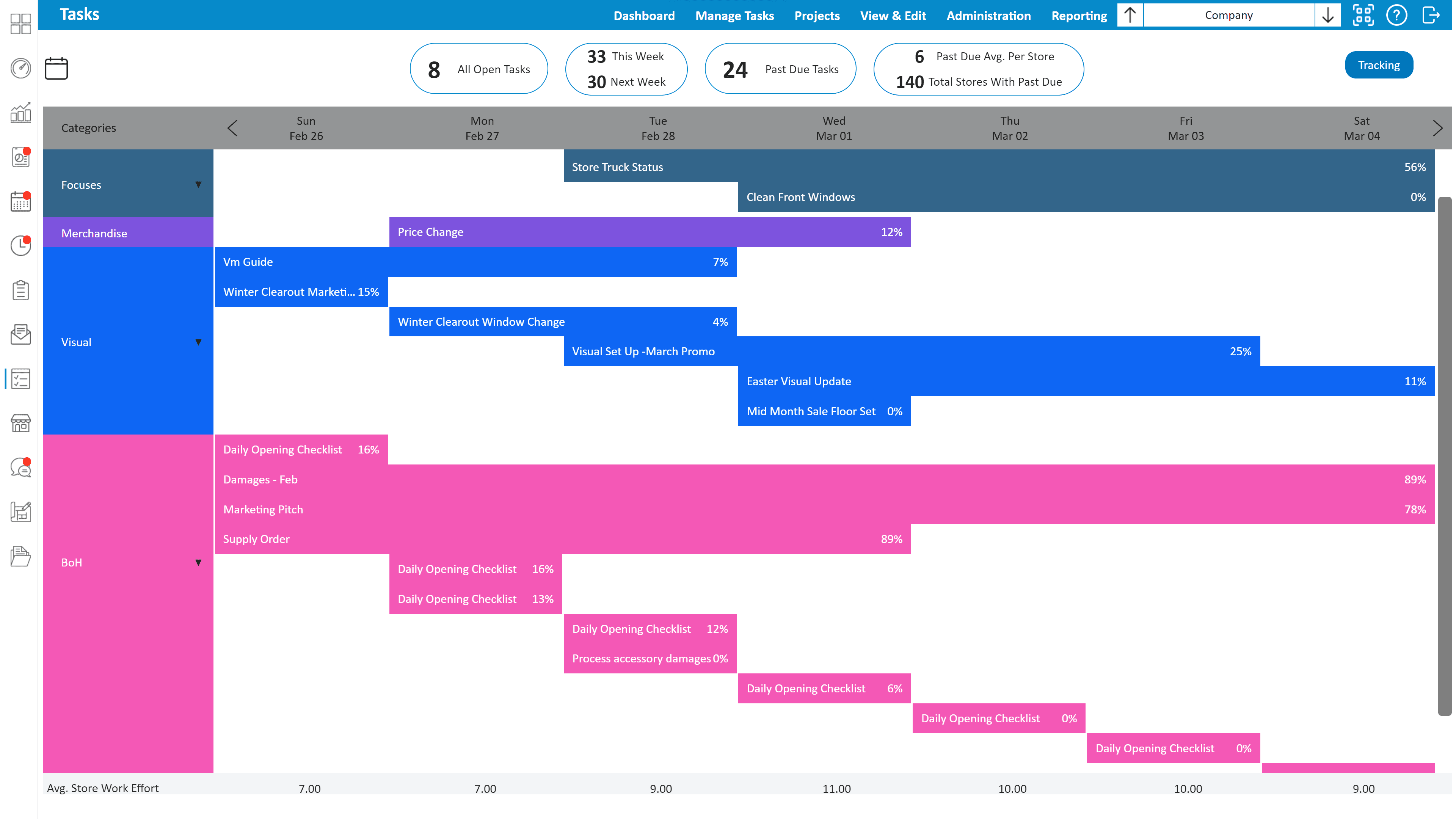
Task Management
Every retail store has hundreds of tasks that must be completed throughout the week.
Opening procedures, promotional displays, price changes, cleaning, replenishment, receiving deliveries, cycle counts, and closing routines all compete for employees' attention.
Without a structured task management process, priorities become unclear and important work is often delayed.
Effective task management gives every associate clear responsibilities, realistic deadlines, and visibility into what matters most each shift. Managers spend less time answering questions and more time supporting their teams.
Visual Merchandising
Merchandising directly influences purchasing decisions.
Products should be easy to find, displays should remain fully stocked, pricing should be accurate, and promotional campaigns should be executed consistently across every location.
Poor merchandising reduces sales even when customer demand exists. If shoppers cannot find what they're looking for quickly, many simply leave without making a purchase.
Great merchandising supports both the customer experience and overall store performance.
Customer Service
Customer service is often viewed as a people issue, but it's also an operational issue.
Even the best associates struggle to provide excellent service if the store is understaffed, inventory is inaccurate, checkout systems are slow, or daily priorities are unclear.
Strong operations give employees the time and resources they need to focus on customers instead of constantly solving operational problems.
Store Performance Management
Retailers need visibility into what's happening across their stores every day.
Performance management involves tracking key metrics like sales, labour costs, task completion, inventory accuracy, customer satisfaction, and employee productivity.
The purpose isn't simply to collect data.
It's to understand what's working, identify problems early, and make informed decisions before small issues become larger ones.
Compliance and Store Standards
Every retail business has standards that define how stores should operate.
These standards cover everything from opening procedures and merchandising guidelines to safety requirements and customer service expectations.
Maintaining consistency requires regular reviews, clear documentation, and accountability throughout the organisation.
Stores that consistently follow operational standards deliver more reliable customer experiences and build stronger brand trust.
The Biggest Retail Operations Challenges in 2026
Retail has always been challenging, but today's environment presents even greater complexity. Managers are expected to do more with fewer resources while meeting higher customer expectations than ever before.
One of the biggest challenges is staffing. Finding and retaining qualified employees remains difficult across much of the retail industry. High turnover means managers spend valuable time recruiting, onboarding, and training instead of developing their existing teams.
At the same time, labour costs continue to rise. Retailers must balance payroll budgets with customer demand, ensuring stores remain adequately staffed without overspending.
Inventory management has become increasingly complex as supply chains continue to evolve. Delayed shipments, changing customer demand, and inventory inaccuracies make it difficult to keep products available without carrying unnecessary stock.
Retailers are also expected to deliver seamless experiences across physical stores, websites, and mobile channels. Customers don't distinguish between online and in-store shopping. They expect the same level of service regardless of how they choose to shop.
Another challenge is visibility.
Many retailers still rely on disconnected systems for scheduling, inventory, sales reporting, task management, and communication. Managers spend valuable time switching between platforms instead of making decisions and supporting their teams.
Finally, maintaining consistency across multiple locations remains one of the most difficult operational challenges. Even stores in the same region often perform differently because processes, communication, and execution vary from one location to another.

Signs Your Retail Operations Need Improvement
Retail operations rarely fail all at once. More often, small problems begin to appear across different areas of the business. Over time, these issues compound, making stores less efficient, increasing costs, and creating a poorer experience for both employees and customers.
If you recognize several of the following signs, it may be time to review your operational processes.
Managers Spend More Time Reacting Than Leading
Store managers should spend most of their day coaching associates, supporting customers, and improving store performance.
Instead, many managers spend their time covering callouts, searching for inventory, answering the same questions repeatedly, chasing overdue tasks, and updating spreadsheets.
When managers are constantly putting out fires, they have very little time left to develop their teams or improve the business.
Associates Are Constantly Asking What to Do Next
Employees should never begin a shift wondering where to start.
If associates regularly ask questions like:
What should I work on first?
Has this task already been completed?
Who is responsible for this display?
Which priorities matter today?
It's usually a sign that communication and task management need improvement.
Clear expectations allow employees to work with confidence while reducing interruptions for managers.
Store Performance Varies Widely Between Locations
No two stores are exactly alike, but stores with similar customer traffic, staffing levels, and product assortments should produce relatively consistent results.
If one location consistently outperforms another, it's worth asking why.
Strong retail operations create consistency through standardised processes, better visibility, and regular coaching rather than relying on individual managers to develop their own systems.
Tasks Are Frequently Left Incomplete
Walk through your stores at the end of the day.
Are promotional displays unfinished?
Are shelves waiting to be replenished?
Are price changes delayed?
Is the stockroom becoming increasingly disorganized?
Missed tasks rarely happen because employees don't care. More often, they happen because workloads aren't realistic, staffing levels are too low, or priorities haven't been communicated clearly.
Instead of asking why tasks weren't completed, ask what prevented employees from completing them.
Customer Complaints Continue to Increase
Customer complaints often reveal operational problems before internal reports do.
Repeated complaints about long checkout queues, unavailable products, inconsistent pricing, or poor service usually point to deeper issues within scheduling, inventory management, staffing, or daily execution.
Listening to customer feedback helps identify areas where operations need attention.
You Rely on Yesterday's Reports to Make Today's Decisions
Retail moves quickly. Waiting until tomorrow to understand today's performance often means opportunities have already been lost. Managers need visibility throughout the day so they can respond while there's still time to improve results. Real-time information allows retailers to solve problems before they affect customers.
Best Practices for Better Retail Operations
Improving retail operations doesn't always require major changes. Small improvements made consistently often have the greatest long-term impact.
Standardise Daily Processes
Every store should follow the same operational standards.
Opening routines, merchandising, inventory counts, customer service expectations, and closing procedures should all be documented and easy for associates to follow.
Standardised processes reduce confusion, improve consistency, and make it easier to train new employees.
Build Schedules Around Customer Demand
Many retailers still build schedules based on habit rather than actual customer traffic.
Instead, review historical sales, seasonal trends, and peak shopping periods to determine where additional staffing will have the biggest impact.
Having the right associates available during busy periods improves customer service without unnecessarily increasing labour costs.
Give Managers Better Visibility
Managers make better decisions when they have access to the right information.
Instead of searching through multiple reports, they should be able to quickly understand sales performance, staffing levels, completed tasks, inventory issues, and store priorities.
The faster managers understand what's happening, the faster they can respond.
Focus on the KPIs That Matter
Retailers collect enormous amounts of data.
Not all of it deserves equal attention.
Focus on metrics that help managers make better operational decisions, such as:
Sales versus target
Labour productivity
Task completion
Inventory accuracy
Customer satisfaction
Conversion rate
Employee attendance
Every KPI should answer a simple question.
What action should we take next?
If a metric doesn't help improve decision-making, it probably doesn't belong on a daily dashboard.
Coach Employees Continuously
Performance reviews shouldn't be the only time employees receive feedback.
Managers should coach associates throughout the week by recognising great performance, identifying opportunities for improvement, and helping employees build confidence.
Regular coaching creates stronger teams while helping employees understand how their work contributes to store success.
Use Technology to Reduce Manual Work
Many retail managers still spend hours every week creating schedules, updating spreadsheets, assigning tasks, and collecting reports.
Technology should reduce that administrative burden.
When repetitive work is automated, managers have more time to spend on the shop floor supporting customers and developing employees.
Technology should never replace leadership.
It should give leaders more time to lead.
How Technology Is Changing Retail Operations
Retail technology has evolved well beyond basic point-of-sale systems.
Today's retailers need connected platforms that help managers understand what's happening across every part of the business.
Scheduling, task management, performance reporting, communication, labour planning, and store execution all influence one another.
When these systems operate independently, managers spend valuable time moving between different platforms while trying to piece together the full picture.
Connected retail operations software brings these functions together so leaders can make decisions using complete, real-time information instead of outdated reports.
This allows retailers to identify problems earlier, respond more quickly, and create greater consistency across every location.
Technology also improves collaboration between head office, district managers, and store teams by giving everyone access to the same operational information.
Instead of reacting after problems occur, retailers can identify trends early and support stores before performance begins to decline.
How StoreForce Helps Retailers Improve Retail Operations
Successful retail operations depend on visibility, consistency, and execution.
StoreForce brings together scheduling, task management, performance tracking, labour planning, communication, and reporting into one platform, helping retail leaders manage every aspect of store operations more effectively.
Managers can spend less time chasing information and more time coaching associates, supporting customers, and improving store performance.
District and regional leaders gain greater visibility across every location, making it easier to identify trends, compare performance, and share best practices throughout the organisation.
By connecting the daily work happening inside each store with real-time performance data, StoreForce helps retailers create more consistent operations while giving managers the tools they need to make better decisions every day.
Frequently Asked Questions…
What are retail operations?
Retail operations are the daily processes, systems, and activities that keep a retail business running efficiently. They include workforce scheduling, inventory management, merchandising, customer service, task management, performance tracking, compliance, and store leadership.
Why are retail operations important?
Strong retail operations improve customer experience, increase sales, reduce costs, create consistency across stores, and help employees work more effectively. They provide the foundation that allows retailers to deliver reliable results every day.
What is the role of retail operations?
The role of retail operations is to ensure stores operate efficiently while meeting customer expectations and business goals. This includes managing people, inventory, daily execution, store standards, and performance across every location.
What are the biggest challenges in retail operations?
Many retailers face challenges including labour shortages, rising operating costs, inventory accuracy, inconsistent execution, disconnected systems, employee turnover, and maintaining consistent standards across multiple stores.
How can retailers improve store operations?
Retailers can improve operations by standardising processes, building schedules around customer demand, improving visibility into store performance, coaching employees consistently, tracking meaningful KPIs, and using technology to reduce manual work and improve decision-making.
Final Thoughts
Great retail operations don't happen by accident.
They are built through clear processes, strong leadership, consistent execution, and a commitment to continuous improvement.
Every scheduling decision, inventory count, merchandising update, coaching conversation, and completed task contributes to the overall customer experience.
Retailers that invest in better operations create stores that are easier to manage, more enjoyable to work in, and more profitable to operate.
As customer expectations continue to rise, operational excellence will become one of the greatest competitive advantages a retailer can have. Businesses that give their managers the right tools, provide clear visibility into performance, and build consistent processes across every location will be better positioned to adapt, grow, and deliver exceptional experiences for customers for years to come.

See How StoreForce Can Work for Your Stores
See how StoreForce brings employee scheduling, labour optimisation, task management, and store execution together in one retail workforce management platform. Book a demo today to see what StoreForce can do for your teams.
Speak To A Retail Expert


