Effectively Manage Frontline Staff Productivity Using Digital Platforms
For retailers, productivity means making the best use of the people and labour hours available. That requires having the right employees in the right place at the right time

Managing frontline staff productivity is not simply about getting employees to complete more work in less time.
For retailers, productivity means making the best use of the people and labour hours available. That requires having the right employees in the right place at the right time, giving them clear priorities and helping managers understand where performance can improve.
Digital platforms can make that easier by connecting workforce planning, scheduling, task management, communication and performance data.
The most effective ways to manage frontline staff productivity using digital platforms include aligning staffing with customer demand, giving employees clear daily priorities, matching workload with available labour, tracking store performance and giving managers better information for coaching.
When those capabilities work together, retailers can create a continuous process:
Plan → Schedule → Execute → Measure → Coach → Improve
Here is what that can look like in practice.
1. Align Staffing With Customer Demand
Frontline productivity starts before an employee's shift begins.
Retailers first need to determine when employees are actually needed.
Customer demand can change significantly by hour, day, location and season. A store may need considerably more coverage on a Saturday afternoon than it does on a Tuesday morning.
Scheduling too many employees during quieter periods can leave labour underutilised. Scheduling too few during peak selling periods can leave employees overwhelmed and potentially cause stores to miss customer opportunities.
Digital workforce management platforms can help retailers use information such as customer traffic, sales forecasts and historical performance to better understand when stores need coverage.
Managers can then build schedules around expected demand rather than relying entirely on fixed staffing patterns or intuition.
The goal is not simply to reduce labour.
It is to make better use of it by putting employees where they can have the greatest impact.
Take control of your store's performance
Book a demo with StoreForce today and run your retail operations better tomorrow.
Book a Demo
2. Give Frontline Employees Clear Daily Priorities
Retail stores can have dozens of priorities competing for attention on any given day.
Shipments need to be received. Promotions need to be set up. Inventory needs to be counted. Training needs to be completed. Visual changes need to be made. Opening and closing routines still need to happen.
Without a centralised way to manage that work, priorities can arrive through emails, spreadsheets, paper checklists, conversations or separate systems.
Digital task management gives retailers a more structured way to communicate daily priorities.
Tasks can be assigned to the appropriate locations or roles with instructions, priorities, due dates and completion requirements. Managers can see what needs attention, while employees have a clearer understanding of what is expected during their shifts.
That reduces ambiguity and helps employees spend less time figuring out what they should be doing next.
3. Match Store Workload With Available Labor
Assigning work is only part of managing productivity. Retailers also need to consider whether stores have enough time and people available to complete it.
Imagine two stores are each scheduled for 120 labour hours tomorrow.
The first has a relatively normal operating day.
The second has a shipment arriving, an inventory count, a major visual change and employee training that needs to be completed.
Those stores may have the same number of labour hours available, but they do not have the same workload.
Digital platforms can help retailers bring those two sides of store operations closer together.
Instead of looking at the workforce plan separately from the work that needs to be completed, retailers can consider:
How much labour is available?
When will customers require the most attention?
What operational work needs to be completed?
Do stores realistically have enough capacity to handle both?
This creates a more useful view of productivity than simply counting how many tasks an employee completes.
The objective should be to plan work realistically against the resources available.
4. Make Store Performance Visible
Activity and productivity are not necessarily the same thing. An employee can be busy for an entire shift. A store can complete every task on its list. Neither automatically means the store performed well.
Retailers ultimately need to understand the outcomes their teams are producing.
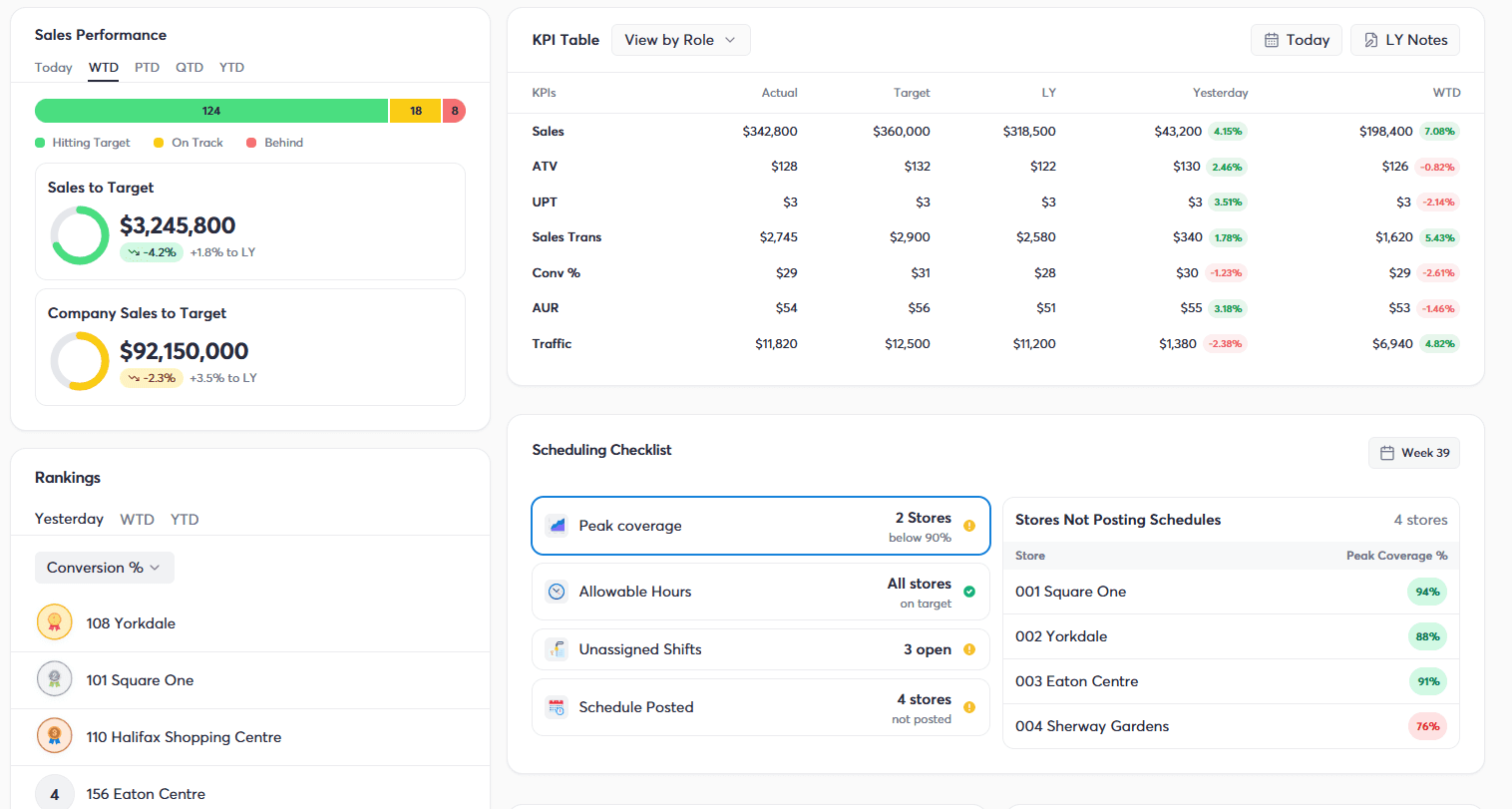
Digital platforms can give store managers, field leaders and head office greater visibility into performance measures such as sales, traffic, conversion, average transaction value, units per transaction and other relevant KPIs.
That visibility helps connect the work happening inside stores with the results retailers are trying to achieve.
Instead of simply asking:
Did employees complete their tasks?
Retail leaders can ask broader questions:
Did we have the right coverage when customers arrived?
Did the store execute its priorities?
How did the store perform?
Where are we seeing opportunities to improve?
That distinction helps retailers manage productivity around outcomes rather than activity alone.
5. Use Performance Data to Support Better Coaching
Visibility into frontline performance should not simply be used to monitor employees.
It should help managers understand where their teams need support.
A digital platform can make performance information easier to access and help managers identify trends that might otherwise be difficult to see.
A store might be generating strong traffic but struggling with conversion. Another may consistently perform well during particular shifts. One location may be completing operational work but falling behind on selling KPIs.
Those signals give managers somewhere to start.
Instead of coaching based entirely on instinct or waiting for a monthly report, managers can use current performance information to have more relevant conversations with employees.
That can help answer questions such as:
Where is the biggest opportunity today?
What is this employee or store doing particularly well?
Where might additional coaching make the greatest difference?
Are there successful behaviours that could be repeated elsewhere?
Used this way, performance data becomes a tool for improvement rather than simply a record of what already happened.
6. Reduce Administrative Work for Store Managers
Frontline productivity is not only about sales associates.
Store managers are frontline employees too, and administrative work can take significant time away from their teams and customers.
Creating schedules, adjusting shifts, checking employee availability, communicating priorities, following up on tasks, reviewing reports and determining where performance needs attention can all consume management time.
Digital platforms can automate or simplify many of those processes.
Schedules can be built using available workforce and demand information. Tasks can be distributed digitally. Employees can access information directly. Completion can be tracked without constant manual follow-up. Performance information can be brought into dashboards rather than assembled manually.
The less time managers spend connecting information from different places, the more time they can spend leading their teams.
That means more time on the sales floor, more time coaching employees and more time focused on the customer experience.
7. Give Frontline Employees Access to the Information They Need
Productivity can also suffer when employees have to rely on managers for basic information.
Questions about schedules, shifts, daily priorities or store communications can create unnecessary interruptions throughout the day.
Digital platforms can give employees more direct access to the information relevant to their work.
Employees can see when they are working, understand what needs to be completed and receive relevant communications without depending entirely on verbal updates or paper-based processes.
The information employees receive should also be relevant to their role and location.
A frontline employee should not have to sort through information intended for another store, region or position to determine what applies to them.
Making the right information easier to find helps employees spend more of their time acting on priorities rather than searching for them.
What Should a Frontline Productivity Platform Bring Together?
There are many digital tools that can improve individual parts of frontline work.
A scheduling application can help manage shifts. A task management application can organise work. A communication platform can distribute information. A business intelligence tool can report performance.
The challenge for retailers is what happens when each of those areas is managed independently.
Managers can end up becoming the connection between the systems.
They have to determine whether the schedule provides enough capacity for the workload, whether operational work is interfering with peak selling periods and whether the work employees are completing is contributing to the outcomes the store needs.
A more connected frontline productivity platform should help retailers bring together:
Workforce planning and scheduling to determine who should be working and when.
Labour optimisation to align employee hours with customer and operational demand.
Task management to establish what work needs to be completed.
Team communication to keep stores aligned around priorities.
Performance visibility to understand what is happening and where improvement is needed.
The value comes not simply from having each capability, but from connecting the decisions they support.
Take control of your store's performance
Book a demo with StoreForce today and run your retail operations better tomorrow.
Book a Demo
How Does StoreForce Help Retailers Manage Frontline Productivity?
StoreForce brings workforce management, task management, team communications and store performance visibility together in a platform built specifically for retail.
That allows retailers to manage frontline productivity as a connected process rather than a collection of individual activities.
Retailers can use demand and performance information to understand when stores require labour. Schedules can then put employees in place around those needs.
Task management helps teams understand what operational work needs to be completed and gives leaders visibility into execution across locations.
Store performance monitoring then gives managers and retail leaders visibility into KPIs so they can understand what is happening, identify opportunities and focus coaching where it can have the greatest impact.
Together, those capabilities create a continuous cycle:
Plan the labour.
Schedule the right people.
Communicate the priorities.
Execute the work.
Measure the results.
Coach where improvement is needed.
Use what you learn to improve the next plan.
That is ultimately what effective frontline productivity management should accomplish.
The goal is not to make every employee appear busier.
It is to help retailers make better use of the people and hours they already have, give frontline teams a clearer understanding of what success looks like and give managers the information they need to help their stores perform.

See How StoreForce Can Work for Your Stores
See how StoreForce brings employee scheduling, labour optimisation, task management, and store execution together in one retail workforce management platform. Book a demo today to see what StoreForce can do for your teams.
Speak To A Retail Expert


