Pooled Labour in Retail: A Smarter Way to Manage Your Workforce
Written by: Ben Flikkema | Content Specialist at StoreForce

Retailers face a familiar staffing challenge. One store has experienced associates looking for more hours, while another location just a few miles away is struggling to cover shifts. Both stores belong to the same brand, yet their scheduling decisions are often made independently.
The result? Retailers can end up hiring new employees at one location while reducing hours for trained, capable associates at another.
It's an inefficient way to manage labour, especially when retailers are already under pressure to control costs, retain employees, and deliver a consistent customer experience.
Pooled labour offers a different approach. Instead of treating every store as an independent workforce, retailers can share qualified associates across nearby locations, giving employees access to more shifts and managers greater flexibility to meet staffing needs.
For multi-location retailers, this creates an opportunity to get more value from the workforce they already have.
What Is Pooled Labour in Retail?
Pooled labour is a workforce management strategy that allows employees to work across multiple store locations within a defined geographic area.
Rather than assigning associates exclusively to one store, retailers create a shared pool of qualified employees who can pick up shifts at other approved locations when additional coverage is needed.
Consider a retailer operating three stores within a 15-minute drive of one another.
Store A has several part-time associates who would happily work additional shifts but don't have enough hours available. Store B is dealing with an employee absence, while Store C needs extra coverage during its busiest selling periods.
Without pooled labour, Store B might scramble to find coverage or ask existing employees to work overtime. Store C might begin recruiting additional part-time staff, even though experienced associates are available elsewhere in the business.
With pooled labour, managers can fill those gaps using qualified employees from nearby locations.
The retailer gains more scheduling flexibility, associates gain additional earning opportunities, and stores can maintain coverage without automatically turning to new hires.
Bring Your Stores Together and Execute Better
Give your teams the workforce management tools to drive better results.
Speak to Our Team
The Problem With Traditional Store-by-Store Scheduling
Most retail scheduling is built around individual store budgets, staffing requirements, and employee availability. Managers are responsible for making sure their location has enough people to operate effectively while staying within their allocated labour hours.
That approach makes sense at the store level, but it can create inefficiencies across an entire retail network.
One location may have more available associates than it can schedule, while another is consistently short-staffed. Because those employees belong to separate store teams, the opportunity to share labour can easily be overlooked.
This becomes particularly challenging when seasonal demand changes.
During the holidays, retailers invest heavily in recruiting and training employees to support increased traffic. Once the season ends, available hours often decline. Strong part-time associates who were working four or five shifts per week might suddenly find themselves scheduled for only one or two.
Some employees will look elsewhere for more consistent work, even if they enjoy their jobs and would prefer to stay with the brand.
When those associates leave, retailers lose more than available labour. They lose product knowledge, operational experience, and employees who have already been trained to deliver the brand's expected level of service.
Replacing that experience takes time and money.
Pooled labour helps retailers address this challenge by creating more opportunities for employees to work across the business rather than depending entirely on the needs of a single location.
Five Benefits of Pooled Labour for Retailers
1. Better Utilisation of Existing Employees
Before recruiting additional employees, retailers should understand whether they are fully utilising the people they already have.
A store experiencing a staffing shortage doesn't necessarily mean the organisation has a labour shortage. Qualified associates may be available at other locations but remain invisible to the manager building the schedule.
Pooled labour makes that available workforce more accessible.
By giving managers visibility into qualified associates across nearby stores, retailers can fill open shifts and respond to changing staffing needs without immediately increasing headcount.
This is particularly valuable for retailers operating multiple locations in shopping malls, urban areas, or regional store clusters.

2. More Consistent Hours and Better Employee Retention
Part-time retail associates often want more predictable hours and opportunities to earn additional income.
When those opportunities aren't available at their primary location, employees may need to find another job, even if they would prefer to continue working for the same retailer.
Pooled labour gives associates greater flexibility to maintain their desired working hours by picking up shifts at other approved stores.
For retailers, this creates an opportunity to retain employees who already understand the products, systems, and expectations of the business.
It can also reduce the constant cycle of recruiting, onboarding, and training replacement employees.
Employee retention becomes especially important when retailers consider how much knowledge experienced associates accumulate over time. Keeping those employees engaged and working consistently helps preserve that investment.
3. Greater Flexibility During Peak Selling Hours
Retail demand isn't evenly distributed throughout the day, week, or year.
A store might need additional coverage on Saturday afternoons but have more than enough staff on a Tuesday morning. Another location in the same area may experience different traffic patterns or promotional demand.
The challenge is making sure available labour is aligned with the moments when customers are most likely to shop.
With pooled labour, retailers can move beyond simply filling schedules and start matching available employees to demand across multiple locations.
For example, an associate might work at their primary store during the week and pick up a Saturday shift at a nearby location experiencing higher customer traffic.
When combined with retail peak-hour analysis and sales-based scheduling, pooled labour gives managers another way to strengthen coverage during important selling periods.
The goal isn't necessarily to schedule more people. It's to make better use of available labour hours when and where they're needed most.
4. Less Pressure to Recruit and Train New Employees
Hiring additional employees is sometimes necessary, but it shouldn't always be the first response to a scheduling gap.
Recruitment requires time, onboarding takes resources, and new associates need experience before they can perform at the same level as established employees.
Pooled labour gives retailers an opportunity to explore existing capacity before creating new positions.
If a nearby store has qualified associates looking for additional hours, those employees may be able to provide immediate coverage without going through the entire hiring and training process.
This doesn't eliminate the need for recruitment, particularly during major expansion or seasonal demand increases. However, it can reduce unnecessary hiring and help retailers make more informed staffing decisions.
5. A More Consistent Customer Experience
Customer experience depends heavily on the associates working on the sales floor.
Customers expect employees to understand the products they're selling, answer questions confidently, and provide helpful recommendations. Those skills develop through training, experience, and regular interaction with customers.
When retailers continually lose experienced associates because they can't offer enough hours, maintaining that level of service becomes more difficult.
Pooled labour helps retailers retain trained employees and make their experience available across multiple locations.
It also gives managers access to qualified associates when additional coverage is required, helping reduce the risk of understaffing during busy periods.
For specialty retailers in particular, this can make a meaningful difference. An experienced associate who understands product features, customer objections, and the brand's selling approach may be better equipped to support customers than a newly hired employee still learning the basics.
The customer experience benefit comes from having capable employees available when customers need them, not simply from adding more people to the schedule.
What Retailers Need to Make Pooled Labour Work
While the benefits are clear, sharing employees across locations requires more than giving associates permission to work at another store.
Retailers need a structured approach that balances employee flexibility with operational control.
That starts with defining which locations can share employees. Geographic proximity matters, but retailers should also consider transportation, employee preferences, store formats, and scheduling requirements.
Employee qualifications are equally important.
An associate who is authorised to open and close their home store may not have the same responsibilities at another location. Someone trained in a specialised product category might not be qualified to perform every role across the business.
Retailers need visibility into these distinctions before making scheduling decisions.
An effective pooled labour strategy should account for:
Approved store locations: Which stores each associate is eligible and willing to work at.
Role qualifications: The positions and responsibilities an associate can perform at each location.
Employee availability: When associates are available to accept additional shifts.
Labour budgets: How hours and labour costs are allocated across participating stores.
Scheduling permissions: Which managers can offer, assign, and approve shifts.
Compliance requirements: Applicable overtime rules, rest periods, and other employment standards.
Without these controls, pooled labour can create additional administrative work and confusion.
With the right processes and workforce management technology, retailers can coordinate shared employees while maintaining accountability at the store level.
Why Workforce Visibility Is Essential to Pooled Labour
One of the biggest barriers to effective pooled labour is a lack of visibility.
A store manager may know which employees are available at their own location, but that doesn't mean they can see qualified associates working at nearby stores.
If scheduling information is scattered across spreadsheets, separate systems, or individual managers, identifying available employees becomes a manual process.
Managers may need to call neighbouring locations, exchange messages, or repeatedly check schedules to find someone who can cover an open shift.
That process becomes increasingly difficult as the number of participating stores grows.
Retailers need a centralised view of employee availability, scheduling requirements, and labour budgets across their store network.
They also need a way to ensure that sharing employees doesn't create scheduling conflicts, exceed labour budgets, or assign associates to roles they aren't qualified to perform.
This is where an integrated retail workforce management platform becomes valuable.
Instead of treating each store schedule as an isolated operation, retailers can make staffing decisions with a clearer understanding of available labour across the business.
How StoreForce Supports Pooled Labour Across Retail Locations
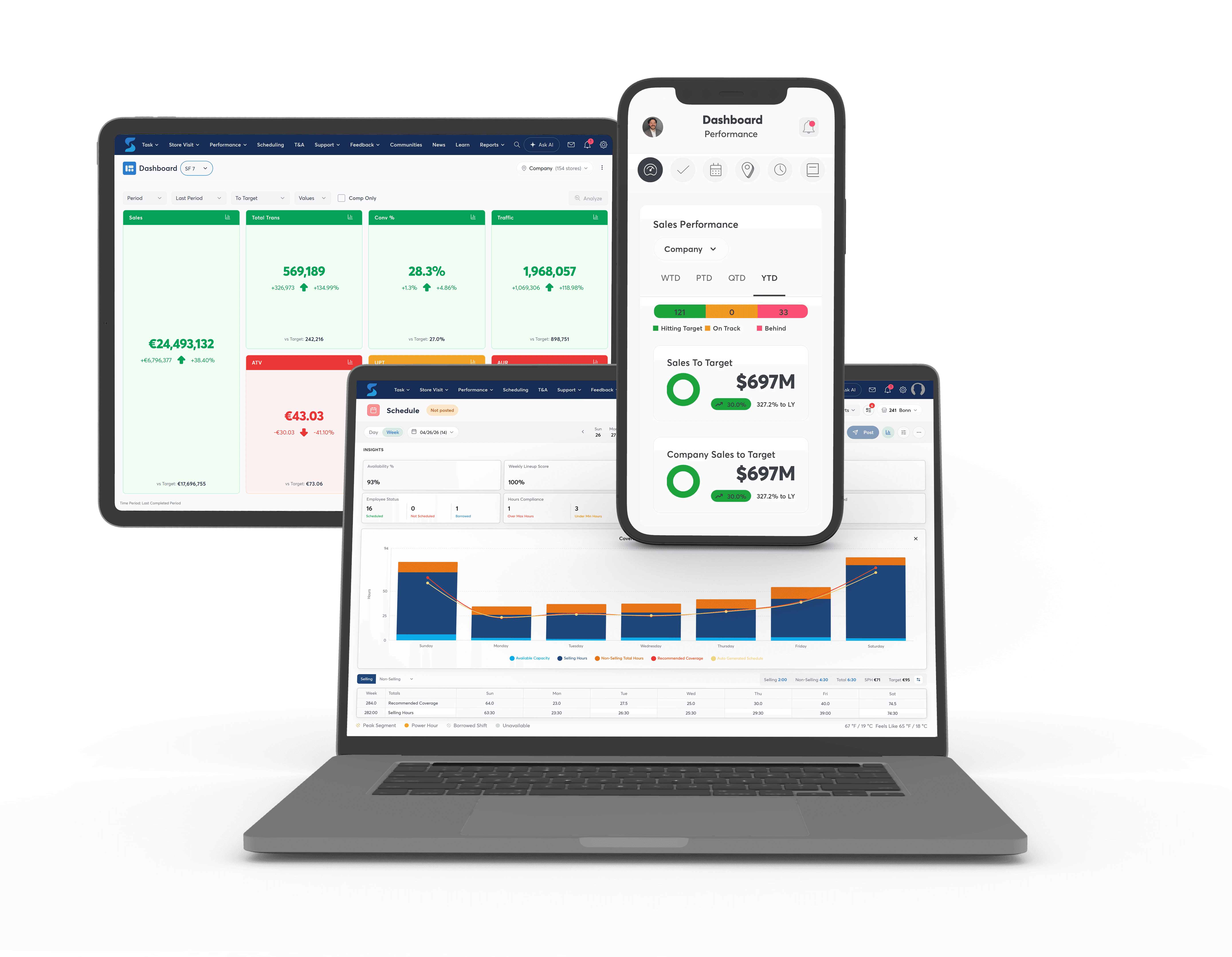
StoreForce helps multi-location retailers manage their workforce with greater visibility and control, making it easier to coordinate labour across participating stores.
Through its retail-focused workforce management and labour optimisation capabilities, StoreForce helps retailers align employee availability, scheduling requirements, and labour demand across locations.
Managers can work with a more complete picture of their workforce, including the employees available to support nearby stores and the labour requirements of individual locations.
StoreForce also helps retailers connect scheduling decisions with sales and performance data, allowing managers to understand when additional coverage is needed and how labour is being used.
Rather than relying on disconnected schedules and manual communication, retail leaders can take a more coordinated approach to workforce planning.
This helps retailers make better use of existing employees, create more opportunities for associates, and maintain the staffing levels needed to support store performance.
For brands managing dozens or hundreds of locations, that visibility can make pooled labour a practical part of a broader workforce management strategy.
Make Better Use of the Workforce You Already Have
Retailers don't always need more employees to solve their staffing challenges. Sometimes, they need a better way to use the employees they already have.
Pooled labour helps connect available associates with stores that need additional coverage, creating opportunities to improve labour utilisation, retain experienced employees, and respond more effectively to changing demand.
It also encourages retailers to think beyond individual store schedules and consider how their workforce can operate more efficiently across an entire network.
With the right scheduling processes, employee permissions, and workforce visibility, pooled labour can help retailers get more value from their existing labour investment while creating a better experience for both associates and customers.
Ready to make smarter labour decisions across your stores?
Talk to StoreForce to discover how retail-focused workforce management can help you improve scheduling flexibility, optimise labour, and get more from your existing team.

See How StoreForce Can Work for Your Stores
Book a quick chat with us today, to improve your retail operations tomorrow.
Speak To A Retail Expert


