
How to Help Retail Store Managers Be More Productive
Written by: Ben Flikkema | Content Specialist at StoreForce

A Saturday callout leaves a retail store one associate short. A delivery shows up early, a promotion needs to be ready by noon, and the manager has a coaching conversation planned before lunch. All of that work was manageable on Friday, when the schedule was set. By Saturday morning, the manager has to decide what still fits.
A workable store plan makes that decision easier. It shows when the store needs the most customer-facing coverage, which tasks have deadlines that matter, and who can take ownership when the schedule changes. It also gives the manager a way to move a coaching conversation and make sure it still happens.
For retail store managers and district leaders, the place to start is with the decisions a manager makes before opening, during a busy shift, and after the same problem has disrupted the schedule several times.
Bring Your Stores Together and Execute Better
Give your teams the workforce management tools to drive better results.
Speak to Our Team
Build the store’s daily plan around customer traffic
A store can have enough labour hours for the day and still be short at the busiest time. That happens when the schedule lines up with total demand but ignores where demand falls within the day. It also happens when several people are scheduled, but some of them are receiving stock, working a fixture reset, or taking breaks at the same time.
Start with traffic by hour for comparable days. Use it to identify where customer-facing coverage matters most, then look at the actual schedule. Account for breaks, shift changes, deliveries, and work that pulls associates off the floor. A promotion or local event may also change the pattern you’d expect from a typical Saturday.
Once you’ve identified those windows, give the day some structure:
Part of the day | What to plan for | Example |
|---|---|---|
Before opening | Work required for the store to open ready for customers | Check that advertised prices are accurate and the promotional display is ready |
Before peak traffic | Work that prepares the team for the rush | Replenish fast-selling items, stagger breaks, and assign sales floor and checkout coverage |
During peak traffic | Customer-facing work and immediate issues | Help customers, manage fitting rooms, and shift an associate to checkout when the line builds |
After peak traffic | Work that needs uninterrupted time | Finish processing stock, complete a floor set, or hold a planned coaching conversation |
The blocks can move. Their value is that they tell the manager what becomes harder to deliver if an hour of coverage disappears. A floor set may still fit after the rush. An advertised price that goes live at noon needs attention before customers see it.
Decide which work moves when the store is short-staffed
A callout changes how much work the team can realistically complete. Before trying to fill the shift, check which hours are affected and what work was assigned to the person who called out. Losing an opener who was due to receive a delivery creates a different problem from losing an associate who was scheduled to cover fitting rooms during peak traffic.
Rebuild the plan in this order:
Cover work with an immediate consequence. Confirm the store can meet safety requirements, serve customers, and deliver any customer commitments due that shift.
Protect the busiest hours. Look at coverage by role. Moving someone to checkout can solve a queue and leave a gap in fitting rooms, so decide who covers both before giving the instruction.
Reduce or move flexible work. Finish the part of a task that matters today and assign the rest a new time. If it needs to carry over to the next shift, name the person who will pick it up.
Communicate the change once. Tell the team what moved, where they’re needed, and who owns each affected task. Update the task or shift plan so the handoff reflects the decision.
Back to that Saturday callout. The manager might assign one associate to receive the delivery, schedule processing for after peak traffic, and give another associate responsibility for checking the promotional prices before noon. The coaching conversation moves to 3 p.m., when the next shift is on the floor. Each change has a reason, an owner, and a time.
District leaders can make these decisions easier by clarifying which deadlines stores can move on their own. If a manager needs approval to reschedule routine work, a five-minute decision can turn into a series of messages while the coverage gap is already affecting the store.
Check progress while there’s still time to act
An end-of-day report can show a missed task. A mid-shift check can tell the manager whether the task is likely to slip and what’s holding it up.
Use natural points in the day, such as before a traffic peak or at a shift handoff. Focus on the work that would trigger a decision if it fell behind. For a promotion due at noon, the manager needs to know who owns the setup, what’s left, and whether anything is blocking it. A status of in progress tells them very little if the signs haven’t arrived or the person assigned to the task is covering checkout.
A quick check should answer three questions:
What’s at risk before the next handoff? Look at the work due soon and whether coverage has changed.
What’s blocking it? Find out whether the issue is time, materials, instructions, or ownership.
What decision would help now? Reassign the work, remove the blocker, adjust the deadline, or escalate it while there’s still time to get a response.
Sales and conversion data can help managers choose where to look. If traffic is tracking as expected but conversion has dropped, walk the floor. Check whether customers can get help, whether popular items are available, and whether queues are backing up. The KPI gives you a place to start. What you see on the floor determines what you do next.
Put coaching on the schedule and give it a fallback
Coaching is easy to postpone because it rarely has the same immediate deadline as a delivery or a promotion. When it gets pushed repeatedly, the manager loses the opportunity to address the small habits that affect the next shift.
Attach coaching to a specific moment. Observe a newer associate during the first busy hour, then schedule a short debrief once traffic eases. If the conversation requires privacy or more time, put it on the schedule and assign someone to cover the floor. Give it a fallback window so a late delivery or an unexpected queue doesn’t wipe it off the day entirely.
Delegation protects that time when the team knows what it can decide. A shift lead who owns checkout coverage should know when to move another associate to the till and when to call the manager. If every routine decision still needs the manager’s approval, their time will remain fragmented even when someone else is nominally in charge.
Fix the problems that keep disrupting the same shift
When the same task slips every week, review when it was due, what else was happening, and how much labour was available at that point in the day. Those details help you distinguish a one-off disruption from a problem in the way work is scheduled or assigned.
For example, suppose a weekly pricing update regularly runs late on Fridays. The task takes about 45 minutes, but it’s due while the assigned associate is covering the floor alone before the evening rush. Sending another reminder leaves the same conflict in place. Moving preparation to Thursday, scheduling overlap on Friday, or changing the deadline could fix it. The right choice depends on when the prices take effect and which steps can be completed in advance.
District leaders can use the same review across stores. If several locations miss the same deadline, compare the task’s estimated duration with how long it actually takes, when it lands, and what else stores are being asked to do. If the problem is concentrated in one location, look at local traffic, deliveries, and role coverage. Give the store manager a way to report those details so the next task plan reflects the work stores can actually fit into the shift.
How StoreForce helps managers plan and adjust the day
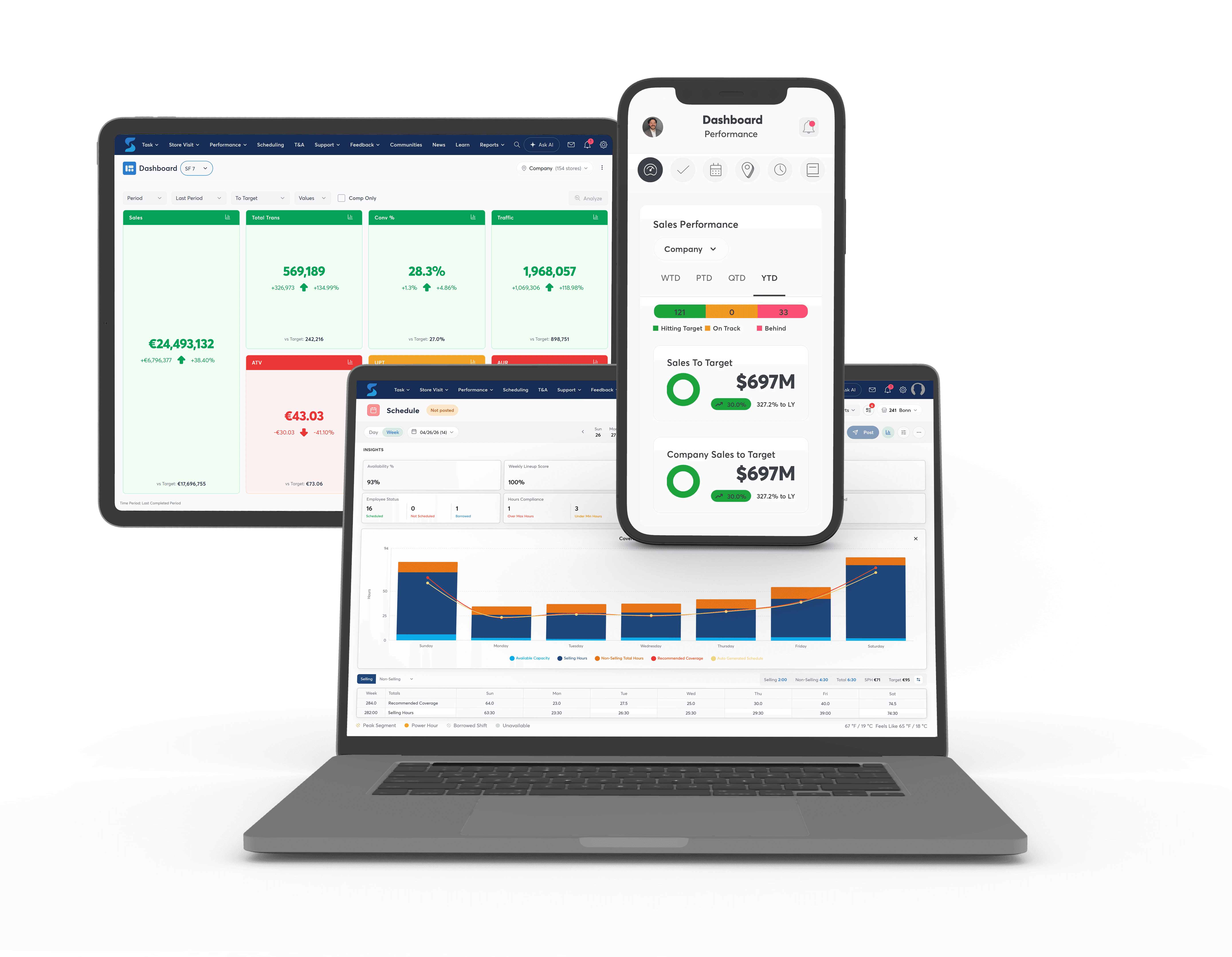
StoreForce brings workforce scheduling, task management, and store performance together. Managers can use traffic patterns to plan coverage, see which tasks are due or overdue, and review performance metrics when they need to investigate a change on the floor.
For a store manager heading into the busiest part of Saturday, that means being able to review coverage alongside the work still due that shift. For a district leader reviewing the week, it means being able to see whether an overdue task is isolated to one store or recurring across several. Those are two different decisions, and both get easier when the schedule, task status, and store performance are visible together.

See How StoreForce Can Work for Your Stores
Book a quick chat with us today, to improve your retail operations tomorrow.
Speak To A Retail Expert


