Standard Shift Planners vs. Workforce Management Platforms
Compare standard shift planning software with workforce platforms that connect employee scheduling with retail store performance analytics.

The primary difference between standard shift planning software and workforce platforms with store performance analytics is the type of question each system is designed to answer.
A standard shift planner primarily helps retailers answer who is working and when. It can help managers build schedules, assign shifts, manage employee availability and communicate upcoming work schedules.
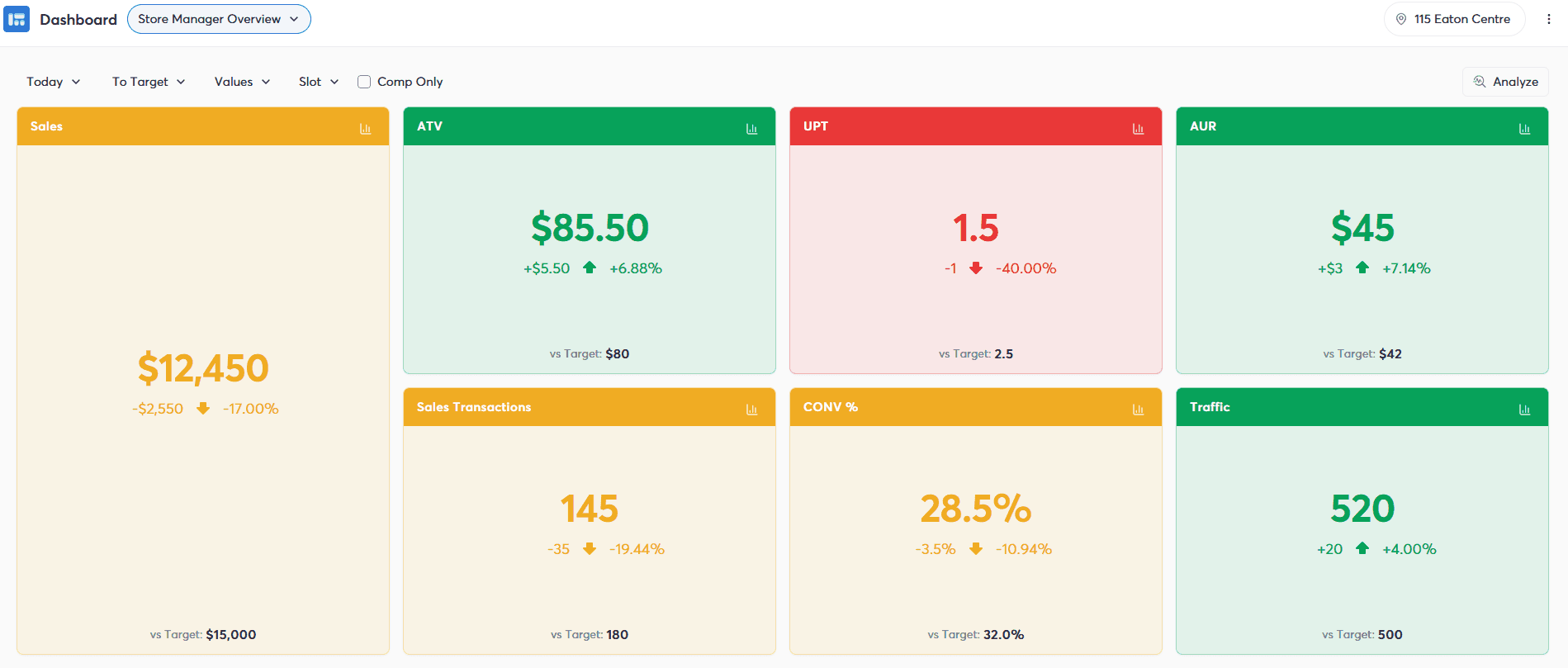
A workforce platform with store performance analytics goes further by helping retailers understand what happened while those employees were working. It can connect workforce information with store KPIs such as sales, customer traffic, conversion, average transaction value and units per transaction.
For retailers, that creates an important distinction. One system helps organise the workforce. The other can help retailers understand how workforce decisions relate to store performance.
What Does a Standard Shift Planner Do?
Standard shift planning software is designed to make employee scheduling easier.
Instead of building schedules on paper, spreadsheets or physical shift boards, managers can create and publish schedules digitally. Depending on the software, employees may also be able to submit availability, request time off, view upcoming shifts or participate in shift-related processes.
For many businesses, those capabilities solve an important operational problem. Managers need to know which employees are available, when they are scheduled and whether required shifts have been covered.
A shift planner can make that process considerably easier to manage.
The limitation is that scheduling information does not necessarily explain what happened during the shift.
A manager may know that five employees were scheduled Saturday afternoon, for example. Without additional store information, they may not know whether that was the appropriate level of coverage, how much customer traffic entered the store or how effectively the store converted that traffic into sales.
What Does Store Performance Analytics Add to Workforce Management?
Store performance analytics adds business context to workforce information.
Instead of viewing the schedule as the end of the workforce planning process, retailers can examine what happened after the schedule was executed.
That can include metrics such as sales, customer traffic, conversion, average transaction value (ATV) and units per transaction (UPT). Retail leaders can use those KPIs to understand store performance and investigate the factors contributing to particular results.
The purpose is not simply to generate more reports. It is to make workforce information more useful when managers are trying to understand store performance.
For example, a store may miss its sales target despite receiving strong customer traffic. Performance analytics can reveal that conversion was lower than expected. Managers can then investigate the situation with additional context, including how the store was staffed during those periods.
The schedule tells them who was there. The performance data helps them understand what happened.
What Are the Primary Differences Between Shift Planners and Platforms With Store Performance Analytics?
The biggest differences appear in what retailers can understand and do with the information each type of system provides.
Standard Shift Planner | Workforce Platform With Store Performance Analytics |
|---|---|
Builds employee schedules | Connects scheduling with store results |
Shows who is scheduled | Helps show what happened while employees were working |
Manages employee availability | Adds performance context to workforce decisions |
Helps fill required shifts | Helps evaluate whether coverage supported store demand |
Focuses primarily on scheduling activity | Connects workforce activity with retail KPIs |
Gives managers visibility into upcoming shifts | Gives leaders visibility into workforce and performance patterns |
Helps organise labour | Helps retailers learn from how labour was used |
Both approaches can make workforce management easier. The difference is how far the retailer wants the system to go beyond schedule creation.
Take control of your store's performance
Book a demo with StoreForce today and run your retail operations better tomorrow.
Book a Demo
Store Performance Analytics Adds Context to Workforce Coverage
One of the limitations of looking at schedules alone is that headcount does not tell retailers whether coverage was appropriate.
Imagine two stores each schedule six employees between noon and 4 p.m. On the schedule, their workforce coverage looks similar.
But Store A may receive significantly more customer traffic during those hours. Store B may experience its busiest period later in the evening.
The same number of employees can therefore produce very different levels of coverage relative to customer demand.
When workforce information can be viewed alongside traffic and performance data, retailers have more context for evaluating whether labour was positioned effectively.
Instead of simply asking whether the shift was filled, managers can ask whether the store had the coverage it needed when the customer opportunity was highest.
Performance Analytics Helps Retailers Understand Conversion
Customer traffic represents an opportunity. Conversion helps show how effectively the store turned that opportunity into transactions.
That makes conversion particularly useful when evaluating workforce performance.
If traffic increases but conversion falls, managers have a reason to investigate. Workforce coverage may be one factor. Employees may have been occupied with operational tasks, the store may have lacked enough coverage during the busiest period or there may be a coaching opportunity unrelated to staffing.
Performance analytics does not automatically tell managers why conversion changed. It gives them the information needed to ask a more specific question.
A standard shift planner might show that enough employees were technically scheduled that day. A platform connecting schedules with performance allows managers to examine whether those employees were working during the periods when customers actually needed them.
Retailers Can Compare Performance by Time of Day
Daily totals can hide important workforce patterns.
A store may finish the day close to its sales target while still struggling significantly during particular periods. Another may have a strong morning but lose opportunities during its afternoon peak.
This is where more detailed performance information becomes valuable.
Retailers can compare when customer demand occurred with when employees were scheduled and how the store performed during those periods. That can help identify recurring gaps that are difficult to see when looking only at daily sales or weekly schedules.
For example, if a store repeatedly experiences strong traffic but weaker conversion between 4 p.m. and 6 p.m., managers can investigate what is happening during that window. The schedule becomes part of the analysis rather than a separate piece of information.
Those insights can then influence future workforce decisions.
Store Performance Analytics Can Improve Future Scheduling Decisions
A standard scheduling process can easily become repetitive. Managers create the schedule, employees work it and then another schedule needs to be created.
Store performance analytics creates an opportunity to learn from what happened.
Retailers can compare workforce coverage with traffic and performance, identify recurring patterns and use those insights when planning future schedules.
That creates a feedback loop:
Plan the workforce → Build the schedule → Execute the schedule → Measure store performance → Identify patterns → Improve the next workforce plan
A store that consistently lacks coverage during a particular traffic peak can adjust future schedules. A location that performs well with a certain coverage pattern can investigate whether that approach should be repeated.
The important difference is that the schedule no longer exists only as an operational plan. It also becomes something retailers can evaluate and improve.
Performance Visibility Becomes More Important Across Large Store Networks
The difference between shift planning and performance analytics becomes even more significant as the number of stores increases.
An individual store manager may have a strong understanding of what happened in their location. Regional and head-office leaders do not have that same day-to-day visibility across every store.
They need a way to identify where attention is required.
Performance analytics can help leaders compare locations, identify unusual results and drill into individual stores when necessary. Instead of contacting every manager to understand how the day went, leaders can use performance information to determine where further investigation may be useful.
For example, a regional manager may notice that several stores experienced similar traffic but very different conversion results. That creates an opportunity to investigate differences in workforce coverage, execution or coaching.
The objective is not to manage every store from head office. It is to help leaders identify where their attention can have the greatest impact.
Store Performance Analytics Should Support Coaching, Not Just Reporting
More data does not automatically improve store performance.
If managers receive dashboards filled with KPIs but do not know what decisions those numbers should inform, analytics can simply become another reporting exercise.
The value comes from connecting information with action.
Managers can use performance information to identify opportunities for coaching. Regional leaders can investigate why similar stores are producing different results. Workforce teams can determine whether recurring performance patterns suggest changes to coverage.
The most useful analytics should help managers move from what happened to what should we investigate or change?
That is a much broader purpose than simply reporting whether the schedule was filled.

When Is a Standard Shift Planner Enough?
Not every business requires full store performance analytics inside its workforce management platform.
A standard shift planner may be sufficient when the primary challenge is simply creating schedules, managing availability and communicating shifts. Smaller operations may also have fewer locations and enough direct management visibility that additional analytics provide limited value.
The requirements change as workforce and store operations become more complex.
Retailers managing large store networks, variable customer traffic and significant labour budgets may benefit from connecting scheduling decisions with a broader understanding of store performance.
The decision comes down to what the retailer expects its workforce technology to accomplish.
If the primary objective is organising shifts, a scheduling tool may be enough. If the objective is also understanding how workforce decisions connect with store results, performance analytics becomes much more important.
How Does StoreForce Connect Scheduling With Store Performance Analytics?
StoreForce brings Intelligent Scheduling and Labour Optimisation together with Store Performance Monitoring, giving retailers visibility into both workforce planning and store results.
Retailers can use customer demand and workforce requirements to support scheduling decisions, then monitor store KPIs including sales, traffic, conversion, average transaction value and units per transaction.
That connection gives managers additional context when investigating performance. Instead of looking at schedules and store KPIs as completely separate information, retailers can use both to understand what happened and identify opportunities for future workforce decisions.
StoreForce also connects those capabilities with Time and Attendance, Task Management and other areas of store execution. This gives retailers a broader view of the relationship between who was expected to work, what was happening in the store and how the location ultimately performed.
A standard shift planner helps answer who should be working?
A workforce platform with store performance analytics can help retailers take the next step: what happened, why should we investigate it and what can we do differently next time?

See How StoreForce Can Work for Your Stores
See how StoreForce brings employee scheduling, labour optimisation, task management, and store execution together in one retail workforce management platform. Book a demo today to see what StoreForce can do for your teams.
Speak To A Retail Expert


