Retail Workforce Management ROI: Is WFM Worth It?
Written by: Ben Flikkema | Content Specialist at StoreForce
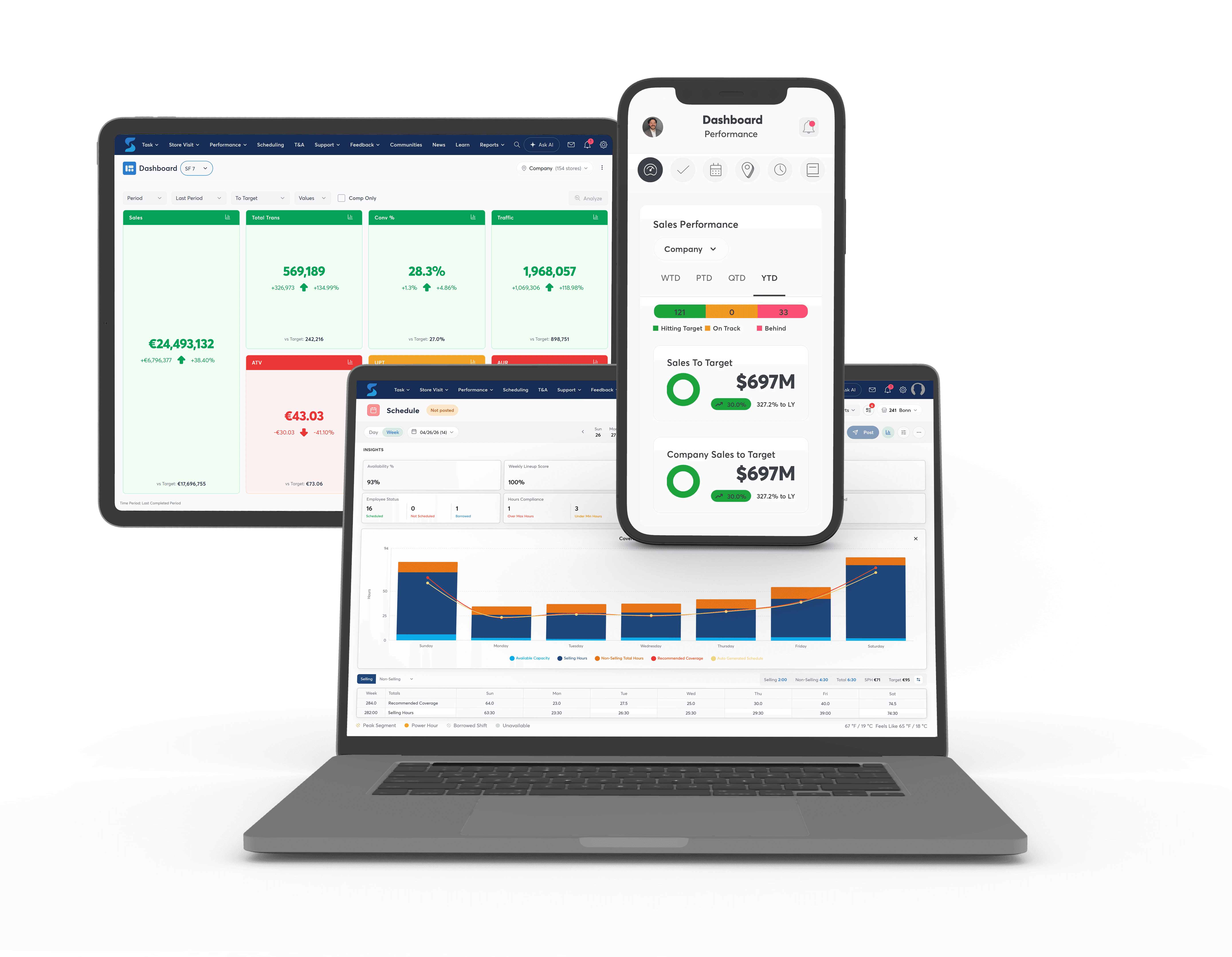
What would a 1% reduction in labour spending mean across your stores? How much additional profit could a small conversion improvement generate? What would managers do with the hours they currently spend building schedules and chasing task updates?
These are the questions behind the return on investment in retail workforce management software.
For a retailer operating dozens or hundreds of locations, modest improvements can add up quickly. The business case comes from identifying where those improvements are achievable, putting a financial value against them, and comparing the benefit with the full cost of implementation.
Retail workforce management ROI measures the financial return from better labour planning, scheduling, and workforce processes relative to what the system costs. Platforms that also connect task management, communication, and performance reporting can support additional returns through stronger execution and fewer disconnected tools.
Here is where that value comes from—and how to calculate it for your stores.
Bring Your Stores Together and Execute Better
Give your teams the workforce management tools to drive better results.
Speak to Our Team
What Results Have Retailers Achieved With StoreForce?
Customer results show several ways workforce management can contribute to the business.
Retailer | Reported result | What changed |
|---|---|---|
Cape Union Mart | 5% reduction in labour costs | Better visibility into hours, staffing patterns, and labour allocation |
Aesop | Conversion increased from 49% to 53% with total labour hours held flat year over year | Existing hours redistributed around demand, targeting 90% peak coverage |
Knix | 17% comparable sales growth in the first six to eight months after rollout | Peak coverage increased from 60–70% to a consistent 90%, with stronger sellers aligned to peak periods |
These results reflect each retailer’s implementation and operating changes. They demonstrate the range of opportunities a retail WFM business case can examine.
1. Reduce Labour Spending That Does Not Support Demand
Labour savings begin with understanding where hours are going.
A retailer may be funding repeated closing overruns, scheduling unnecessary overlap during quiet periods, or allocating hours using assumptions that no longer reflect how stores trade.
Workforce management brings forecasts, schedules, and actual hours into a more consistent planning process. Leaders can investigate exceptions and make targeted changes while protecting essential work and customer coverage.
At Cape Union Mart, StoreForce provided visibility into hours worked, staffing patterns, and labour allocation. The retailer reported a 5% reduction in labour costs after implementation, alongside improvements in how it managed its workforce.
[Read the Cape Union Mart case study]
How to estimate the opportunity
Start with annual labour spending and an achievable improvement assumption.
For a retailer with a $20 million annual labour bill:
A 0.5% reduction represents $100,000.
A 1% reduction represents $200,000.
A 2% reduction represents $400,000.
Use a pilot or your own operating evidence to support the assumption. Track conversion, service, and execution alongside spending so the business can see whether the change is sustainable.
2. Generate More Sales From Existing Customer Traffic
A store can meet its weekly payroll budget and still miss sales because too few associates are available during the rush.
Better scheduling can strengthen service capacity when demand is highest. Associates have more opportunity to answer questions, retrieve sizes, explain products, and keep checkout moving.
Aesop targeted 90% peak coverage and redistributed existing hours around customer demand. Conversion increased by four percentage points, from 49% to 53%, while total labour hours stayed flat year over year.
The commercial opportunity follows a familiar relationship:
Sales = Customer visits × Conversion rate × Average transaction value
If a store receives 1,000 visits, converts 20%, and generates an $80 average transaction value, sales are $16,000.
At 21% conversion, sales reach $16,800 with the same traffic and transaction value. That illustrative one-percentage-point improvement produces $800 in additional revenue.
How to include sales growth in ROI
Convert additional sales into incremental contribution after product costs and other variable costs.
If $500,000 in additional annual sales produces a 40% incremental contribution margin, the financial benefit is $200,000 before any further costs included elsewhere in the model.
This gives finance a more meaningful figure than counting all additional revenue as return.
3. Give Managers and Field Leaders Time Back
Manual scheduling, reporting, and task follow-up consume management capacity.
A connected platform can reduce repeated data entry, report preparation, and requests for status updates. That frees time for floor leadership, coaching, and resolving operational issues.
Nucleus Research found that organizations deploying StoreForce reduced district manager follow-up time by an average of approximately 85%. Its research also reported task completion rates of up to 90%.
[Read the Nucleus Research findings]
How to value the time
Measure the activity before and after implementation. Then calculate:
Annual capacity value = Hours released per week × Weeks × Relevant hourly employment cost
For example, two hours released per week across 100 store managers equals 10,400 hours annually. At an illustrative $30 per hour, that represents $312,000 in management capacity.
Record this separately from cash savings when payroll spending stays the same. Decide how the time will be used, then assess whether that redeployment improves the operation.
4. Protect the Selling Window Through Better Task Execution
A promotion creates value when stores are ready to sell it.
Late displays, missing signage, and incomplete replenishment can reduce the benefit of inventory and marketing investments. When task management is connected with the schedule, teams can plan the work, identify blockers, and verify readiness before launch.
For a retailer evaluating a broader WFM platform, this is a separate value stream worth measuring.
What to track
Review:
Stores ready by the launch deadline.
Critical tasks completed correctly and on time.
Hours spent correcting avoidable errors.
Repeat visits or follow-up required.
Performance during comparable promotional periods.
Where you estimate a sales benefit, account for traffic, assortment, availability, and promotional differences. If the sales improvement is already included in your revenue calculation, count it once.

5. Retire Overlapping Software and Manual Processes
Retailers may use separate systems for scheduling, task management, newsletters, support requests, and reporting. Each can carry licensing, administration, integration, and training costs.
A platform covering several required workflows creates an opportunity to simplify that environment.
Nucleus Research found that the organizations it studied consolidated an average of two to three standalone tools into StoreForce, including combinations of task, ticketing, newsletter, and communication systems
How to calculate the savings
List the tools and costs that can actually be retired. Account for contract end dates, migration work, and any period when both systems must remain active.
Count savings from the date the expense ends. A planned consolidation becomes a financial benefit when the relevant cost is removed.
How to Calculate Retail Workforce Management ROI
Use the same period for benefits and costs:
WFM ROI = (Financial benefits − Total costs) ÷ Total costs × 100
Include the full investment:
Software subscriptions and required modules.
Implementation and configuration.
Data preparation and integrations.
Training and internal project time.
Devices or infrastructure where needed.
Ongoing administration and support.
Separate the benefits into three categories so leadership can assess them clearly.
Benefit category | Examples | How to treat it |
|---|---|---|
Cash savings | Lower avoidable labour spending, retired licences, reduced external costs | Include when supported by evidence |
Incremental contribution | Additional sales after associated variable costs | Include with a credible attribution method |
Released capacity | Manager hours available for other work | Report separately unless a financial benefit is demonstrated |
A phased rollout also needs phased benefits. Model when stores go live, when teams adopt the processes, and when improvements become visible.
A Worked Retail WFM ROI Example
Consider this illustrative 50-store retailer. These figures demonstrate the calculation and are separate from StoreForce pricing or a customer forecast.
First-year benefit | Assumption | Value |
|---|---|---|
Labour savings | 1% reduction on $10 million in annual labour spending | $100,000 |
Incremental contribution | 0.5% additional sales on $50 million, at a 40% contribution margin | $100,000 |
Retired software | Existing costs removed during the year | $30,000 |
Total financial benefit | $230,000 |
Assume first-year software, implementation, training, integration, and internal costs total $120,000.
The calculation is:
($230,000 − $120,000) ÷ $120,000 × 100 = approximately 92% ROI
The first-year net benefit is $110,000.
Management time released could be reported alongside that result. Keeping it separate makes the distinction between financial return and additional operating capacity clear.
Build conservative, expected, and upside scenarios. Show which assumptions have the greatest effect so leadership knows what the pilot needs to validate.
How to Prove the Return Across Your Stores
Agree on the measurement plan before implementation.
Establish a baseline
Record labour spending, actual hours, peak coverage, conversion, task readiness, administrative effort, and existing software costs.
Use consistent definitions and flag unusual periods.
Test a representative group
Include stores with relevant differences in format, volume, and operating conditions. Where practical, compare with similar locations that have yet to implement the changes.
Account for other changes
Promotions, pricing, traffic, assortment, and opening hours can affect results. Include them in the review when assessing the platform’s contribution.
Review adoption and outcomes together
If managers continue rebuilding schedules manually or tasks remain outside the agreed process, investigate why. The expected return depends on the operating changes being used.
Review service and execution alongside financial measures to confirm that improvements are holding.
Bring Your Stores Together and Execute Better
Give your teams the workforce management tools to drive better results.
Speak to Our Team
Build Your StoreForce Business Case Around Your Biggest Opportunity
For some retailers, the strongest case begins with avoidable labour spending. For others, it is weak peak coverage, time-consuming field follow-up, or overlapping systems.
StoreForce connects scheduling, task execution, communication, and performance visibility so retailers can address those opportunities within a shared operating environment.

See How StoreForce Can Work for Your Stores
Book a quick chat with us today, to improve your retail operations tomorrow.
Speak To A Retail Expert


