Store Management in Retail: How to Balance People, Ops, Performance
Written by: Ben Flikkema | Content Specialist at StoreForce

A delivery arrives late. Two associates are needed in the stockroom, customer traffic is building, and a new employee needs help processing a return. The store manager has to decide what moves, what waits, and who takes responsibility.
That is store management in practice. Each decision affects the team, the customer experience, and the store’s results.
Strong store management in retail connects three areas: people, operations, and performance. Managers need capable employees, workable processes, and enough visibility to understand whether their decisions are helping.
The challenge is managing these areas together. A merchandising deadline needs labor behind it. A sales target needs sufficient selling coverage. A performance gap needs investigation before it becomes another instruction to “do better.”
Bring Your Stores Together and Execute Better
Give your teams the workforce management tools to drive better results.
Talk to Our Team
What Is Store Management in Retail?
Retail store management is the coordination of employees, daily operations, customer service, and commercial performance within a store.
Store managers translate business priorities into a plan their teams can execute. They assign responsibilities, deploy labor, coach employees, maintain standards, and respond when conditions change.
For multi-location retailers, that responsibility is shared. Head office defines priorities and provides resources. District leaders identify patterns and support managers. Store teams apply the plan to local conditions.
The three areas below provide a practical framework for keeping those responsibilities connected.
1. People: Build a Team That Can Run the Shift
People management involves more than having enough names on the schedule. Managers need to know whether the team has the availability, skills, and support required for the work ahead.
Hire Against Actual Coverage and Skill Gaps
Before opening a vacancy, identify what the store is missing.
A team may need weekend availability, experienced closing coverage, specialist product knowledge, or someone who can support receiving. Hiring another employee with the same availability as the existing team may leave the original gap unresolved.
Use realistic interview scenarios to understand how candidates approach the work. Ask how they would handle competing customer requests, an unfamiliar product question, or a task they cannot finish before their shift ends.
Clear expectations about hours, responsibilities, and working conditions also help candidates assess whether the role fits their needs.
Train for Independent Performance
Training completion tells you someone has received information. It does not confirm they can apply it.
Define what employees should be able to do independently, then check through observation and practice. For example, a new associate might need to demonstrate how to:
Explain a current promotion accurately.
Locate an unavailable size or product.
Process a return within their authority.
Escalate an issue to the appropriate person.
Complete a replenishment task to the required standard.
Give managers a simple way to record where support is still needed. This makes training more targeted and helps avoid placing an employee in a role they are not yet ready to handle alone.
Schedule Skills Alongside Headcount
Five scheduled employees do not necessarily provide five people’s worth of customer-facing coverage.
One may be training, another receiving stock, and a third completing a visual update. The remaining two have to serve the floor.
Effective retail scheduling accounts for demand, availability, required skills, breaks, leadership coverage, and non-selling work.
Before publishing, review the busiest trading windows and ask:
Who is available to serve customers?
Who can handle exceptions or specialist requests?
Who is leading the floor?
What work could pull those people away?
This reveals problems that a weekly hours total cannot show.

Coach a Specific Behavior
A broad instruction such as “improve conversion” gives employees little to apply.
Useful coaching connects an observation with a practical next step. If customers are leaving after asking for unavailable products, for example, coach associates on checking alternatives or locating stock elsewhere.
Observe the behavior again and follow up. Recognize what improved and identify what still needs practice.
That creates a clearer development process than discussing results only at the end of the month.
2. Operations: Make the Plan Workable
Retail store operations provide the structure that allows employees to work consistently across shifts.
The manager’s role is to make that structure usable, with clear priorities, realistic workload expectations, and a reliable response when work becomes blocked.
Define What Must Happen and When
A list of tasks is incomplete without timing and ownership.
A promotional setup needed before opening should be distinguishable from a routine task that can wait until a quieter period. Each important assignment should identify:
The person responsible.
The completion deadline.
The expected standard.
Any required materials or instructions.
What to do if completion is at risk.
Include estimated workload where possible. A store cannot absorb a four-hour setup simply because the request arrived in a task list.
When new work is added, decide what should move or receive additional support. Leaving every priority unchanged passes an unresolved capacity problem to the store.
Use Handoffs to Transfer Responsibility
A useful handoff explains what the next shift needs to act on.
“Delivery incomplete” leaves the incoming manager to investigate. A stronger update identifies what remains, where it is, who owns the next step, and whether customer availability is affected.
Keep handoffs focused on unresolved work, coverage changes, customer commitments, and exceptions. Employees should be able to find the information without reconstructing the previous shift through separate messages.
Turn Audit Findings Into Corrections
Store audits are valuable when findings lead to action.
If a display fails a merchandising check, record what needs correcting, assign an owner, and set a deadline. For critical findings, define who verifies the correction.
Also review recurrence. The same issue appearing across several stores may indicate an unclear brief, missing materials, inadequate training, or an unrealistic workload.
Store managers can correct individual problems. District and head office teams should address the conditions causing them to repeat.
Check Campaign Readiness Before Launch
A campaign requires more than a completed display.
Before launch, confirm that stores have the product, signage, instructions, employee knowledge, and labor needed to execute it. Give teams a way to flag missing items early.
Separate “ready,” “at risk,” and “blocked” locations so support can be directed before the selling window begins.
This also improves later evaluation. Leaders can distinguish a weak customer response from a campaign that never launched properly in some stores.
3. Performance: Use Metrics to Choose the Next Action
Performance management should help managers understand what needs attention and what they can influence.
A manageable set of connected measures is more useful than a dashboard that requires a lengthy explanation every morning.

Break Sales Into Its Drivers
Total sales show the result. Traffic, conversion, and average transaction value help explain it.
If sales are below plan, first determine whether fewer customers visited, fewer visitors purchased, or customers spent less per transaction.
Each finding suggests a different investigation:
Performance signal | What to investigate |
|---|---|
Traffic declined, conversion held steady | Local demand, campaign activity, opening hours, and traffic data quality |
Traffic held steady, conversion declined | Selling coverage, queues, availability, and service behaviors |
Conversion held steady, basket value declined | Product mix, discounting, units per transaction, and stock availability |
The numbers narrow the question. Floor observation and employee input help explain the cause.
Read Labor Metrics Together
Sales per labor hour and labor cost as a percentage of sales provide useful productivity measures. Neither explains staffing quality by itself.
High sales per labor hour could reflect effective deployment. It could also occur while queues grow and operational work falls behind.
Compare labor measures with peak coverage, conversion, task completion, and service conditions. Review scheduled versus worked hours to understand where the plan changed.
The aim is to identify whether hours are insufficient, poorly placed, or being consumed by work that was not planned.
Measure Execution Quality Alongside Completion
A completed task may still require correction.
For important initiatives, consider whether work was finished on time, accepted on review, or reopened. A high completion rate has limited value if promotional displays repeatedly need rework after launch.
Use the level of verification appropriate to the task. Critical pricing or campaign work may justify closer validation than a low-risk routine update.
Make Customer Feedback Specific Enough to Use
A satisfaction score can indicate a problem without explaining the operational response.
Group feedback by recurring themes such as waiting, product availability, staff knowledge, checkout, or returns. Then compare those themes with store conditions.
Repeated comments about difficulty finding help during busy afternoons should prompt a review of floor deployment. A product knowledge issue suggests a different intervention.
Bring the Three Areas Together in a Weekly Review
A short weekly review should produce decisions the store can apply.
Use four questions:
Where did performance differ from expectations? Identify a specific period, process, or customer issue.
What conditions contributed? Review staffing, skills, workload, availability, and execution.
What will change? Agree on a practical action with an owner.
When will we check it? Set a review date and define what improvement would look like.
For example, recurring Saturday conversion gaps might lead to moving replenishment earlier, changing shift overlaps, and assigning a floor leader during the affected window. The next review should check conversion, service conditions, and whether replenishment still finished.
This connects the performance discussion to the people and operational decisions behind it.
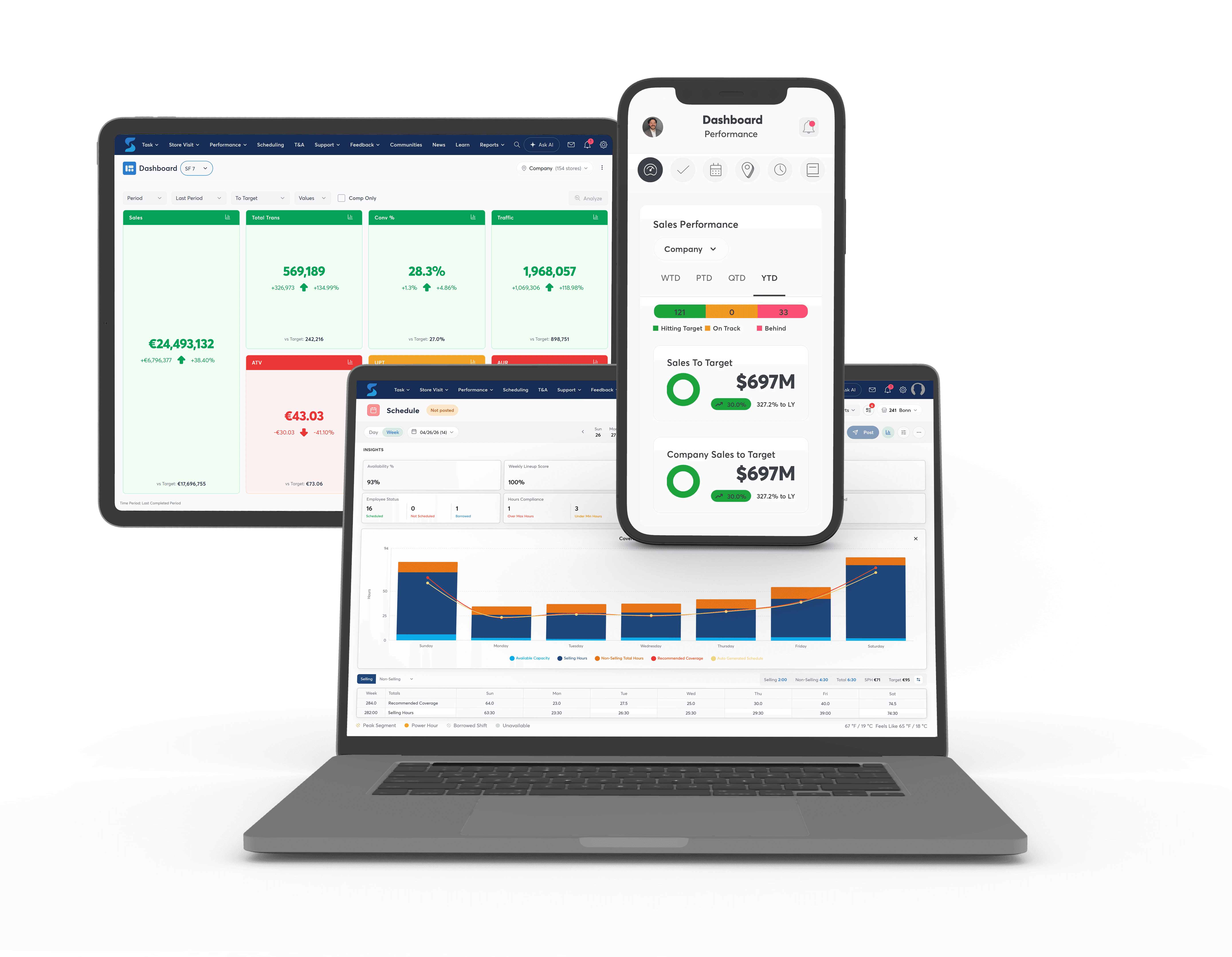
How StoreForce Supports Retail Store Management
StoreForce brings workforce scheduling, labor planning, task management, communication, and performance visibility into one platform.
That connection helps retail teams work through management decisions with more context. A manager can review coverage alongside trading demand, track operational priorities, and use performance information to focus coaching. District leaders can identify which stores need support and follow up on agreed actions.
The value is in reducing the distance between identifying a problem and organizing a response. Teams have a clearer view of the plan, the work still outstanding, and the results that need attention.
Explore StoreForce to see how connected workforce management and store execution can support your retail teams.

See How StoreForce Can Work for Your Stores
Book a quick chat with us today, to improve your retail operations tomorrow.
Speak To A Retail Expert


