How to Track Staff Performance With Granular Reporting
Learn what granular staff performance reporting looks like in retail and how detailed workforce data can support better performance analysis and coaching.

Retailers looking for detailed individual staff performance reporting need more than store-level dashboards. The most useful retail performance tools allow managers to move from overall store results into individual employee performance, specific KPIs and trends over time.
StoreForce's Store Performance Monitoring gives retailers visibility into performance statistics with drill-down capabilities that help managers better understand what is happening across their teams. The more granular that visibility becomes, the easier it is to identify individual strengths, uncover opportunities for improvement and give employees more specific coaching.
The goal isn't simply to collect more employee data. It's to give managers better information about where their teams are succeeding, where support may be needed and what can be done to help the store win the day.
Take control of your store performance
Book a demo with StoreForce today and run your retail operations better tomorrow.
Book A Demo
Why Track Individual Staff Performance in Retail?
Store-level performance tells managers whether the location is succeeding. Individual performance can help them understand more about what is contributing to those results.
Two stores could produce similar sales numbers while having very different performance underneath them. The same is true for employees working within a single store.
One employee may consistently generate strong average transaction values. Another may be particularly effective at converting customer opportunities. Someone else may be improving their units per transaction after receiving coaching in that area.
Without individual performance visibility, those differences can disappear inside the store average.
Tracking individual performance gives managers another layer of information they can use to understand their teams. It can help identify strong performers, recognize improvement, uncover coaching opportunities and make performance conversations more specific.
Instead of managing entirely from the overall store result, managers can better understand the people contributing to it.
What Does Granular Staff Performance Reporting Mean?
Granular reporting is about how deeply managers can investigate performance.
A company-wide KPI is a high-level view. Regional and district results provide another layer. Store-level reporting goes deeper again. Individual employee performance provides an even more detailed understanding of what is happening.
The reporting can become more specific from there by examining particular KPIs and periods of time:
Company → Region → District → Store → Individual Employee → KPI → Time Period
The important distinction is that more data does not necessarily mean more granular reporting. A dashboard containing dozens of company-level metrics may contain a lot of information without helping a store manager understand individual performance.
Useful granularity allows the retailer to move from a broad result into the specific area requiring attention.
If conversion is declining, for example, a retailer should be able to investigate where that decline is occurring. Is it concentrated in a particular region? A group of stores? One location? Are there individual performance patterns within that store worth investigating?
Each additional layer helps turn a broad performance result into a more specific management question.
Which KPIs Can Help Retailers Understand Individual Performance?
Individual sales can be useful, but sales alone rarely provide the complete picture of frontline performance.
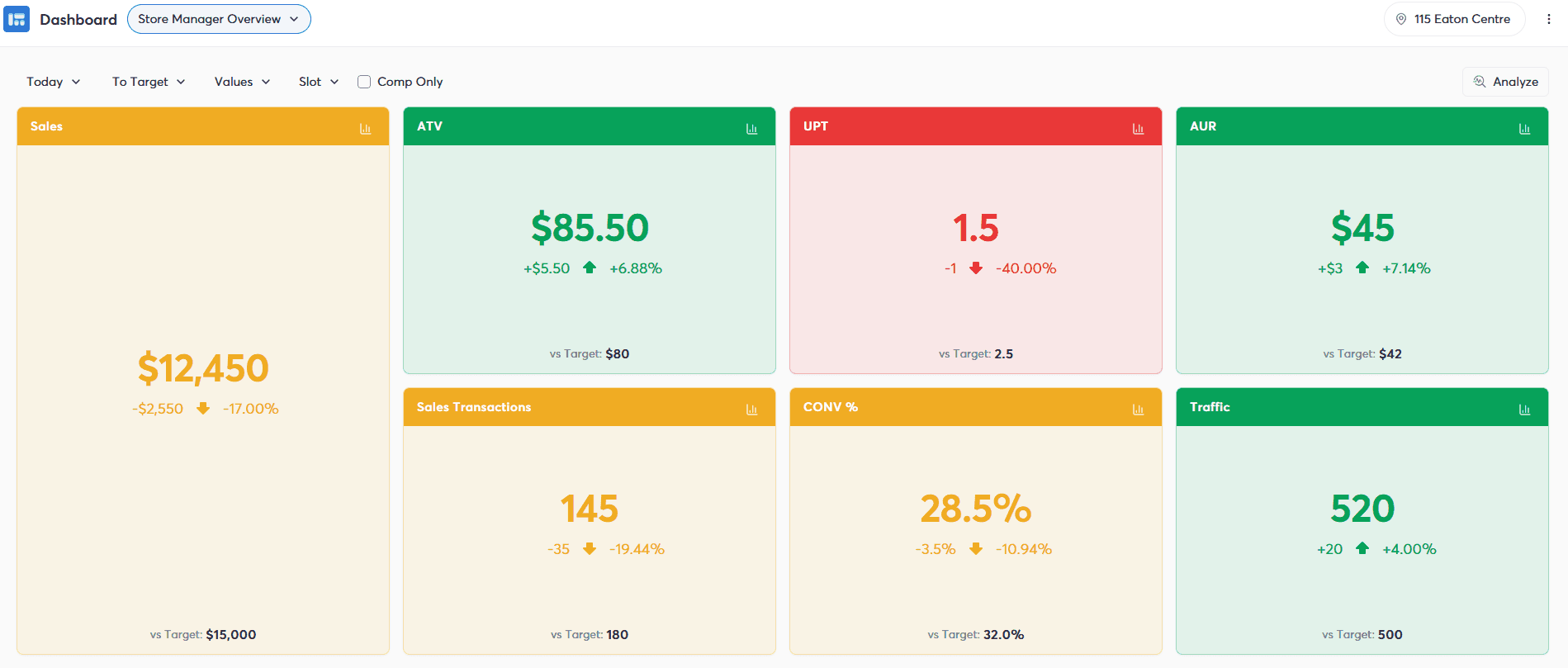
Retailers may also want to examine available employee-level metrics such as conversion, average transaction value (ATV), units per transaction (UPT) and other relevant performance statistics.
Looking at multiple KPIs can reveal differences that a single number hides.
Two employees may generate similar sales while getting there in completely different ways. One may have a higher conversion rate but lower ATV. Another may complete fewer transactions while generating larger baskets.
Those differences matter because the coaching opportunity is different.
Telling both employees to simply “sell more” provides very little direction. Understanding the KPIs behind their results gives the manager something more specific to work with.
How Does Individual Performance Tracking Improve Coaching?
One of the biggest benefits of individual performance reporting is the ability to make coaching more specific.
Without detailed performance information, managers may know that an employee is struggling but have limited evidence about where the opportunity actually exists. Coaching can quickly become general advice about improving sales or engaging customers more effectively.
Granular reporting gives managers a better starting point.
If an employee's conversion is strong but UPT is consistently lower, the coaching conversation can focus on basket building and complementary products. If ATV is improving while conversion has recently declined, the manager can focus on how the employee is engaging more customer opportunities.
The same reporting can also identify positive performance. Managers can recognize an employee whose conversion has improved over several weeks or identify a team member who consistently performs well during important selling periods.
That makes performance reporting useful for more than correcting problems. It gives managers evidence they can use to reinforce what employees are already doing well.
The more specific the information becomes, the more specific the coaching can become.
Why Should Retailers Look at Performance Trends Over Time?
Individual performance should not be judged entirely by one shift, one day or one number.
Retail stores are dynamic environments. Customer traffic changes, employees work different shifts and stores experience different selling conditions throughout the week.
Looking at performance over time gives managers a better understanding of whether something represents a genuine pattern.
An employee may have one unusually strong sales day because the store experienced exceptional traffic. Another employee may have a difficult shift that looks concerning in isolation but is completely inconsistent with their normal performance.
Historical trends help managers separate those isolated results from recurring patterns.
They can also make improvement easier to see. If an employee has been coached on UPT, managers can monitor how that metric develops over subsequent weeks rather than relying on a general impression of whether the coaching worked.
That creates a more useful cycle between performance measurement and employee development.

How Can Individual Performance Reporting Help Stores Win the Day?
Performance information becomes especially useful when managers can use it to influence what happens next rather than simply explain what happened last month.
Retail managers make decisions throughout the day. They coach employees, adjust priorities, respond to customer traffic and determine where their attention is needed.
Better performance visibility gives them additional information for those decisions.
If the team is having a strong day, managers can understand what is working and reinforce it. If a particular KPI is behind expectations, they can focus attention on that area. If an employee has an opportunity to improve a specific part of their performance, the manager has something concrete to coach toward.
This is where individual performance reporting becomes operational rather than simply analytical.
The objective isn't to watch every employee number constantly. It is to give managers enough visibility to recognize what is happening, focus their coaching and help the team make the most of the opportunities available that day.
Winning the day comes from turning performance information into action while there is still time for that action to matter.
Why Is Context Important When Evaluating Individual Staff Performance?
Granular reporting becomes more useful when managers understand the context surrounding the numbers.
An employee working during a high-traffic Saturday afternoon has a different selling environment from someone working during a quiet weekday morning. Different roles may also have different opportunities to directly influence particular KPIs.
Operational workload matters too. Employees may spend part of a shift processing shipments, completing inventory work or executing other store priorities rather than serving customers.
Performance data should therefore support management judgment rather than replace it.
A lower number tells a manager where to investigate. It does not automatically explain why the result occurred.
Combining granular reporting with a manager's understanding of the store, employee, shift and workload creates a much stronger foundation for coaching than relying on a leaderboard alone.
Why Is Granular Reporting More Useful Than Employee Rankings?
Employee rankings can show who is ahead or behind on a particular metric, but they provide limited information about why.
Knowing an employee ranks 15th in a district does not tell a manager what that employee should work on tomorrow.
Granular reporting can.
A manager may discover that the employee's overall sales are below average while their conversion is strong. Digging deeper may reveal that ATV or UPT represents the larger opportunity.
That changes the coaching conversation from “you need to improve your numbers” to a discussion about the specific behavior or KPI where improvement could have the greatest impact.
Rankings tell managers where someone stands. Granular reporting can help managers understand where to focus.

What Should Retailers Look for in Staff Performance Reporting Software?
Retailers evaluating individual staff performance reporting should consider both the information available and how easily managers can get from a high-level result to something actionable.
Useful capabilities can include organizational and store-level drill-down, individual employee reporting, multiple retail KPIs, historical trends, flexible reporting periods and the ability to compare performance across different levels of the organization.
Retailers should also consider who will actually use the information. Head office, regional leaders, district managers and store managers may each require different levels of visibility.
The best reporting experience should make it easier for each leader to identify what deserves their attention without forcing them to dig through unnecessary information.
Most importantly, the reporting should support action. The ultimate value of another KPI or drill-down is whether it helps someone make a better decision, recognize a win or have a more useful coaching conversation.
How Does StoreForce Help Retailers Track Individual Staff Performance?
StoreForce Store Performance Monitoring gives retailers visibility into the KPIs that help explain how stores and teams are performing.
Retailers can monitor performance statistics such as sales, traffic, conversion, average transaction value and units per transaction, with drill-down capabilities that allow leaders to investigate results in greater detail.
That visibility can help different levels of the retail organization focus their attention. Head office can understand broader performance, regional and district leaders can investigate patterns across their locations, and managers can use more detailed information to support store-level coaching.
StoreForce also connects performance visibility with other areas of retail workforce management, including Intelligent Scheduling, Labor Optimization, Time and Attendance and Task Management. That broader context can help retailers understand performance alongside the people, labor and work involved in running the store.
The value of granular staff performance reporting is ultimately not the amount of data retailers can collect. It is how precisely that information can help managers understand their teams.
The closer managers can get to the specific KPI, trend or opportunity affecting an individual employee, the more focused their coaching can become. And when managers can turn those insights into action, performance reporting becomes another tool for helping employees improve, strengthening store execution and winning the day.

See How StoreForce Can Work for Your Stores
See how StoreForce brings employee scheduling, labor optimization, task management, and store execution together in one retail workforce management platform. Book a demo today to see what StoreForce can do for your teams.
Speak To A Retail Expert


