What the Next Generation of Retail Workers Really Wants From Work
Discover what Gen Z retail workers want from frontline work and how greater visibility, predictability and flexibility can improve the employee experience.

The expectations of younger frontline workers are exposing weaknesses in the frontline employee experience.
For retailers, that's worth paying attention to.
The conversation around Gen Z at work can quickly become a conversation about the generation itself: how ambitious they are, how long they'll stay in a role, how they think about work-life balance or whether their expectations of employers are different from the generations before them.
But focusing too heavily on Gen Z risks missing what those expectations are telling retailers about frontline work.
Younger employees are looking for greater clarity about what's expected of them and where they're going. They want more predictability and control over when they work. And growing financial pressures are changing their expectations around how and when they can access the money they've already earned.
Those may sound like generational preferences. In practice, they point toward something much bigger.
How well is the frontline employee experience actually working?
That's becoming an increasingly important question as employee engagement declines. Gallup's State of the Global Workplace 2026 found that just 20% of employees globally were engaged at work in 2025. In the U.S., Gallup found that engagement among Gen Z and younger millennials fell eight percentage points between 2020 and 2025.
For retailers that depend heavily on younger frontline workers, the instinct shouldn't be to ask what's wrong with the next generation.
It should be to look more closely at what they're asking for - and what it reveals about the way frontline work is designed.
Because when you do, three areas stand out: greater visibility, greater predictability and greater flexibility.
Take control of your store performance
Book a demo with StoreForce today and run your retail operations better tomorrow.
Book A Demo
They Want Greater Visibility into Their Work
Knowing where you stand matters.
For a frontline employee, that can mean understanding what's expected during today's shift. It can mean knowing how they're performing, what skills they should be developing or where their current role could eventually take them.
That visibility isn't always there.
Research from McKinsey and Cara Plus found that more than 70% of frontline employees had applied for advancement opportunities. Among retail workers specifically, job growth ranked as the most important career advancement attribute.
Yet 65% of frontline employees surveyed were unaware or unsure of how to achieve advancement.
There's also a significant disconnect between what employers believe they're communicating and what employees actually experience. Only 17% of frontline employees said they had frequent discussions about career advancement, while nearly 40% of employers believed those conversations were taking place.
That isn't simply a career development problem. It's a visibility problem.
Employees shouldn't have to piece together how they're doing, what opportunities exist or what they need to do next.
And that principle extends beyond advancement.
A strong frontline experience gives employees visibility into the things that shape their working day: their schedule, priorities, responsibilities, performance, communications and opportunities to grow.
The easier those things are to understand and access, the less friction employees have to navigate just to do their jobs.
They Want Work to Fit More Predictably into Their Lives
Retail will never be completely predictable.
Customer traffic changes. Promotions launch. Shipments arrive. Seasonal peaks put different demands on stores. But unpredictable retail doesn't automatically have to mean unpredictable work.
For younger employees, having greater visibility and control over when they work can make it easier to plan everything else around it - from education and childcare to transportation, appointments and their personal lives.
And there is evidence that providing that predictability doesn't have to come at the expense of store performance.
The Stable Scheduling Study, conducted across Gap stores, tested practices designed to create greater stability for hourly retail employees. These included publishing schedules two weeks in advance, eliminating on-call shifts, creating more consistent shifts and giving employees greater input into their schedules.
During the intervention, median sales increased 7% in participating stores and labor productivity increased 5%. Treatment stores generated an additional $6.20 in revenue per labor hour compared with control stores.
But one of the study's most interesting findings wasn't about employees at all.
It was about operations.
Only 30% of the week-to-week variation in payroll hours could be explained by changes in customer traffic. Researchers identified inaccurate shipment information, last-minute promotional changes and visits from corporate leaders among the major sources of scheduling instability coming from headquarters.
In other words, much of the unpredictability experienced by frontline employees wasn't an unavoidable consequence of retail demand.
It was being created internally. That distinction matters.
Because if retailers are creating some of the volatility themselves, they have an opportunity to reduce it.
Better forecasting, earlier planning, clearer communication and scheduling processes that account for both business demand and employee availability can give frontline employees greater predictability while still giving stores the coverage they need.
The goal isn't to eliminate flexibility from retail.
It's to eliminate unnecessary unpredictability from the employee experience.

They Want Greater Flexibility From Work
The same desire for greater control extends beyond scheduling.
It also shows up in how younger employees think about their finances.
PwC's 2026 Employee Financial Wellness Survey found that 59% of employees were experiencing financial stress. Among Gen Z respondents, 85% said financial stress affected their mental health and 71% said it reduced their productivity.
For many workers, there isn't much room for an unexpected expense.
PwC found that 53% of respondents had less than $5,000 in emergency savings and 30% had less than $1,000. Thirty-nine percent had used payday loans or advances.
Those pressures are helping change expectations around the traditional relationship between working and getting paid.
Consumer Financial Protection Bureau research estimated that 7.2 million workers used employer-partnered earned wage products in 2022, accessing $22.8 billion across 214 million transactions.
Earned wage access is one example of a broader shift toward giving frontline employees more flexibility around work.
The employee has already worked the hours. The question becomes whether the systems surrounding that work can give them more control over when and how they access what they've earned.
That doesn't mean every retailer needs to approach financial flexibility in exactly the same way.
But it does reinforce a larger expectation among younger workers: work should be able to fit into their lives rather than requiring their lives to constantly bend around work.
For employers, that's not exclusively a wellness conversation either.
When 71% of financially stressed Gen Z employees report that stress reducing their productivity, the line between employee experience and store performance becomes much harder to draw.
The Frontline Experience Has to Catch Up
Retailers have spent years removing friction from the customer experience.
Customers can check inventory before leaving home, receive personalized recommendations, move between digital and physical channels and access information almost instantly.
The experience of working inside those same stores hasn't always evolved at the same pace.
For frontline employees, basic questions can still be more difficult to answer than they should be.
When am I working?
Can I change a shift?
What needs to get done today?
What are the priorities for my store?
How am I performing?
Where can I find the information I need?
What opportunities are available to me?
And, increasingly, when can I access the money I've already earned?
Individually, these can look like separate workforce challenges. Together, they're part of the same employee experience.
And improving that experience requires more than introducing another isolated perk or program.
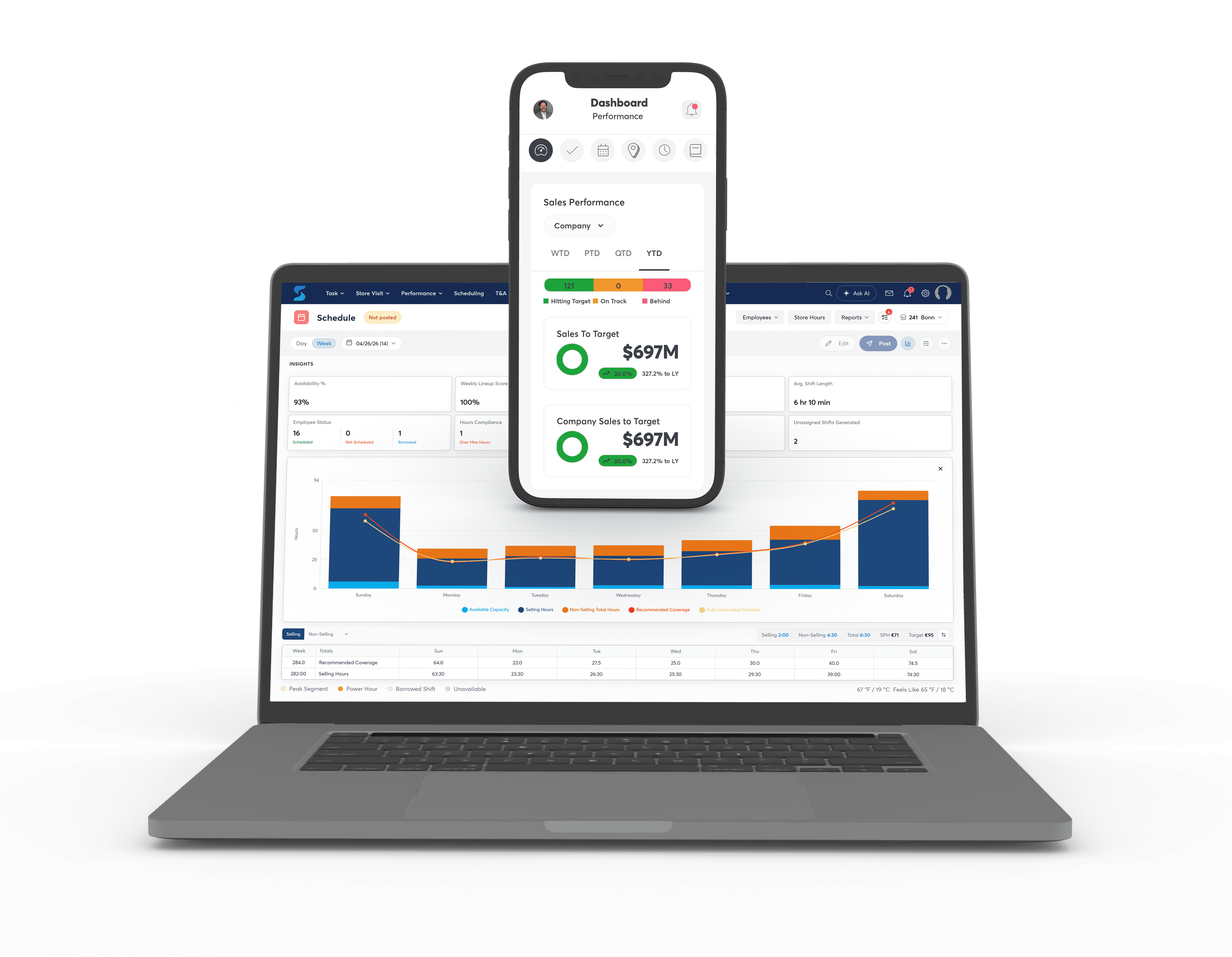
Retailers need the processes behind frontline work to connect. Scheduling needs to reflect demand and employee availability. Employees need clear access to the information and priorities that affect their day. Managers need visibility into what's happening across their teams. Communication, development and day-to-day execution need to feel like parts of the same working experience rather than disconnected processes.
That raises an important question for retailers:
Are the processes and technology supporting frontline employees actually designed to deliver the experience the next generation increasingly expects?
The answer isn't necessarily more technology.
In fact, Deloitte's 2026 Gen Z and Millennial Survey found that 58% of Gen Z respondents reported digital fatigue from constant alerts, switching between tools and navigating multiple platforms.
The opportunity is to make frontline work simpler and more connected, not simply more digital.
Technology should remove steps, surface information and make it easier for employees and managers to understand what is happening.
When it adds another place to check, another disconnected login or another process employees have to remember, it can create the exact friction retailers are trying to remove.
Better for Gen Z Can Mean Better for Everyone
The most important thing about these expectations may be how little of this is actually exclusive to Gen Z.
A predictable schedule isn't only useful to a 22-year-old.
Neither is knowing what's expected during a shift.
These are simply characteristics of a better frontline employee experience. What may be changing is the willingness of younger workers to accept an experience that doesn't provide them.
Deloitte's 2026 research describes a generation prioritizing stability, skills and well-being over rapid career progression. Only 25% of Gen Z respondents preferred fast-paced advancement through rapid promotions, while 44% favored steady progress.
That's not necessarily a rejection of work or ambition.
It can also be read as a demand for work that is more sustainable, transparent and compatible with the rest of their lives.
And for retailers, responding to that demand doesn't have to mean lowering expectations or redesigning stores around one generation.
It means looking at the friction that already exists in frontline work and asking whether it still needs to be there.
Because the next generation of retail workers may not be asking for an entirely different kind of workplace.
They may simply be making it harder for retailers to ignore where the frontline experience needs to get better.

See How StoreForce Can Work for Your Stores
See how StoreForce brings employee scheduling, labor optimization, task management, and store execution together in one retail workforce management platform. Book a demo today to see what StoreForce can do for your teams.
Speak To A Retail Expert


