How Retail Scheduling Software Helps Balance Labour Costs
The goal isn't to schedule the fewest possible labour hours. It's to make the best use of the labour hours available.

Labour is one of the largest controllable expenses in retail, but controlling labour costs does not simply mean scheduling fewer employees.
Cut too many hours and stores may not have enough coverage when customers need assistance. Schedule too many and retailers can spend valuable labour dollars during periods when that coverage is not required.
Retail scheduling software helps retailers find a better balance by aligning staffing with customer demand, labour requirements, employee availability and store workload.
The objective is not necessarily to use less labour.
It is to make better use of the labour a retailer already has.
That means putting the right employees in the right places at the right times while keeping the schedule aligned with the retailer's labour requirements.
Take control of your store's performance
Book a demo with StoreForce today and run your retail operations better tomorrow.
Book a Demo
Why Is It Difficult to Balance Labour Costs in Retail?
Retail labour demand changes constantly.
A store may need relatively little coverage when it opens but significantly more during an afternoon rush. Weekends may require different staffing than weekdays. Promotions, holidays and seasonal changes can create entirely different demand patterns.
Stores also have operational work that requires employee time.
Shipments arrive. Inventory needs to be counted. Visual changes need to happen. Promotions need to be set up. Employees require training. Daily store routines still need to be completed.
At the same time, managers have a finite amount of labour available.
That creates a balancing act:
Control labour costs without leaving stores understaffed.
Traditional scheduling processes can make that difficult because managers have to determine how much coverage they need, when they need it and which employees can provide it.
Retail scheduling software can bring more of those variables into the workforce planning process.
What Are the Biggest Benefits of Using Retail Scheduling Software to Manage Labour Costs?
Retail scheduling software can help retailers manage labour costs by improving how available labour is planned and distributed.
Rather than treating the labour budget simply as a number of hours to fill, retailers can use demand, availability and workforce information to determine where those hours can have the greatest impact.
Here are some of the biggest benefits.
1. Schedule Labour Around Customer Demand
One of the most important ways retailers can improve labour efficiency is by understanding when customers are actually visiting stores.
Customer demand is rarely evenly distributed throughout the day.
Consider two schedules that both use 100 labour hours.
The first puts more employees on the shop floor during quieter morning periods and fewer during the afternoon rush.
The second concentrates more of those hours during the busiest customer periods.
The labour cost can be exactly the same. The potential impact of that labour can be very different.
Retail scheduling software can use customer traffic, sales forecasts and historical demand patterns to help determine when stores require coverage.
Managers can then build schedules around those requirements rather than distributing labour evenly or relying entirely on intuition.
2. Protect Peak Coverage
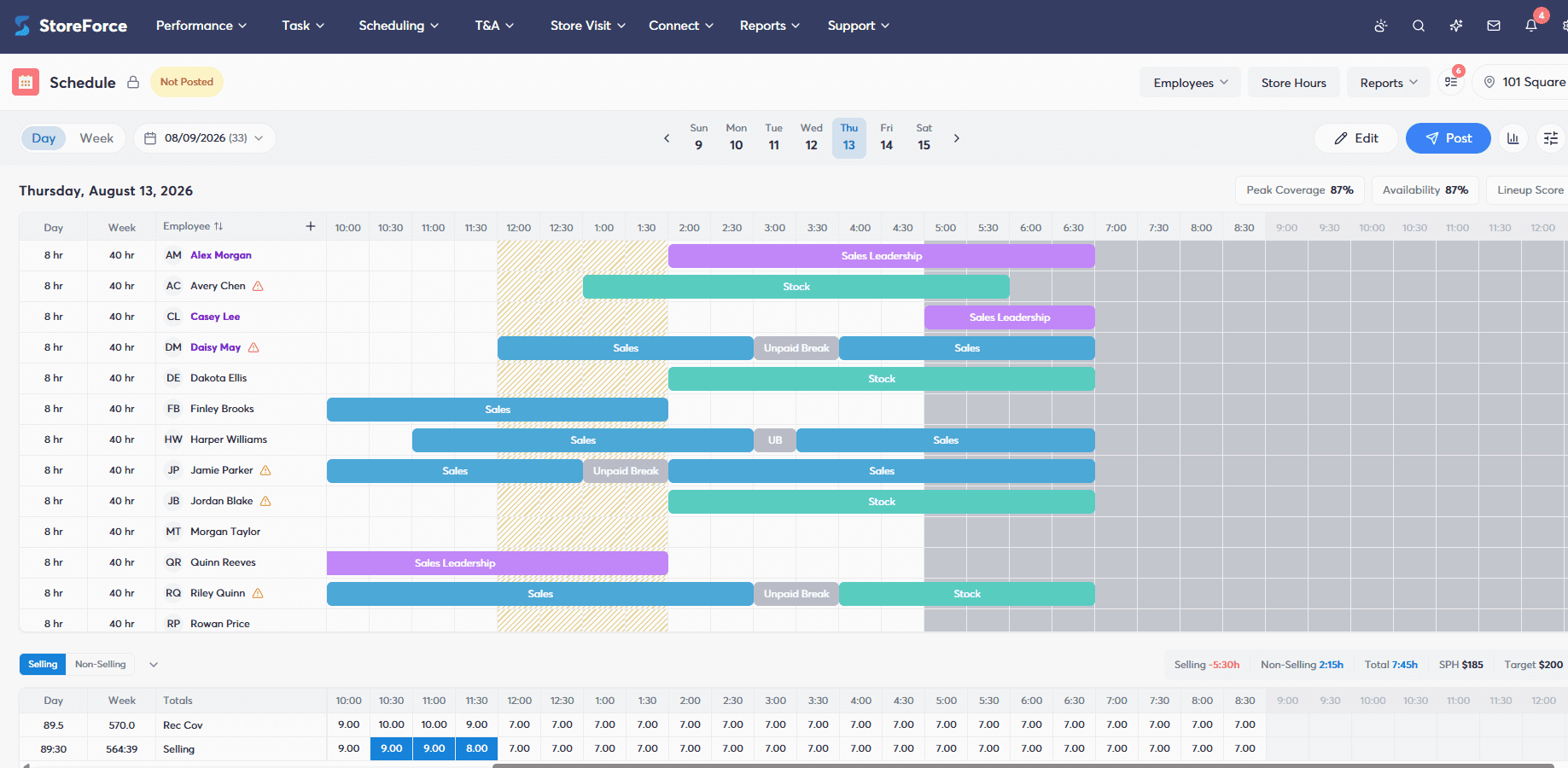
Peak periods can represent some of the most important selling opportunities in retail.
When customer traffic increases, stores need enough employees available to serve those customers.
If coverage is too low, employees may become overwhelmed, customers may wait longer for assistance and stores can miss sales opportunities.
The solution, however, is not necessarily adding more labour to the week.
Retailers can instead look at where existing labour hours are being used.
If a store is overstaffed during a quieter period and understaffed during its peak, moving some of those hours can improve coverage without increasing the overall labour budget.
Retail scheduling software can help retailers identify these periods and build schedules that better protect peak coverage.
3. Reduce Overscheduling During Quieter Periods
The opposite side of peak coverage is unnecessary labour during periods of lower demand.
Managers naturally want to make sure they have enough employees working, and without strong demand information it can be tempting to build in additional coverage just in case.
Across a large retail organisation, those additional hours can add up.
Scheduling software can give managers greater visibility into expected demand so staffing requirements can more closely reflect what stores are likely to experience.
That does not mean scheduling every store to the absolute minimum.
Retail environments still require enough flexibility to respond to changing conditions and complete operational work.
The goal is to make scheduling decisions based on a clearer understanding of what the store actually needs.
4. Consider Store Workload Alongside Customer Traffic
Customer traffic is only one source of labour demand.
A store can have relatively low traffic and still require significant employee hours because of operational workload.
Imagine two stores with similar traffic forecasts.
One has a major shipment arriving, an inventory count and a promotional change scheduled.
The other has a relatively normal operating day.
Those stores may require different amounts of labour even though expected customer traffic is similar.
Integrated retail workforce software can help retailers consider operational workload alongside customer demand when planning labour.
This is important because simply cutting hours during lower-traffic periods can create another problem: stores no longer have enough time to complete the work required to operate effectively.
Balancing labour costs therefore requires retailers to consider both:
How much labour do customers require?
and
How much labour does store execution require?
5. Account for Employee Availability
Determining when a store needs employees is only one part of building the schedule.
Retailers also need to know who can actually work.
Frontline retail workforces often include employees with different availability, roles, skills, contracted hours and time-off requirements.
Managing those variables manually can make schedule creation significantly more complicated.
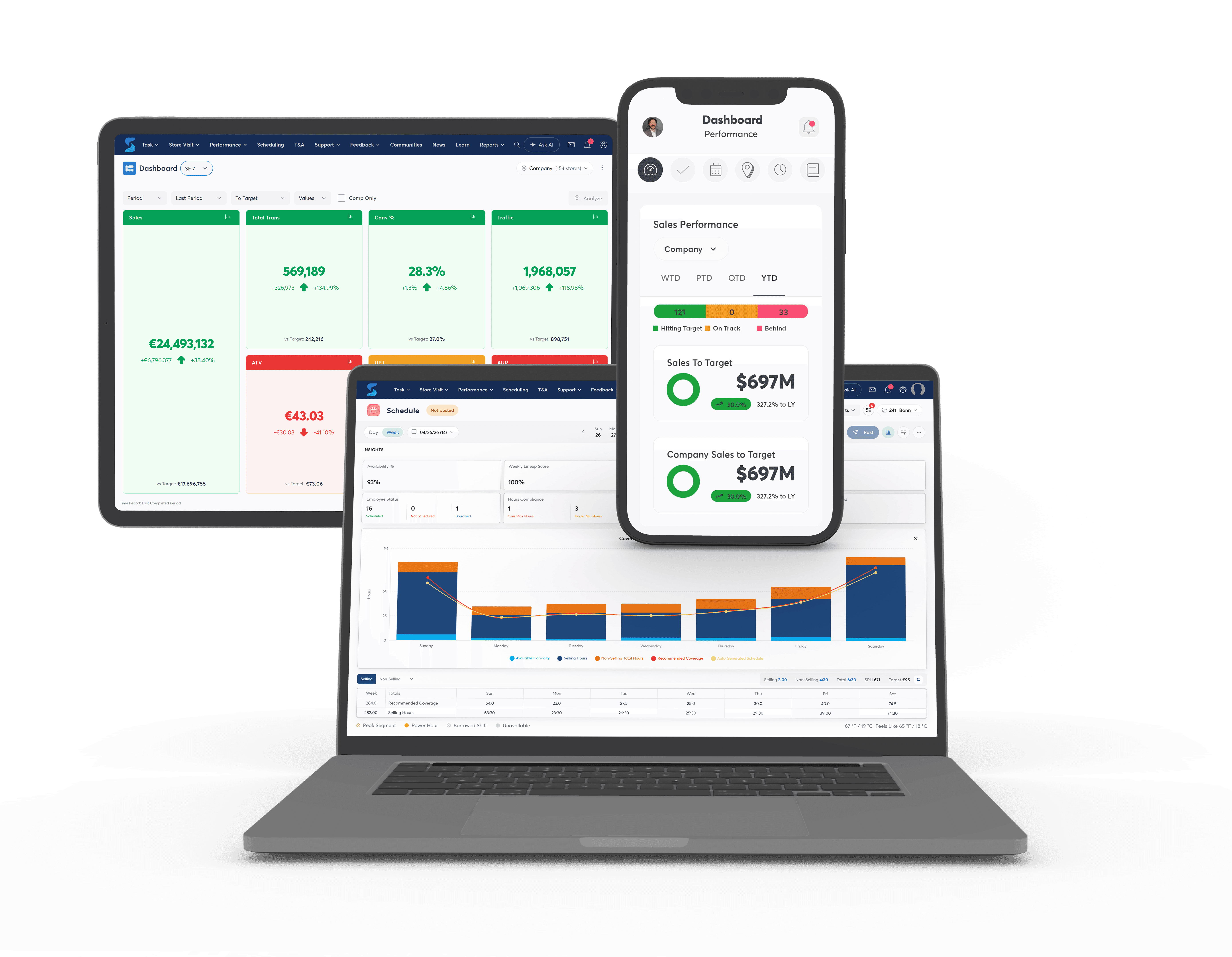
Digital scheduling software can bring employee availability into the scheduling process so managers can compare workforce requirements with the employees available to meet them.
Instead of beginning with:
Who can I schedule?
retailers can begin with:
When does the store need coverage, and who is available to provide it?
That creates a more demand-driven approach to workforce planning.
6. Reduce Manual Scheduling Inefficiencies
Labour efficiency is not only about the hours employees spend working in stores.
There is also a management cost associated with creating and maintaining schedules.
Managers can spend significant time gathering availability, building shifts, checking labour requirements, making adjustments and responding to schedule changes.
The more employees and locations involved, the more complicated that process becomes.
Retail scheduling software can automate parts of schedule creation by considering demand, employee availability, labour requirements and scheduling rules.
Managers can then spend more of their time reviewing the schedule and addressing exceptions rather than manually assembling every shift.
This can make the scheduling process itself more efficient while helping managers make more consistent workforce decisions.
7. Respond to Schedule Changes Without Losing Sight of Labour Requirements
Even a well-built retail schedule will change.
Employees call in sick. Availability changes. Shifts need to be swapped. Stores encounter unexpected demand.
When those changes happen, managers need to solve the immediate coverage problem without losing sight of the broader workforce plan.
Finding someone who can cover an open shift is useful.
Finding someone who can cover it while maintaining the coverage the store requires and keeping labour within the appropriate parameters is better.
Digital scheduling gives managers greater visibility into the schedule when making those adjustments.
Employees can also have clearer access to their schedules and relevant shift information, reducing some of the manual communication required when changes occur.
8. Apply Labour Strategies More Consistently Across Stores
Managing labour becomes even more difficult as retailers scale.
One store manager may schedule conservatively. Another may consistently add extra coverage. Another may rely heavily on previous schedules regardless of changing demand.
Small differences in scheduling decisions can become significant when repeated across hundreds of stores.
Retail scheduling software gives organisations a more consistent framework for workforce planning.
Retailers can establish common labour rules and scheduling processes while still allowing schedules to reflect the individual demand, workforce and workload of each location.
That does not mean every store gets the same schedule.
It means every store can use a more consistent approach to determining the schedule it actually needs.
9. Connect Labour Decisions With Store Performance
A labour plan should not be judged only by whether the store stayed within budget.
Retailers also need to understand what happened as a result of that plan.
Did the store have enough coverage during peak traffic?
Did employees complete operational priorities?
How did sales perform?
What happened to conversion?
Were labour hours positioned effectively throughout the day?
Connecting workforce information with store performance can help retailers evaluate whether their labour strategy is actually working.
A store that consistently comes in under its labour allocation but misses important customer opportunities may not necessarily be operating efficiently.
Likewise, a store using more labour is not automatically performing better.
The objective is to understand the relationship between labour investment and store outcomes.
That information can then help retailers improve future workforce plans.
Balancing Labour Costs Is About Where Hours Are Used
One of the biggest mistakes retailers can make is treating labour optimisation purely as a cost-cutting exercise.
Consider a store with 120 labour hours available for the day.
Reducing that to 110 hours would lower the immediate labour cost.
But that does not automatically make the store more efficient.
If those missing hours leave the store understaffed during its busiest selling period, the savings may come at the expense of customer experience or sales opportunities.
Before asking whether labour can be reduced, retailers should also ask:
Are the hours we already have being used at the right times?
That is where better scheduling can make a significant difference.
Sometimes the opportunity is not reducing labour. It is moving labour.
Take control of your store's performance
Book a demo with StoreForce today and run your retail operations better tomorrow.
Book a Demo
How Does StoreForce Help Retailers Balance Labour Costs?
StoreForce combines labour optimisation and intelligent scheduling within a workforce management platform built specifically for retail.
Rather than treating scheduling as simply filling shifts, StoreForce helps retailers determine workforce requirements based on what is happening in their stores.
Customer traffic, sales forecasts and performance information can help retailers understand when stores require coverage. Labour requirements provide the framework for how much labour is available. Employee availability helps determine who can provide that coverage.
StoreForce Intelligent Scheduling can then help retailers build schedules around those requirements and align employees with periods of customer demand.
Because retail labour demand is not created by customers alone, StoreForce can also connect workforce planning with store execution.
Operational priorities and tasks require employee capacity too.
Bringing scheduling, labour optimisation and task management together can give retailers a more complete view of how available labour needs to be used.
The process becomes:
Understand customer demand.
Determine labour requirements.
Consider operational workload.
Account for employee availability.
Build the schedule.
Protect peak coverage.
Monitor store performance.
Improve the next workforce plan.
This creates a more useful definition of labour optimisation.
It is not simply about spending less.
It is about getting more value from the labour dollars retailers are already investing.

See How StoreForce Can Work for Your Stores
See how StoreForce brings employee scheduling, labour optimisation, task management, and store execution together in one retail workforce management platform. Book a demo today to see what StoreForce can do for your teams.
Speak To A Retail Expert


