Task Management & Scheduling Software for a Mid-Sized Business
Don't buy small-business software you'll quickly outgrow. Don't buy enterprise complexity you don't need. Choose software that solves the operational complexity you have now and can scale with what comes next.

Choosing task management and scheduling software for a mid-sized business is largely about finding the right level of sophistication.
A growing business may have already outgrown basic scheduling apps, spreadsheets and disconnected task lists. There are more employees to schedule, more locations to coordinate and more work that needs to be communicated consistently. At the same time, the business may not need the complexity or administrative overhead associated with software designed for a massive enterprise.
The right platform should sit somewhere in the middle: powerful enough to manage growing operational complexity, but straightforward enough that managers can actually use it every day.
For mid-sized retailers in particular, that means looking beyond whether software can simply create schedules and assign tasks. It should help the business make better use of labour, create consistency across locations, reduce administrative work and provide room to grow.
Take control of your store's performance
Book a demo with StoreForce today and run your retail operations better tomorrow.
Book a Demo
What Does a Mid-Sized Business Need From Scheduling and Task Management Software?
There is no single employee or location count that defines every mid-sized business.
From a workforce management perspective, the more important question is whether the organisation has reached a level of complexity where basic tools are becoming difficult to manage.
A retailer may now have dozens of locations instead of a handful. Store managers may oversee larger teams. Head office may need to coordinate promotions, shipments, training, visual changes and other work across the entire business.
Scheduling also becomes more complicated. Managers have to consider employee availability, customer demand, labour budgets and the operational workload inside each store.
At this stage, the business needs more structure.
But mid-sized organisations often still operate with relatively lean teams. They may not have large workforce management, IT or operations departments dedicated to administering complex software.
That creates a very specific requirement:
The software needs to handle more complexity without creating more complexity for the people using it.
When Has a Mid-Sized Business Outgrown Basic Scheduling Software?
Basic scheduling software can work extremely well when the primary challenge is simply determining who works and when.
The limitations become more noticeable as the organisation grows.
Managers may start coordinating schedules through one system while employee availability lives somewhere else. Tasks may be distributed through email, spreadsheets or messaging apps. Labour decisions may rely heavily on individual manager judgment, while head office has limited visibility into how consistently different stores operate.
None of those problems necessarily appear overnight. They accumulate as more stores, employees and processes are added.
Some common signs that a business is beginning to outgrow basic tools include managers spending increasing amounts of time building and adjusting schedules, different locations developing their own processes, head office struggling to track store execution and employees relying on managers for routine schedule or availability changes.
Another sign is simply that the business has information but cannot easily bring it together.
Customer traffic might exist in one system. Sales forecasts in another. Employee availability somewhere else. Tasks may arrive through email. Managers are then responsible for manually connecting everything when making daily workforce decisions.
At that point, simplicity isn't necessarily having fewer capabilities.
Simplicity is having software that handles more of that complexity for you.
What Should a Mid-Sized Business Look for in Scheduling Software?
Scheduling should become easier to manage as the organisation grows, not progressively more difficult.
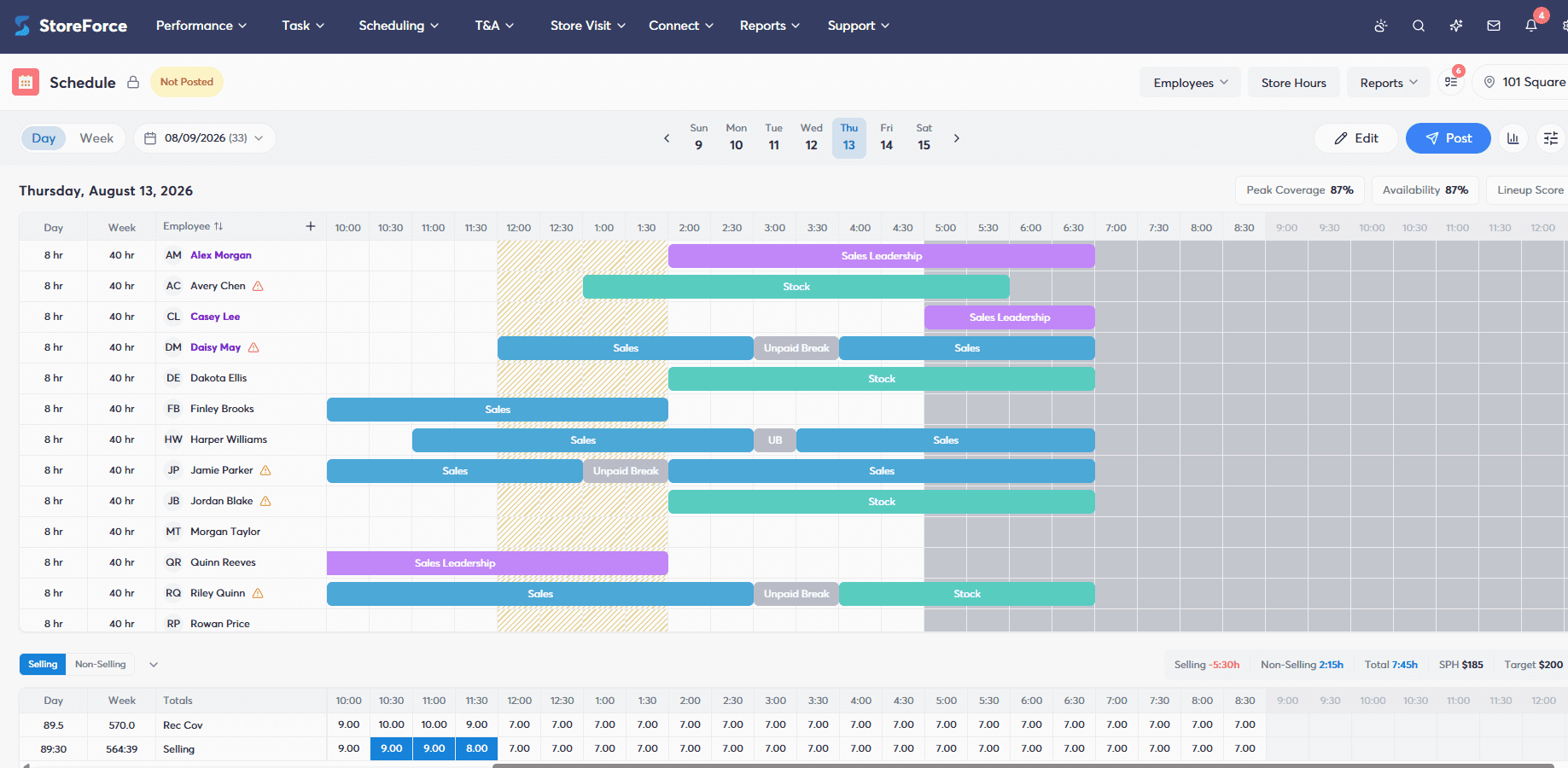
For a mid-sized retailer, that means moving beyond software that simply places employee names into open shifts.
Managers need to consider when customers are expected to visit, how much labour is available, when employees can work and what needs to happen inside the store.
Scheduling software should help bring those inputs together.
It should also support the organisational structure of a growing retailer. Individual store managers need enough control to operate their locations, while regional and head office leaders need visibility and consistency across the business.
The goal isn't to centralise every scheduling decision.
It's to give managers better tools for making those decisions while giving the organisation a more consistent approach to workforce planning.
Why Does Task Management Become More Important as a Business Grows?
A small group of stores can often coordinate work informally.
A manager can send a message about a new promotion. Someone at head office can email stores about a visual change. Regional leaders can call managers when something important needs to happen.
That becomes much harder to sustain as the store network grows.
More locations mean more promotions, shipments, training, audits, inventory work, operational changes and daily tasks that need to reach the right people.
Task management gives that work structure.
Instead of relying on every store manager to interpret and organise incoming requests, retailers can establish what needs to happen, where it needs to happen, who should handle it and when it needs to be completed.
For a mid-sized business, this can be particularly important because head office is trying to create greater consistency without adding layers of administration.
The task management system should make work easier to coordinate, not become another place managers have to constantly maintain.
Why Should Scheduling and Task Management Work Together?
This is where a mid-sized business can start getting significantly more value from integrated software.
A schedule tells the business who is working.
Task management tells the business what needs to get done.
Those two questions are closely connected.
Imagine a store has 120 labour hours available tomorrow. Looking at the labour number alone might suggest the store is appropriately staffed.
But tomorrow also includes a shipment, inventory count, promotional change and employee training.
Now the question isn't simply whether 120 hours fit the labour plan.
It's whether those hours provide enough workforce capacity to serve customers and complete the work required to operate the store.
When scheduling and task management are disconnected, managers have to make that connection themselves.
Integrated software gives retailers an opportunity to think about labour and workload together.
How Can Mid-Sized Businesses Reduce Scheduling Administration?
Manager time matters.
This is particularly important in mid-sized organisations where people frequently wear multiple hats. Store managers aren't dedicated workforce administrators. They are running stores, supporting employees, serving customers and managing performance.
Every hour spent manually reconciling availability, rebuilding schedules, communicating changes or answering routine scheduling questions is time taken away from those responsibilities.
Automation can help reduce that burden.
Scheduling software can help managers build schedules around workforce requirements rather than starting from scratch every week. Employee self-service can give team members greater ability to manage availability and access schedule information without routing every interaction through a manager.
The objective isn't to remove managers from workforce decisions.
It's to remove unnecessary administrative work so managers can spend more time on the decisions where their judgment actually matters.
How Should Mid-Sized Businesses Think About Labor Optimisation?
As a retailer grows, small labour inefficiencies begin to multiply.
An extra hour used inefficiently at one store may not seem significant. Repeating the same pattern across dozens of stores, multiple days each week, creates a much larger problem.
That makes labour optimisation increasingly valuable in the mid-market.
But optimising labour shouldn't simply mean cutting hours.
A mid-sized retailer needs to understand where those hours are being used.
Two stores could each schedule 100 labour hours and produce very different results depending on when those hours are placed. Coverage during periods of strong customer traffic may be more valuable than having excess coverage during slower periods.
Scheduling software should therefore help retailers align labour with expected demand while still accounting for employee availability and store workload.
The goal is to make better use of the labour the business already has.
Why Is Employee Self-Service Important for a Growing Business?
The administrative impact of employee requests grows alongside the workforce.
A few employees texting a manager about availability or schedules may be manageable.
Hundreds of employees doing it across a growing store network is different.
Employee self-service can move routine workforce interactions into a more structured process. Employees can access schedules, maintain availability and interact with appropriate scheduling processes without requiring the manager to manually coordinate every request.
That benefits employees, but it also helps the business scale.
Processes that depend heavily on individual managers become increasingly difficult to maintain as more people and locations are added.
Giving employees direct access to appropriate workforce information helps reduce that dependency.
How Much Visibility Does a Mid-Sized Business Need Across Locations?
Mid-sized retailers need visibility without drowning their teams in reporting.
Store managers need information relevant to their own teams and locations. Regional leaders may need to understand what is happening across several stores. Head office needs enough visibility to identify broader patterns and maintain operational consistency.
That does not necessarily require an enormous enterprise reporting environment.
It requires the ability to move between the levels of the organisation that actually matter.
Leadership should be able to understand whether stores are appropriately staffed, whether important work is being completed and where operational attention may be required.
The key is making that information accessible to the people who can act on it.
What Integrations Matter for a Mid-Sized Business?
Mid-sized businesses shouldn't have to rebuild their entire technology stack just to improve workforce management.
The retailer may already have systems handling payroll, point-of-sale data, customer traffic and other parts of the operation.
The question should be whether workforce management software can fit into that environment and make useful information available for better workforce decisions.
For example, sales forecasts and customer traffic can help inform labour requirements. Payroll processes depend on accurate time and attendance information. Store performance data can provide context around workforce decisions.
The objective isn't to integrate everything simply because integration is possible.
It's to connect the systems and information that remove manual work or improve decision-making.
Should a Mid-Sized Business Choose Software Based on Where It Is Today?
Not entirely.
Replacing workforce software can be disruptive, so businesses should consider whether the platform they choose can support the next stage of growth.
A retailer with 25 locations today may be planning for 40, 60 or more. More locations will mean more employees, more scheduling decisions, more store work and greater demand for organisational visibility.
Choosing software that only solves today's problems can create another replacement project a few years down the road.
But the opposite mistake is possible too.
A mid-sized retailer doesn't necessarily need to buy an extremely complex enterprise platform because of problems it might experience someday.
The better question is:
Can this platform comfortably support the business we operate today and the business we're realistically building toward?
That keeps scalability grounded in actual growth plans rather than hypothetical requirements.
Does a Mid-Sized Business Need Enterprise Workforce Management Software?
Not necessarily.
Mid-sized retailers may need many capabilities commonly associated with enterprise workforce management without needing the same degree of organisational complexity.
Intelligent scheduling, labour optimisation, time and attendance, task management, employee self-service and store performance visibility can all become valuable well before a retailer reaches enterprise scale.
The difference is how those capabilities are delivered.
A mid-sized business should look for enough sophistication to solve its operational challenges without requiring unnecessary layers of configuration, administration or management.
That is the balance between software that is too basic and software that is more complicated than the business needs.
What Questions Should a Mid-Sized Business Ask Before Choosing a Platform?
Before selecting task management and scheduling software, mid-sized businesses should evaluate how the platform would actually fit into their daily operations.
Can managers build schedules around customer demand, employee availability and labour requirements? Can head office coordinate tasks across multiple stores? Can managers see whether important work has been completed? Can employees access the information they need without constantly going through their manager?
Businesses should also consider how much manual work the platform eliminates. If managers still need spreadsheets, email chains and separate systems to coordinate everyday workforce decisions, the organisation may simply be adding another tool rather than solving the underlying problem.
Finally, consider what happens as the business grows.
Can additional stores, employees and management levels be added without fundamentally changing how the organisation operates?
For a mid-sized business, the right platform should solve today's complexity while making tomorrow's growth easier to manage.
How Can StoreForce Support a Growing Mid-Sized Retail Business?
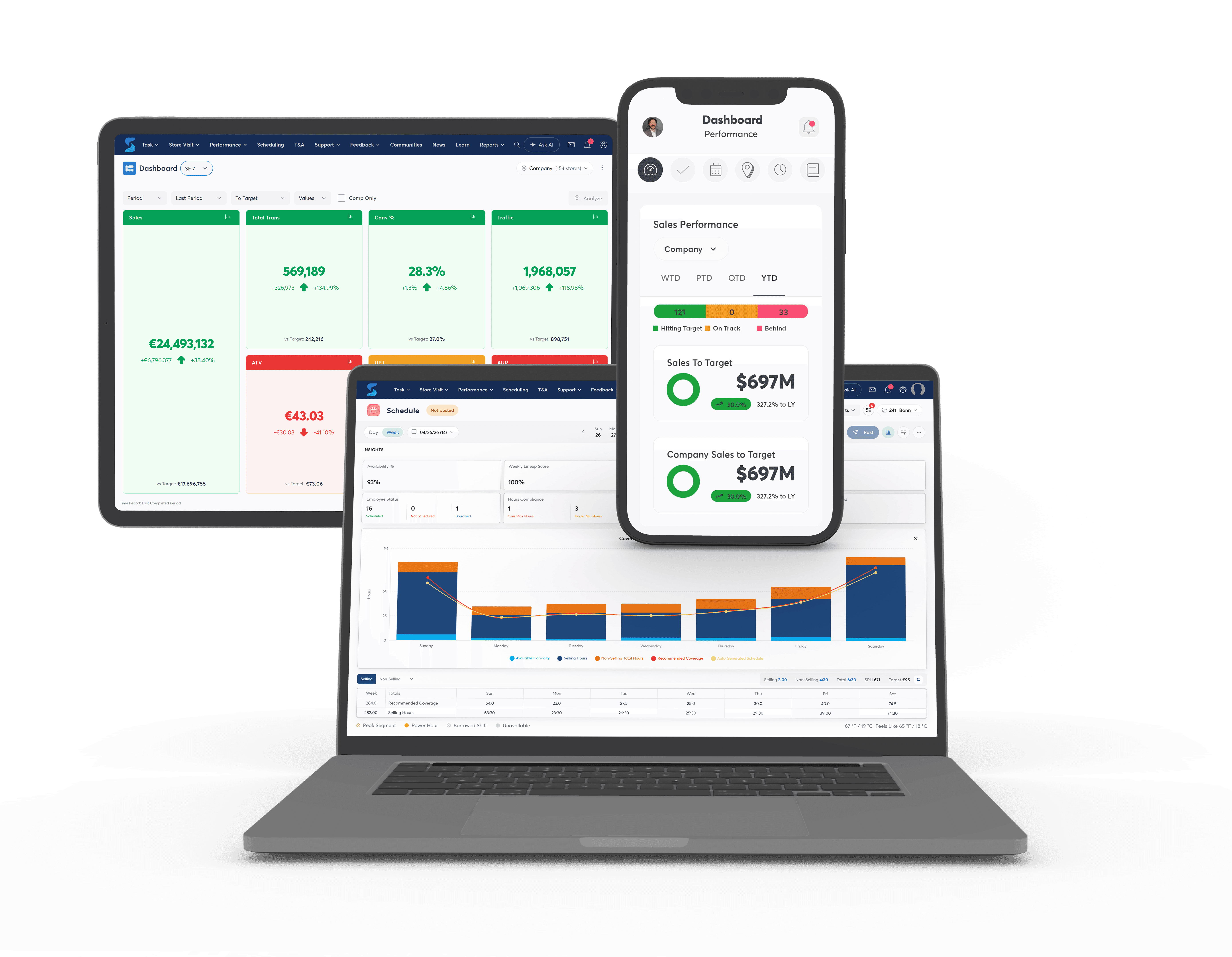
StoreForce brings several areas of retail workforce management together in one platform, including Intelligent Scheduling, Labor Optimisation, Task Management, Time and Attendance, Team Communications and Store Performance Monitoring.
For a growing retailer, bringing those capabilities together can reduce the need to manage workforce operations through a collection of disconnected tools.
Scheduling can consider customer demand, labour requirements and employee availability. Task Management gives retailers a structured way to plan, assign and track store work. Time and Attendance provides visibility into scheduled and actual labour, while Store Performance Monitoring helps leaders understand how stores and teams are performing.
The benefit for a mid-sized retailer is not simply having more features.
It's having a connected operating model that can support more stores, employees and operational complexity without requiring managers to manually connect all of those pieces themselves.
That is ultimately what mid-sized businesses should be looking for when choosing task management and scheduling software.
Don't choose basic software you'll quickly outgrow. Don't choose enterprise complexity you don't need.
Choose a platform that can manage the complexity your business has today, reduce the administrative burden on your teams and grow with where the business is going next.

See How StoreForce Can Work for Your Stores
See how StoreForce brings employee scheduling, labour optimisation, task management, and store execution together in one retail workforce management platform. Book a demo today to see what StoreForce can do for your teams.
Speak To A Retail Expert

