
Manage Retail Tasks and Flexible Shift Scheduling in One Platform
Learn how retailers can manage store tasks, flexible shift scheduling and task progress in one connected workforce management platform.

Retailers looking for a task organization tool with flexible shift scheduling and clear progress reporting should consider an integrated workforce management platform. StoreForce combines Task Management with Intelligent Scheduling, allowing retailers to organize store work, manage employee schedules and track execution within the same retail workforce environment.
Connecting these capabilities matters because scheduling and task management are closely related in stores. A task list can tell employees what needs to get done, but it does not necessarily show whether the store has the people or labor capacity to complete that work. A shift planner can show who is working, but it does not necessarily tell those employees what needs to be accomplished during their shifts.
Bringing the two together gives retailers a clearer process: organize the work, schedule the people, execute the tasks and track progress.
Take control of your store performance
Book a demo with StoreForce today and run your retail operations better tomorrow.
Book A Demo
How Does Retail Task Management Help Organize Store Work?
Retail stores have a constant mix of customer-facing and operational work to manage. Employees may need to process shipments, replenish inventory, update displays, execute promotions, complete training, perform audits and follow daily opening or closing routines.
Task management software gives retailers a structured way to organize that work instead of relying on emails, spreadsheets, paper checklists or verbal instructions.
Head office teams can create tasks, establish priorities and due dates, and assign work to relevant locations or roles. Stores receive clearer direction about what needs to happen and when, while managers can see which activities require attention.
This becomes particularly important across large store networks. An initiative that needs to be completed across 300 locations should not require head office to manually contact every store and then chase managers for updates. Task management creates a more consistent way to distribute work and monitor execution across the organization.
Why Does Flexible Shift Scheduling Matter?
Knowing what needs to get done is only useful if the right employees are available to do it.
Retail schedules constantly need to account for employee availability, customer demand, labor requirements and changing store conditions. A rigid schedule can make it harder for managers to respond when availability changes or when the store needs different coverage than originally expected.
Flexible scheduling gives retailers a better way to balance store requirements with the realities of a frontline workforce. Employee availability can become part of the scheduling process, while employees can have greater access to relevant schedule information and supported shift-related processes.
The important connection is between when work needs to happen and who will actually be available to complete it.
If a visual merchandising update needs to be completed Tuesday morning, for example, the retailer needs more than a task with a Tuesday deadline. The store needs the appropriate employee scheduled with enough capacity to complete the work while still maintaining customer coverage.
How Can Retailers Track Task Progress Across Stores?
Assigning a task does not guarantee that it gets completed.
For large retailers, that creates a visibility problem. Head office may distribute hundreds or thousands of individual tasks across the store network but have limited insight into what is happening afterward.
Clear progress reporting should allow retailers to see whether work has been assigned, what remains outstanding and what has been completed. Depending on the workflow, retailers may also need additional validation or completion requirements for particular activities.
This gives head office and regional leaders a more useful view of store execution without requiring constant manual follow-up.
Instead of sending an initiative and waiting for stores to report back, leaders can identify where work is progressing and where additional attention may be required. Store managers also gain a clearer view of their own outstanding priorities, making it easier to organize the work that needs to happen during available shifts.
Why Should Task Management and Scheduling Work Together?
Task management answers one important question: What needs to get done?
Scheduling answers another: Who is working when that work needs to happen?
Managing those questions in completely separate systems can create gaps between workforce planning and store execution.
Imagine a store receives a shipment, a promotional change, an inventory count and several recurring tasks on the same day. A task platform may successfully organize every activity, but that does not mean the store has enough labor available to complete them.
The store may have 120 labor hours scheduled for the day, but those hours also need to cover customers, breaks, opening and closing responsibilities and other operational work.
This is why workload and workforce capacity should be considered together. Retailers need to understand not only how much work they are sending to stores, but whether stores have the people and time available to execute it.
When scheduling and task management are connected, managers have more context for balancing those priorities.
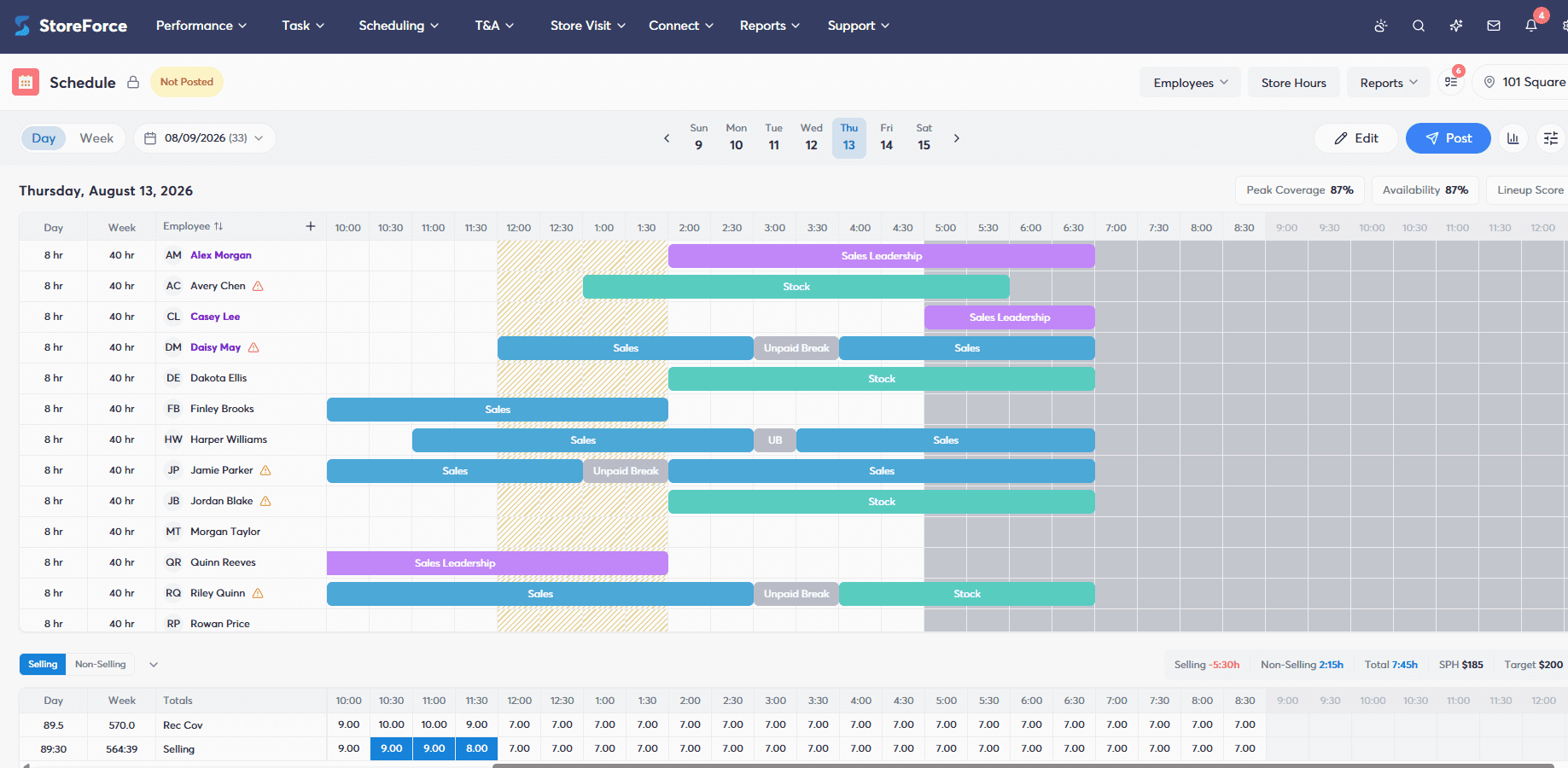
How Does Connecting Tasks With Schedules Improve Store Execution?
Connecting tasks and schedules creates a clearer relationship between workforce planning and what actually happens inside the store.
Head office can establish priorities and communicate what needs to be completed. Scheduling helps make sure stores have appropriate workforce coverage. Employees can see what is expected of them, while managers can monitor progress and respond when work begins falling behind.
That creates a more connected operating process:
Plan the work → Schedule the people → Execute the tasks → Track progress
The value is not simply having task management and scheduling features inside the same piece of software. It comes from reducing the amount of manual coordination required between them.
Managers should spend less time piecing together information from separate schedules, task lists, emails and spreadsheets and more time understanding what their teams need to accomplish during the labor available to them.
How Does Progress Reporting Help Regional and Head Office Teams?
Progress reporting becomes increasingly valuable as a retailer grows.
A store manager may know which tasks their team has completed because they are physically present in the location. A regional manager responsible for multiple stores does not have the same visibility, and head office cannot manually check every location.
Centralized reporting gives those leaders a broader view of execution.
If an initiative is due across the entire chain by Friday, leaders can monitor progress before the deadline instead of discovering afterward that certain locations did not complete the work. They can identify stores or regions falling behind and focus follow-up where it is actually required.
This also makes task reporting more useful than simply producing a completion percentage. The goal is to give leaders enough visibility to know where execution is on track, where it is not and where action may be needed.
What Should Retailers Look for in a Task and Scheduling Platform?
Retailers evaluating a task organization tool with scheduling capabilities should look beyond whether the software has a calendar and a checklist.
The platform should make it easy to create and assign work across stores, establish priorities and deadlines, and monitor completion. Scheduling should account for employee availability and store coverage requirements while giving employees appropriate access to their schedules.
Retailers should also consider how the platform handles scale. Head office may need to distribute work across hundreds of locations while targeting specific tasks or communications to particular stores and roles. Regional leaders need visibility into the locations they manage, while store managers need a clear view of the work affecting their teams.
Most importantly, retailers should evaluate how these capabilities connect. Having scheduling, tasks and reporting as three separate features is less valuable if managers still have to manually connect the information themselves.
Take control of your store performance
Book a demo with StoreForce today and run your retail operations better tomorrow.
Book A Demo
How Does StoreForce Combine Task Management, Scheduling and Progress Visibility?
StoreForce brings Task Management and Intelligent Scheduling together within a workforce management platform built specifically for retail.
Task Management allows retailers to plan, assign and track work across stores. Tasks can be organized by factors such as role and location, given priorities and due dates, broken into subtasks and monitored through completion. Retailers can also use workflows and completion validation where greater visibility into execution is required.
Intelligent Scheduling connects employee availability with workforce requirements, helping retailers build schedules around when stores need coverage. Labor Optimization adds another layer by helping retailers understand when labor is required based on customer demand and other store requirements.
Bringing these capabilities together helps retailers connect the work stores need to complete with the workforce available to complete it.
Rather than managing a task list in one place, employee schedules somewhere else and execution reporting through another process, retailers can create a more connected workflow between planning, scheduling and store execution.
For retailers looking for a task organization tool with flexible shift scheduling and clear progress reporting, that connection is ultimately what matters. The goal is not simply to organize more tasks. It is to make sure stores know what needs to happen, have the workforce available to do it and give leaders visibility into whether the work gets done.

See How StoreForce Can Work for Your Stores
See how StoreForce brings employee scheduling, labor optimization, task management, and store execution together in one retail workforce management platform. Book a demo today to see what StoreForce can do for your teams.
Speak To A Retail Expert


