Why Retail Staff Schedules and Store Tasks Belong in One Platform
See how StoreForce brings retail staff scheduling and store task management into one platform to improve labour planning and give teams a clearer plan for every shift.

Retailers manage two things every day: the people working in their stores and the work those people need to complete.
Yet many retailers still manage staff schedules in one system and store tasks in another. Managers have to move between the two, employees have more software to learn, and task workload can be disconnected from the schedules meant to support it.
Bringing retail staff scheduling and task management into one workforce management platform changes that. The schedule can account for the work that needs to happen, employees have one place to understand their day, and managers get a clearer picture of whether they have the people and hours needed to get everything done.
The people and the work are already connected in the store. It makes sense for the software managing them to be connected too.
Take control of your store's performance
Book a demo with StoreForce today and run your retail operations better tomorrow.
Book a Demo
Bringing Scheduling and Tasks Together Creates a More Realistic Store Plan
A schedule tells you who is working. A task list tells you what needs to get done. Managing them together helps retailers answer the more important question: do we have the right people and hours to handle the work ahead?
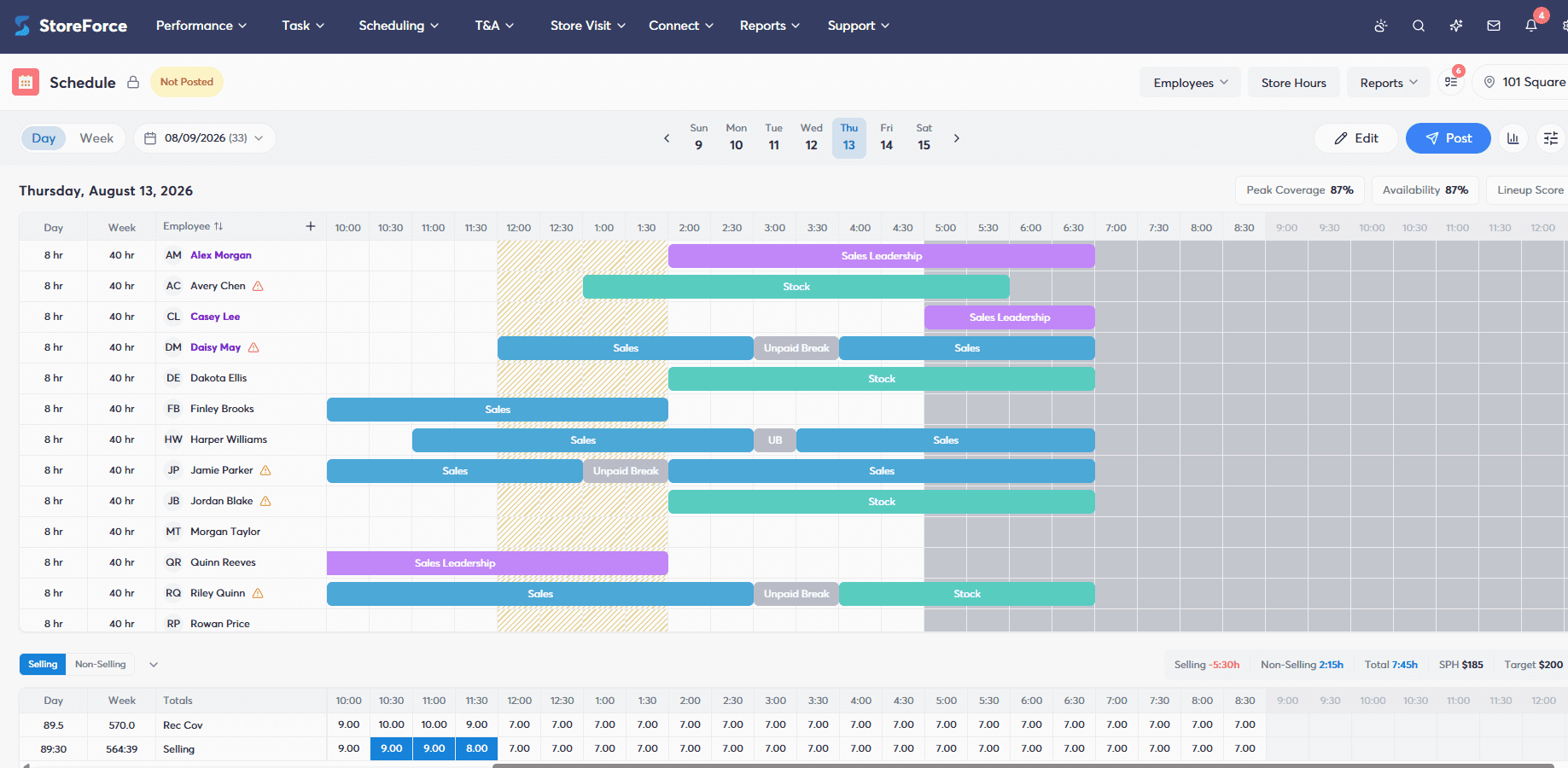
Store tasks create real labour demand. A five-hour shipment requires five hours of work. Floor sets, inventory counts, promotions, audits, and training all need employee time too. When those tasks sit outside the scheduling system, stores can end up with a schedule that does not account for the work employees are expected to complete.
Bringing tasks into the workforce management platform gives retailers a better way to consider that workload when planning staff. If Wednesday has more operational work than Thursday, the labour plan should be able to reflect it.
A better schedule does not only account for who needs to be in the store. It accounts for why they need to be there.
Customer Demand Is Only One Part of Store Labour Demand
Retailers already plan staffing around customer traffic, but customers are not the only reason stores need labour.
A quieter Tuesday could include a major shipment, inventory work, a promotional setup, and employee training. That Tuesday may require more labour than sales forecasts alone suggest.
Connecting tasks with scheduling gives retailers a fuller picture of store demand, helping them plan for both the customers coming through the door and the work that needs to happen behind the scenes.
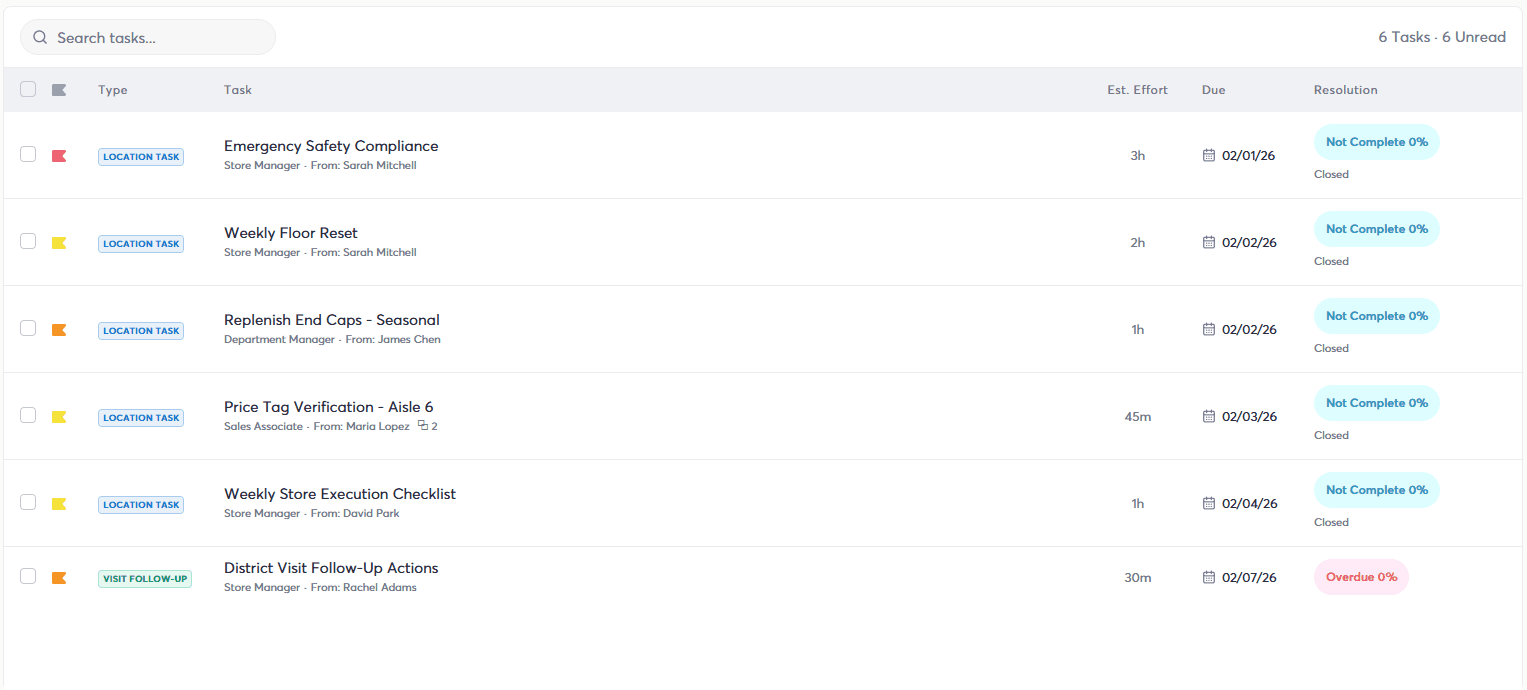
Giving Frontline Employees One Place to See When They Work and What They Need to Do
There is also a much simpler benefit to bringing retail scheduling and task management together.
Employees have less software to deal with.
They should not need one application to find out when they work and another to find out what they are supposed to do when they get there.
Putting both in one workforce management platform gives employees a familiar place to see more of their workday. They can check their schedule, understand their responsibilities, and see store priorities without constantly moving between systems.
That can also make onboarding easier. Every separate app means another login, another interface, and another process managers have to teach new employees.
Across a large retail workforce, that matters. One system becomes easier to teach, easier to remember, and easier to make part of the daily routine.
One place for the schedule and the work gives frontline employees a much clearer answer to a basic question: what does my day look like?
Store Managers Stop Being the Connection Between Scheduling and Task Apps
Separate systems do not remove the relationship between schedules and tasks. They simply make someone responsible for connecting them.
Usually, that person is the store manager.
The manager checks the schedule to see who is working, opens the task system to see what needs to happen, works out how the tasks fit into available hours, and then adjusts the plan as the day changes.
Do that for one task and it is a small inconvenience. Do it across every shift, every day, and every location and it becomes part of the manager's workload.
When scheduling and tasks live in one platform, managers have more of the information they need in the same place. They can focus on making decisions instead of collecting information from separate systems before they can make those decisions.
Retail managers already have enough variables to manage on the shop floor. Their software should help connect the store day rather than asking them to do the connecting themselves.
Head Office Can See Store Workload and Workforce Together
Connecting schedules and tasks also changes the view from head office.
Task management can tell retail leaders what stores were asked to accomplish and whether that work was completed. Workforce management provides information about the people and labour available in those stores.
Looking at either one alone can leave important questions unanswered.
If a store repeatedly misses tasks, is it an execution issue? Or is the store consistently being given more work than its available labour can support? Are major initiatives landing on already busy days? Are stores being given enough hours to complete both operational work and customer-facing responsibilities?
Bringing workforce and task information closer together gives leaders better context around what is happening across locations.
It also changes the conversation from "Why didn't the store complete the task?" to "Did we create a realistic plan for the store to complete it?"
That is a much more useful question for retail operations teams.
One Platform Means Less Software to Buy, Manage, Train and Support
Combining scheduling and task management is not only about how the features work together. There is also a practical benefit to reducing the number of systems stores depend on.
Separate platforms can mean separate vendors, contracts, renewals, logins, support teams, training, accounts, permissions, and data.
Then there is the question of getting the systems to work together.
If task management needs employee or scheduling information from the WFM system, retailers may eventually find themselves paying for and maintaining connections between two platforms that are supporting the same store workforce.
A workforce management suite reduces those moving parts.
This becomes increasingly important as the retailer grows. One extra platform may seem manageable across ten stores. Across hundreds of locations and thousands of employees, another system becomes a much larger commitment.
The value of putting scheduling and tasks under one roof is not simply having fewer applications. It is having fewer applications because the functions already belong together.
Retail Workforce Management Is Moving Beyond Just Building Schedules
Workforce management software has traditionally focused heavily on labour planning and employee scheduling.
But the role of retail WFM is getting broader.
Store teams need to know more than when they are working. They need to know what needs to happen during those hours. Managers need to do more than fill shifts. They need to balance customers, labour, operational work, and store performance every day.
That is why modern retail workforce management suites are bringing more of the store operation together.
Scheduling, task management, performance, and daily execution are closely related parts of running a retail store. Putting them into separate systems does not change that relationship. It only makes it harder to see.
Modern WFM platforms can give retailers a more connected view of the store day, where the workforce plan and the work itself are managed together.
Retail WFM is becoming less about simply scheduling people and more about helping retailers make better use of the people they schedule.
What to Look for in Software That Combines Retail Scheduling and Task Management
Having scheduling and task management listed on the same product page is not enough. Retailers should look for software where the two actually work together.
A strong retail workforce management platform should let managers plan store tasks alongside employee schedules and available labour. Frontline employees should have one familiar place to see their schedules and responsibilities. Head office should have visibility across locations without asking stores to maintain separate processes.
It should also be built around the realities of multi-location retail, where the same platform may need to support thousands of employees, different store formats, changing workloads, and priorities coming from both head office and the store.
When comparing retail scheduling and task management software, ask whether the platform can help answer four questions:
Who is working?
What needs to get done?
Do we have the people and hours to do it?
Did the store execute the plan?
If the software can only answer one or two of those questions, store teams may still be left connecting the rest themselves.
The goal is not simply to find software with scheduling and task management. It is to find software where scheduling and task management make each other more useful.
StoreForce Puts Retail Scheduling and Task Management Under One Roof
StoreForce brings employee scheduling, task management, performance tracking, and daily store operations together in one retail workforce management platform.
For frontline employees, that means one familiar place to understand when they work and what needs to get done.
For managers, it means the workforce and the workload can be managed closer together. Store tasks can provide more context for workforce planning, while managers get a clearer view of the people and hours available to execute the work.
For retail leaders, StoreForce brings more of the store operation into one platform, creating better visibility across schedules, tasks, execution, and performance without asking stores to piece everything together themselves.
The people working in your stores and the work they need to complete are already connected.
StoreForce puts them under one roof.
Book a StoreForce demo to see how connected retail scheduling and task management can create a clearer plan for every store day.

See How StoreForce Can Work for Your Stores
See how StoreForce brings employee scheduling, labour optimisation, task management, and store execution together in one retail workforce management platform. Book a demo today to see what StoreForce can do for your teams.
Speak To A Retail Expert


