
Choose the Best Retail Workforce Management Software in 2027
Written by: Ben Flikkema | Content Specialist at StoreForce

Choosing the best retail workforce management software in 2027 is not just about features. It is about control, visibility, and results. The best retail workforce management software helps you schedule smarter, manage daily tasks, control labour costs, and keep every store aligned.
In 2027, retailers cannot afford disconnected tools or manual processes. If you want consistent execution across locations and stronger performance from your teams, choosing the right retail workforce management software matters more than ever.
What Is Retail Workforce Management Software?
Retail workforce management software or retail WFM software is a system or digital platform that helps retailers plan, schedule, and manage their store teams in one place. Retail workforce management software gives managers real-time visibility into staffing, tasks, and performance so they can run stores more consistently and hit their targets.
At its core, retail workforce management software connects three key areas of store operations:
1. Scheduling and labour planning
2. Task management and execution
3. Performance tracking and accountability
Employee engagement and communication between teams
Without retail workforce management software, many retailers rely on spreadsheets, paper schedules, and disconnected tools. That leads to errors, wasted time, and inconsistent execution across locations.
Bring Your Stores Together and Execute Better
Give your teams the workforce management tools to drive better results.
Speak to Our Team
How Retail Workforce Management Differs from Basic Tools
Here is a clear breakdown of the differences.
When it comes to basic tools, they focus on single functions, usually scheduling or time tracking. They help managers complete tasks, but they do not connect the bigger picture and can lead to missed communication, lost revenue and overall store effectiveness.
What basic tools get you:
Weekly schedule creation
Time and attendance tracking
Shift reminders or notifications
Simple payroll exports
Manual reporting
What is missing:
Labour forecasting tied to sales
Visibility across multiple stores
Real-time performance tracking
Task management connected to staffing
Centralised data in one system
In many retail stores today, managers are still relying on outdated, manual processes to fill these gaps. Tasks are often sent through long email chains that get buried or missed entirely. A district manager might send a weekly execution plan over email, but there is no clear way to track who completed what or when. This leads to constant follow-ups, confusion, and inconsistent execution across stores.
Scheduling is another area where old habits still slow teams down. Some managers build schedules by copying last year’s templates or reusing old spreadsheets without factoring in current sales trends, traffic patterns, or staffing needs. Others are texting employees individually to fill shifts or posting schedules as photos in group chats, which creates miscommunication and last-minute changes. These workarounds might seem quick, but they lead to coverage gaps, overstaffing during slow periods, and missed sales when stores are busy.
The Key Features to Look for in the Best Retail Workforce Management Software in 2027
The best retail workforce management software in 2027 needs to do more than build employee schedules or track labour costs. Retailers need a connected platform that brings workforce management, store performance, task execution, and communication together in one place.
For years, retailers have relied on separate systems to manage scheduling, measure KPIs, communicate with store teams, and track operational tasks. The problem is that these systems often operate independently, making it harder for store managers and head office teams to connect daily decisions to business performance.
When evaluating retail workforce management software, look for a solution that connects these critical areas of store operations, giving teams the visibility, tools, and insights they need to improve performance across every location.
1. Intelligent Scheduling and Labour Optimisation
Effective workforce management starts with having the right people working at the right times. The best platforms use sales forecasts, traffic patterns, and historical performance to help retailers align labour with customer demand.
Look for capabilities such as:
Automated scheduling based on forecasted sales and traffic
Labour optimisation that aligns staffing with peak selling periods
Real-time visibility into labour budgets and scheduled hours
Employee availability, shift swaps, and scheduling flexibility
Insights into how staffing decisions influence store performance
Rather than simply controlling labour costs, retailers should be looking for software that helps them maximise the value of every scheduled hour.
2. Retail KPIs and Performance Management
Scheduling employees is only one part of improving store performance. Retailers also need to understand how their stores and teams are performing, where opportunities exist, and what actions will make the biggest difference.
Look for capabilities such as:
Real-time visibility into sales, conversion, productivity, and labour KPIs
Dashboards that give different levels of the organisation relevant information
Performance comparisons across stores, districts, and regions
Reporting that connects workforce decisions to business outcomes
The goal is to move beyond simply reporting numbers. The right platform should help store managers understand what their KPIs mean, identify opportunities, and make better decisions that directly influence results.
3. Integrated Task Management and Store Execution
Even the best staffing strategies and performance insights mean little if store teams cannot consistently execute on business priorities.
Modern workforce management software should connect corporate initiatives with what actually happens on the store floor, giving retailers a reliable way to assign, manage, and verify work across their entire network.
Look for capabilities such as:
Centralised task management for daily operations and corporate initiatives
Task assignments targeted by store, region, role, or department
Real-time visibility into completion rates and overdue work
Photo verification, checklists, and execution tracking
Reporting that helps identify operational gaps and improve accountability
When task management is part of the same platform used to manage people and performance, retailers gain a clearer picture of how store execution supports their broader business objectives.
4. Centralised Communication and Employee Engagement
Disconnected communication is one of the biggest obstacles to consistent retail execution. When important information is spread across emails, messaging apps, PDFs, and separate systems, store teams can easily miss updates or lose track of priorities.
The best retail workforce management platforms should provide a centralised communication experience that keeps everyone connected.
Look for capabilities such as:
A single hub for communication between head office, field leaders, and store teams
Targeted messaging based on store, region, or employee role
Read receipts and acknowledgment tracking
Employee engagement tools that keep teams informed and connected
Direct connections between communications, assigned tasks, and operational priorities
By bringing communication into the same environment as scheduling, performance, and task management, retailers can reduce unnecessary back-and-forth and give employees a clearer understanding of what matters most.
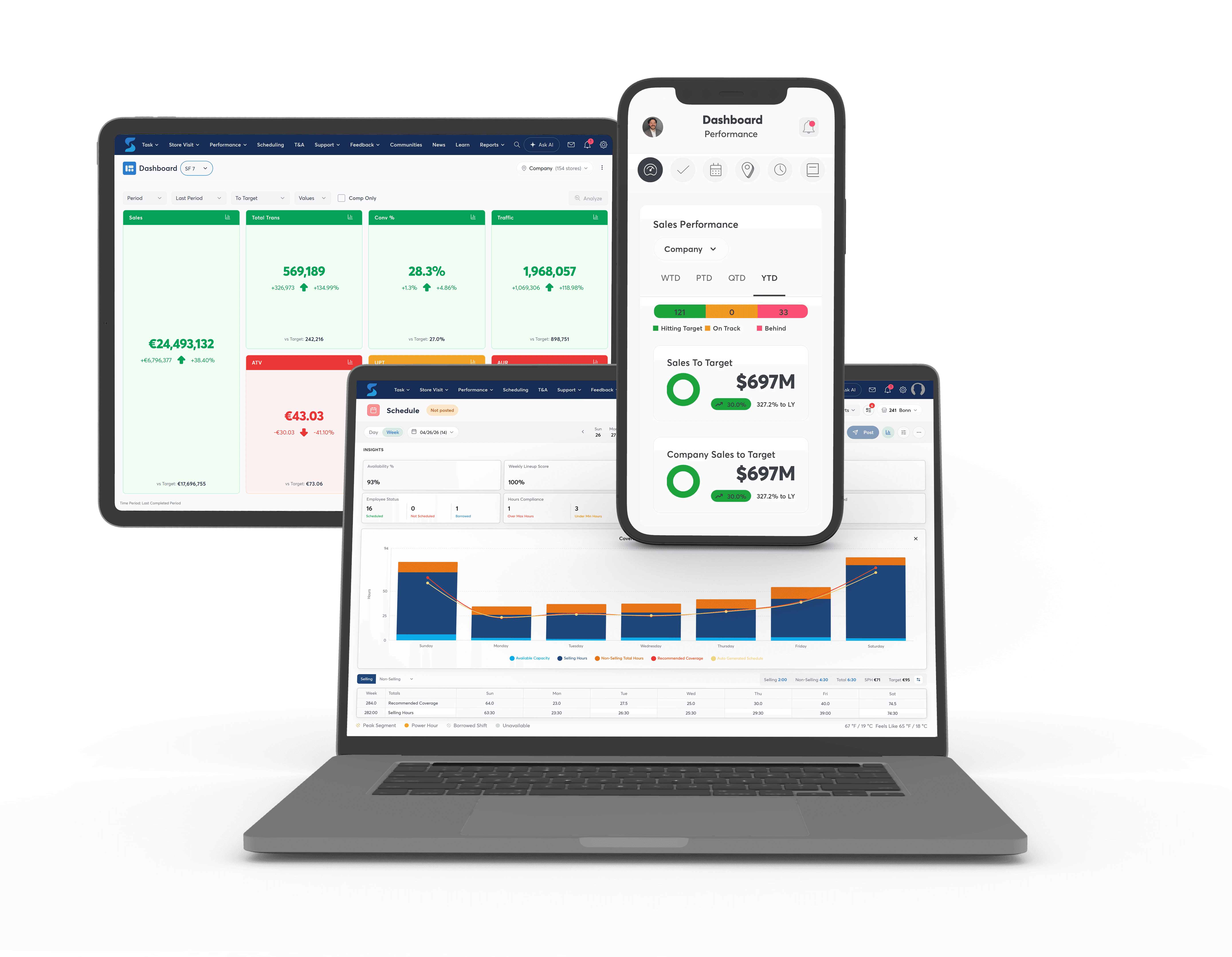
5. A Unified Platform That Connects People, Performance, and Execution
Perhaps the most important consideration when choosing retail workforce management software in 2027 is how well its capabilities work together.
Retailers should no longer have to rely on one platform for scheduling, another for performance reporting, and several more for communication and task management.
Look for a unified solution that provides:
Workforce scheduling and labour optimisation in one connected environment
Retail KPIs that inform staffing and operational decisions
Task management that turns business priorities into measurable action
Centralised communication that keeps teams aligned
Shared visibility across store managers, district leaders, and head office
Fewer disconnected tools and less administrative work
The real value comes from connecting these functions. When managers can see how their stores are performing, schedule employees around demand, communicate priorities, and verify execution without switching between multiple systems, they can spend less time managing software and more time improving their stores.
6. Seamless Integrations and Scalability Across Retail Operations
A unified workforce management platform should also work alongside the other essential systems retailers already use.
Look for capabilities such as:
Integration with payroll, HR, and point-of-sale systems
Reliable data sharing across workforce and operational tools
Secure access and permissions for different organisational roles
Reduced manual data entry and duplicated work
The flexibility to support growing, multi-location retail businesses
The right solution should simplify the technology retailers depend on, not introduce another disconnected system into an already complicated environment.
Choosing a Connected Retail Workforce Management Platform for 2027
The definition of retail workforce management is changing. Scheduling and labour optimisation remain essential, but they are no longer enough on their own.
The best retail workforce management software in 2027 should help retailers manage their people, understand their performance, communicate priorities, and execute consistently across every store.
Instead of asking which software has the best scheduling tools, retailers should be asking which platform gives them the clearest picture of their entire store operation and helps them act on it.
That's where a connected approach to workforce management creates the greatest opportunity: bringing people, performance, and execution together so every store can operate more effectively.
Cloud-Based vs. On-Premise Retail Workforce Management Solutions
Cloud-based retail workforce management software runs online, which means no servers in the back office, no manual updates, and no waiting on IT to fix things. Managers can access schedules, labour data, and reports from anywhere, whether they are in store, at home, or covering another location. Updates happen automatically, and rolling the system out to multiple stores is much faster.
On-premise retail workforce management software is installed on local servers and managed internally. That often means higher upfront costs, ongoing maintenance, and more hands-on support from IT. It can work, but it usually requires more effort to maintain. For most modern retailers that need flexibility and speed, cloud-based systems simply make day-to-day operations easier.

Evaluating Retail Workforce Management Software Vendors in 2027
Choosing the right retail workforce management software is about more than finding a better way to schedule employees. Retailers need a platform that connects their people, performance, and daily operations without adding unnecessary complexity.
Here are five important considerations when evaluating vendors in 2027.
1. Choose a Platform Built Specifically for Retail
Not all workforce management systems understand the complexities of retail. Look for a solution that supports sales-driven scheduling, peak traffic coverage, multi-location operations, and the unique demands of store teams.
Retailers need technology designed around how their stores actually operate, not generic workforce management tools adapted for retail.
2. Prioritise a Unified Solution Over Disconnected Tools
The best workforce management platforms go beyond scheduling to bring labour optimisation, retail KPIs, task management, and communication together.
Ask vendors whether these capabilities operate within one connected platform or require separate systems and integrations. A unified approach reduces administrative work, improves visibility, and helps teams connect daily decisions to business performance.
3. Demand Real-Time Visibility Into Performance and Execution
Retail leaders need more than historical reports. They need to understand what's happening across their stores and where action is required.
Look for real-time dashboards that connect sales performance, labour efficiency, staffing coverage, and task completion. The right platform should make it easy to identify opportunities and take action before small issues become bigger problems.
4. Make Sure Store Teams Can Easily Use It
Workforce management happens on the store floor, not just behind a desk. Employees and managers need simple, mobile-friendly access to schedules, communications, tasks, and performance information.
Prioritise platforms that make everyday work easier, reduce unnecessary steps, and give employees one central place to find what they need.
5. Evaluate Long-Term Scalability and Support
Your workforce management platform should support your business as it evolves. Consider how easily the solution can expand across new locations, introduce additional capabilities, and adapt to changing operational priorities.
Look beyond implementation costs and evaluate the long-term value of consolidating systems, improving store execution, and giving teams the tools they need to succeed.
Ultimately, the best retail workforce management software in 2027 won't simply help retailers manage their workforce. It will help them manage their entire store operation through one connected platform.
How the Right Retail Workforce Management Software Impacts Profitability
The right retail workforce management software does more than control labour costs. By connecting scheduling, performance insights, task management, and communication, retailers can make smarter decisions that directly influence profitability across every store.
Here's how a connected approach to workforce management helps retailers improve their bottom line.
Optimising Labour Costs and Maximising Peak Selling Hours
Labour is one of retail's largest controllable expenses, but reducing hours isn't always the answer. The goal is to make every scheduled hour more valuable.
Retail workforce management software uses sales forecasts, traffic patterns, and performance data to align staffing with customer demand. This helps retailers reduce unnecessary overtime and overstaffing while ensuring their strongest employees are available during the busiest selling periods.
Improving Store Productivity and Execution
Having the right people scheduled is only half the equation. Retailers also need to ensure those employees are focused on the right priorities.
When scheduling, task management, and communication work together, store teams can spend less time navigating disconnected systems and more time executing the activities that matter. Managers gain visibility into task completion, operational priorities, and performance without constantly chasing updates.
Driving Sales Through Better Performance Insights
The best workforce management platforms help retailers understand not just how their stores are performing, but why.
By connecting retail KPIs such as conversion, sales per labour hour, and average transaction value with scheduling and operational execution, managers can identify opportunities to improve results.
This creates a more proactive approach to store performance, where decisions are informed by real data rather than assumptions.
Creating a Better Employee and Customer Experience
Employees perform better when they have clear schedules, accessible information, and a better understanding of what's expected of them.
A unified platform gives store teams one place to access schedules, receive communications, complete tasks, and stay connected to business priorities.
For customers, better staffing and more consistent store execution can mean shorter wait times, improved service, and a stronger overall shopping experience.
The Metrics That Matter
The impact of retail workforce management software should be measurable across labour efficiency, store performance, and operational execution.
Key metrics to monitor include:
Labour cost as a percentage of sales: Understanding how effectively labour budgets are being used.
Sales per labour hour: Measuring how much revenue is generated from scheduled labour.
Conversion rate: Identifying how effectively stores turn customer traffic into sales.
Average transaction value: Understanding opportunities to increase revenue from each purchase.
Peak coverage: Measuring whether stores have the right staffing levels during their busiest selling periods.
Task completion rates: Tracking how consistently operational priorities are executed across locations.
Employee turnover: Understanding how scheduling, workload, and engagement influence retention.
When retailers can measure these KPIs alongside scheduling, communication, and task execution, they gain a much clearer understanding of what drives profitability.
Ultimately, the greatest value of modern retail workforce management software comes from connecting people, performance, and execution. It's not just about spending less on labour. It's about getting more value from every hour, every employee, and every store.
Frequently Asked Questions (FAQS) About Retail Workforce Management Software
What is retail workforce management software?
Retail workforce management software is a system that helps retailers schedule employees, track time and attendance, manage daily tasks, and monitor performance in one place. It connects labour planning to sales data so stores can run more efficiently and control costs.
How does retail workforce management software reduce labour costs?
It uses sales forecasts and historical data to build smarter schedules. Managers can see labour spend in real time, reduce overtime, and avoid overstaffing during slow periods. Better planning means fewer wasted hours and tighter payroll control.
Is retail workforce management software only for large retailers?
No. While multi-location retailers benefit the most, even smaller retailers can improve scheduling accuracy, task execution, and visibility with the right system. As a business grows, having a structured platform becomes even more important.
Can retail workforce management software integrate with payroll and POS systems?
Yes. Most modern retail workforce management software connects with payroll, HR, and POS systems. This reduces double data entry, improves reporting accuracy, and keeps all operational data aligned.
How long does it take to implement retail workforce management software?
Timelines vary based on the size of the business and number of stores. Cloud-based systems are typically faster to deploy than on-premise solutions. A strong vendor will provide onboarding, training, and support to ensure a smooth rollout.
What should I look for when choosing retail workforce management software?
Focus on retail-specific functionality, real-time visibility, multi-location support, ease of use, mobile access, and strong reporting. The right system should reduce manual work, improve scheduling accuracy, and give leadership clear insight into store performance.
Why StoreForce Is the Top Choice for Retail Workforce Management Software
StoreForce is more than workforce management software. It's a unified retail operations platform that brings scheduling, labour optimisation, retail KPIs, task management, and communication together in one connected solution.
Built specifically for retail, StoreForce gives retailers the tools to manage their people, measure performance, and execute consistently across every location without relying on multiple disconnected systems.
Rather than treating scheduling, store performance, and daily operations as separate functions, StoreForce connects them. Managers can build smarter schedules around customer demand, understand the KPIs driving their business, communicate priorities, and ensure important tasks are completed, all within one platform.
This connected approach gives every level of the organisation greater visibility and control. Head office can monitor performance and execution across the entire store network, district managers can identify opportunities and support their teams, and store managers can focus on making better decisions instead of chasing information.
StoreForce also helps retailers make the most of their busiest selling periods. By connecting sales and traffic insights with labour planning and store execution, retailers can put the right people in the right place at the right time while keeping teams focused on the activities that drive results.
The value extends beyond labour savings. With StoreForce, retailers can work toward stronger conversion rates, improved sales per labour hour, better operational consistency, and a more engaged workforce.
The future of retail workforce management isn't about adding more tools. It's about bringing everything together.
StoreForce delivers a connected approach to retail operations, helping retailers turn workforce decisions, performance insights, and daily execution into measurable business results across every store.

See How StoreForce Can Work for Your Stores
Book a quick chat with us today, to improve your retail operations tomorrow.
Speak To A Retail Expert


