How Modern Retail Systems Improve Frontline Staff Performance
Modern retail systems use real-time data to give frontline teams and their managers greater visibility into what is happening in the store while there is still time to act.

Retail stores generate information constantly.
The faster retailers can turn that information into useful decisions, the more opportunity they have to influence what happens next.
Modern retail systems use real-time data to give frontline teams and their managers greater visibility into what is happening in the store while there is still time to act.
Instead of waiting for an end-of-day report to discover that conversion fell during the afternoon rush or an important task was never completed, managers can identify issues earlier, understand where attention may be required and adjust their approach.
That changes performance management from simply reporting what happened to helping teams influence what happens next.
Take control of your store's performance
Book a demo with StoreForce today and run your retail operations better tomorrow.
Book a Demo
Why Does Real-Time Data Matter in Retail?
A store can be ahead of its sales target in the morning and behind it several hours later. Traffic can unexpectedly increase. An employee can call in sick. A major operational task can fall behind schedule.
If managers only see those changes after the fact, their options are limited.
They can investigate what happened and potentially make a better decision tomorrow, but they cannot change what already happened today.
Real-time data creates an opportunity to intervene sooner. That does not mean managers should react to every small movement in a KPI. It means they can have greater visibility into meaningful changes while there is still an opportunity to respond.
The difference is simple:
Historical reporting asks: What happened?
Real-time visibility also asks: What should we do now?
What Types of Real-Time Data Can Help Frontline Retail Teams?
Frontline performance is not represented by a single metric.
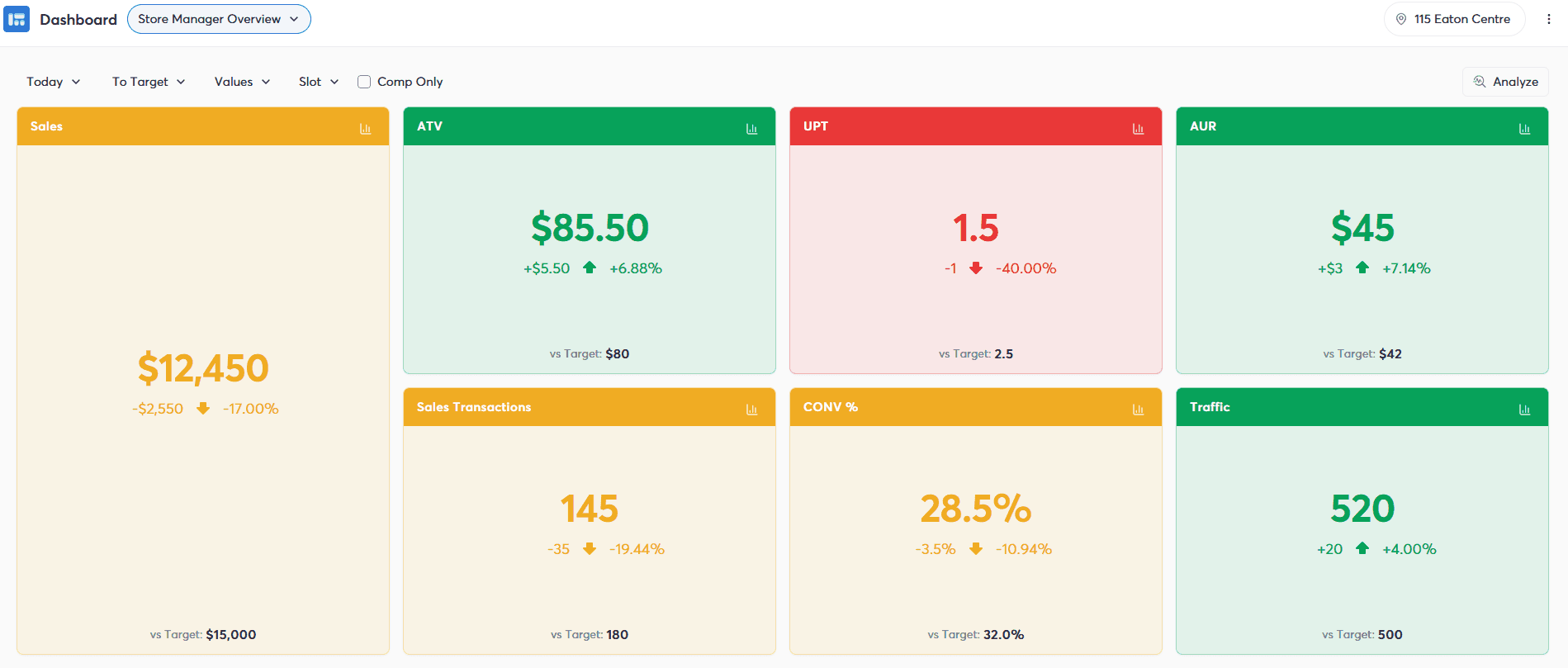
Modern retail systems can bring together different types of information to provide greater context around what is happening in a store.
That can include:
Customer traffic
Sales performance
Conversion
Units per transaction
Employee attendance
Task completion
Store execution
Individually, each data point tells part of the story.
Together, they can help managers understand not only whether the store is performing, but potentially why.
For example, lower-than-expected sales could mean several different things.
Maybe traffic is down.
Maybe traffic is strong but conversion is below target.
Maybe the store is busy but does not have enough coverage during the peak period.
Maybe an operational issue is taking employees away from customers.
Real-time visibility gives managers more information to distinguish between those situations.
What Are the Biggest Benefits of Using Real-Time Data to Improve Frontline Performance?
The biggest advantage of real-time data is not simply seeing information faster.
It is reducing the time between performance, insight and action.
For frontline retail teams, that can create several important benefits.
1. Identify Performance Gaps Earlier
Traditional reporting often tells managers about a problem after the opportunity to address it has passed.
Real-time performance data can make gaps visible earlier.
Imagine a store is experiencing strong customer traffic but conversion is falling below expectations.
If the manager discovers that tomorrow morning, the information is useful for understanding yesterday's results.
If the manager can see it during the selling period, they can investigate immediately.
Are employees positioned appropriately?
Are customers waiting too long for assistance?
Is there a product availability issue?
Does the team need additional direction?
The data does not automatically provide the answer.
It tells the manager where to look.
That distinction is important because effective performance management should not simply produce more numbers. It should help managers identify where their attention can have the greatest impact.
2. Make Frontline Priorities Clearer
Retail employees can have many competing responsibilities during a shift.
They may need to serve customers, replenish products, complete operational tasks, maintain displays, process shipments and respond to changing store conditions.
Real-time information can help managers determine what matters most at a particular moment.
If customer traffic suddenly increases, serving customers may become the immediate priority.
If traffic slows and an important operational task is still outstanding, employees may have an opportunity to shift their attention toward execution.
Modern systems can give managers greater visibility into both store performance and operational priorities, helping them direct employees toward the work that matters most.
The result is not necessarily more work.
It is better prioritisation of the work already expected from the team.

3. Improve Coaching Conversations
Performance data becomes much more useful when managers can turn it into coaching.
Instead of relying only on general observations such as:
“We need to sell more.”
a manager can have a more specific conversation.
Traffic may be strong, but conversion is behind target.
Average transaction value may be healthy, but units per transaction could improve.
A particular selling period may consistently outperform another.
Those insights give managers something more concrete to discuss with employees.
Real-time visibility can make those conversations even more relevant because coaching can happen closer to the moment when the behaviour or performance is occurring.
The objective should not be to use data as a scoreboard for criticising employees.
It should help managers understand where employees may need direction, support or recognition.
4. Connect Staffing With What Is Happening in the Store
Frontline performance is influenced by more than individual employee effort.
Employees also need the right conditions to perform.
A store may struggle during a busy period because it does not have enough people available to serve customers.
Another may have sufficient total labour hours for the day but have those hours concentrated during quieter periods.
Real-time information can give managers greater context around the relationship between customer demand and workforce coverage.
That can help retailers identify questions such as:
Do we have enough coverage during peak periods?
Are employees available when customer traffic is highest?
Are operational activities pulling employees away from customers?
Are attendance issues creating unexpected coverage gaps?
This prevents performance conversations from automatically becoming employee-performance conversations.
Sometimes the issue is the workforce plan surrounding the employee.
Take control of your store's performance
Book a demo with StoreForce today and run your retail operations better tomorrow.
Book a Demo
5. Keep Store Execution Visible
Sales and customer metrics are only one part of frontline performance.
Stores also have operational work that needs to happen.
Promotions need to be launched. Shipments need to be processed. Visual changes need to be completed. Inventory activities need to happen. Daily routines need to be followed.
Modern retail systems can give managers visibility into task progress and completion while work is happening.
That makes it easier to identify stores or activities that are falling behind before a deadline passes.
Instead of discovering afterward that an initiative was not executed correctly, leaders can see where attention may be required and follow up.
For multi-location retailers, that visibility becomes particularly valuable.
Head office and regional leaders can understand execution across many stores without relying entirely on emails, spreadsheets or individual updates from every location.
6. Give Store Managers Better Context for Decisions
A number by itself rarely tells the entire story.
Imagine a store is 10% behind its sales target.
That sounds negative.
But what if customer traffic is down 20%?
The store may actually be converting the customers it receives exceptionally well.
Now consider the opposite.
Sales could be on target while traffic is significantly above expectations. In that case, the store may be missing an opportunity because conversion is weaker than it should be.
Modern systems can bring multiple KPIs together so managers can investigate the relationships between them.
That helps move decision-making away from isolated metrics.
Instead of asking:
“Are sales up or down?”
managers can ask:
“What is happening in the store, and what is contributing to the result?”
That is a much more useful question for improving frontline performance.
7. Help Retail Leaders Identify Patterns Across Stores
Real-time visibility is useful at the individual store level, but its value can increase across a larger retail organisation.
Regional and head-office leaders need to understand performance across dozens, hundreds or even thousands of locations.
Modern retail systems can help surface differences between stores.
One location may consistently convert traffic more effectively.
Another may struggle with execution.
A region may experience similar performance challenges across several locations.
Leaders can use those patterns to determine where additional investigation, coaching or support may be required.
They can also identify high-performing stores and examine what those teams are doing differently.
Real-time data therefore does not have to be used only to find problems.
It can also help retailers identify what is working and where.
Real-Time Data Should Lead to a Decision
More data does not automatically create better retail performance.
A manager can have access to dozens of dashboards and hundreds of metrics without knowing what to do with any of them.
The value comes from turning information into decisions.
A useful framework is:
See what is happening.
Understand why it may be happening.
Decide what needs attention.
Take action.
Measure what happens next.
That creates a continuous feedback loop between store performance and frontline execution.
Without that connection, real-time reporting can simply become faster reporting.
With it, data becomes something managers can actually use.
How Does StoreForce Help Retailers Turn Real-Time Data Into Action?
StoreForce connects workforce management, store execution and performance visibility within a platform designed specifically for retail.
Store Performance Monitoring gives retailers visibility into important store KPIs such as sales, traffic, conversion, average transaction value and units per transaction, with the ability to drill down into performance.
But performance data becomes more useful when retailers can view it alongside what is happening with the workforce.
StoreForce also connects scheduling, labour optimisation, time and attendance, task management and team communications.
That gives managers and retail leaders greater context when investigating performance.
If a store is struggling during a peak period, leaders can consider customer traffic alongside workforce coverage.
If execution is falling behind, they can consider assigned work alongside available labour and store priorities.
If a KPI is underperforming, managers can use that information to guide more specific coaching conversations.
The goal is not simply to give retailers another dashboard.
It is to connect information with the decisions people make throughout the store.
Performance data → insight → decision → frontline action → performance
The shorter retailers can make that cycle, the greater their opportunity to influence results while there is still time to make a difference.
Modern retail systems make real-time data valuable not because retailers can see more of it, but because managers can use it to make better decisions about their people, priorities and stores.

See How StoreForce Can Work for Your Stores
See how StoreForce brings employee scheduling, labour optimisation, task management, and store execution together in one retail workforce management platform. Book a demo today to see what StoreForce can do for your teams.
Speak To A Retail Expert


