Retail KPI Guide and Checklist: 16 Metrics That Matter Most
The most effective retailers do not track every available metric. Instead, they focus on a core group of KPIs that provide visibility into four critical areas of the business

Retail KPIs help retailers measure performance, identify opportunities for improvement, and make better decisions across their stores. Whether you're managing a single location or overseeing hundreds of stores, the right KPIs provide visibility into what's working, what's not, and where action is needed.
The challenge is that modern retailers have access to more data than ever before.
Sales reports, labour metrics, task completion rates, employee performance data, and operational reports can quickly become overwhelming. As a result, many retail leaders spend more time reviewing reports than acting on insights.
That's why focusing on the right retail KPIs matters.
The most effective retailers do not track every available metric. Instead, they focus on a core group of KPIs that provide visibility into four critical areas of the business:
Sales performance
Labour efficiency
Employee performance
When monitored consistently, these KPIs help retailers improve profitability, increase productivity, strengthen execution, and create better customer experiences.
What Are Retail KPIs?
Retail KPIs, or Key Performance Indicators, are measurable metrics used to evaluate the performance of a retail business.
They help retailers understand whether stores, teams, and employees are achieving business objectives while providing insight into areas that require attention.
Retail KPIs can be used to track everything from sales and labour costs to employee retention and operational compliance.
For store managers, KPIs help guide day-to-day decision-making.
For district managers and retail leaders, KPIs provide a broader view of performance across multiple locations, helping identify trends, opportunities, and potential risks.
Simply put, retail KPIs turn data into actionable insights.
Take control of your store's performance
Book a demo with StoreForce today and run your retail operations better tomorrow.
Book a Demo
Why Do Retail KPIs Matter?
Retail success is rarely driven by a single metric.
Strong sales numbers may look positive on the surface, but they do not tell the whole story. A store may be generating revenue while struggling with labour costs, poor execution, employee turnover, or operational inefficiencies.
KPIs help retailers see the bigger picture.
When leaders track the right metrics, they can:
Improve sales performance
Increase labour productivity
Reduce unnecessary costs
Improve store execution
Identify performance issues earlier
Support employee development
Create more consistent customer experiences
Most importantly, KPIs help retailers move from reactive decision-making to proactive management.
Instead of waiting for problems to appear, leaders can identify trends early and take action before they impact store performance.
Retail KPI Guide and Checklist
The following retail KPI checklist includes some of the most important metrics every retail leader should track.
These KPIs provide a balanced view of sales, labour, operations, and employee performance, helping retailers make smarter decisions and improve results across their stores.
1. Total Sales
What it measures:
The total revenue generated by a store, region, or retail business over a specific period.
Why it matters:
Total sales remain one of the most important indicators of overall business performance. While sales alone do not tell the entire story, they provide the foundation for nearly every other retail KPI.
Most influenced by:
Customer traffic
Conversion rate
Product availability
Staffing levels
Promotions and marketing campaigns
2. Conversion Rate
What it measures:
The percentage of shoppers who make a purchase.
Formula:
Conversion Rate = Customers Who Purchase ÷ Total Store Visitors × 100
Why it matters:
Conversion rate is often one of the clearest indicators of store effectiveness. It helps retailers understand how well employees are turning traffic into sales.
A store with high traffic and low conversion may have staffing, training, product availability, or customer experience challenges.
Most influenced by:
Employee performance
Customer service
Product availability
Store layout
Queue times

3. Sales Per Labour Hour (SPLH)
What it measures:
The amount of revenue generated for every labour hour worked.
Formula:
Sales Per Labour Hour = Total Sales ÷ Total Labour Hours
Why it matters:
This is one of the most important workforce management KPIs in retail.
Sales per labour hour helps retailers understand whether labour investments are producing results while balancing customer service and profitability.
Most influenced by:
Scheduling effectiveness
Labour planning
Employee productivity
Customer traffic patterns
Store execution
4. Labour Cost Percentage
What it measures:
The percentage of sales spent on labour.
Formula:
Labour Cost Percentage = Total Labour Costs ÷ Total Sales × 100
Why it matters:
Labour is one of the largest controllable expenses in retail. This KPI helps retailers balance labour investments with business performance.
Most influenced by:
Scheduling decisions
Overtime
Sales volume
Workforce productivity
Labour planning accuracy
5. Average Transaction Value (ATV)
What it measures:
The average amount customers spend per transaction.
Formula:
Average Transaction Value = Total Sales ÷ Total Transactions
Why it matters:
ATV helps retailers understand how effectively employees are increasing basket size through product recommendations, upselling, and customer engagement.
Most influenced by:
Selling skills
Product knowledge
Promotional activity
Product assortment
Customer experience
6. Units Per Transaction (UPT)
What it measures:
The average number of items purchased during each transaction.
Formula:
Units Per Transaction = Total Units Sold ÷ Total Transactions
Why it matters:
UPT provides insight into customer purchasing behaviour and employee selling effectiveness.
Most influenced by:
Cross-selling efforts
Product placement
Employee engagement
Promotional offers
Merchandising execution
7. Sales Per Square Foot
What it measures:
How efficiently retail space generates revenue.
Formula:
Sales Per Square Foot = Total Sales ÷ Selling Square Footage
Why it matters:
This KPI helps retailers understand how effectively they are utilising store space.
Most influenced by:
Store layout
Product assortment
Customer traffic
Merchandising strategy
Inventory management
8. Task Completion Rate
What it measures:
The percentage of assigned tasks completed on time.
Why it matters:
Sales performance often depends on execution. Stores that consistently complete operational tasks are generally better positioned to deliver strong customer experiences and maintain compliance.
Most influenced by:
Store leadership
Staffing levels
Communication
Accountability
Task visibility
9. Store Execution Rate
What it measures:
How consistently stores execute company initiatives, promotions, merchandising standards, and operational processes.
Why it matters:
Retail strategies only create value when they are executed consistently across locations.
Most influenced by:
Communication
Leadership effectiveness
Task management
Compliance processes
Workforce alignment
10. Employee Turnover Rate
What it measures:
The percentage of employees who leave during a given period.
Why it matters:
High turnover can increase hiring costs, reduce productivity, and negatively impact customer service.
Most influenced by:
Scheduling practices
Manager effectiveness
Employee engagement
Development opportunities
Workplace culture
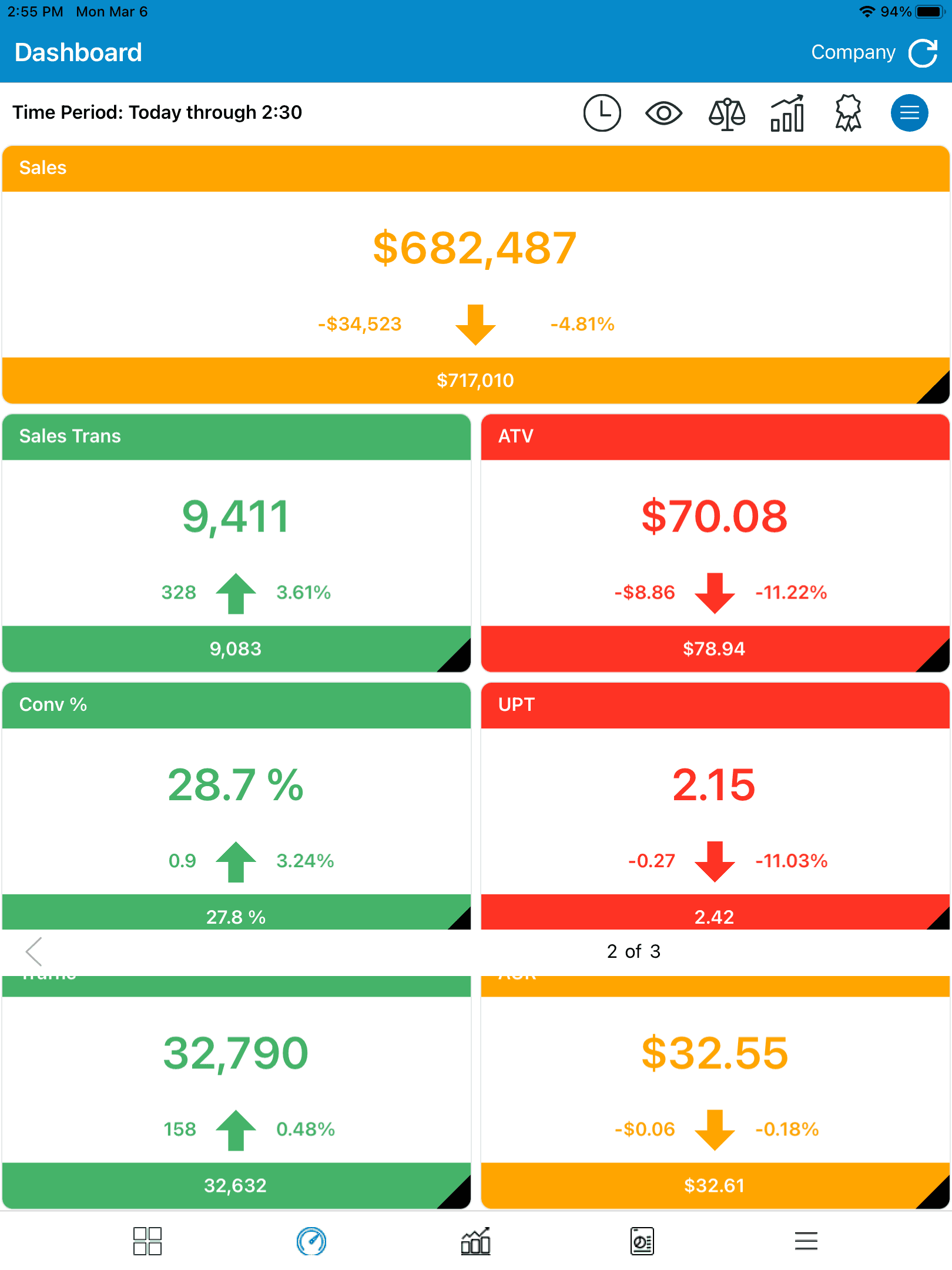
11. Foot Traffic and Digital Traffic
What it measures:
The number of customers visiting your physical stores or digital storefronts.
Formula:
Foot Traffic = Total Store Entrances
Digital Traffic = Total Website Sessions
Why it matters:
Traffic is one of the most important leading indicators in retail.
Before customers can make a purchase, they need to visit your store or website. Monitoring traffic helps retailers understand how effectively they are attracting customers and generating demand.
Traffic data can also provide valuable context for other KPIs. For example, if sales decline while traffic remains stable, the issue may be related to conversion, product availability, or customer experience. If traffic itself is declining, retailers may need to focus on marketing, promotions, brand awareness, or location-specific challenges.
Tracking both physical and digital traffic helps retailers evaluate the performance of marketing campaigns, seasonal promotions, store locations, and omnichannel strategies.
Most influenced by:
Marketing campaigns
Brand awareness
Store location
Seasonal trends
Promotional activity
Website performance
Local market conditions
12. Inventory Turnover Ratio
What it measures:
How quickly inventory is sold and replaced over a specific period.
Formula:
Inventory Turnover Ratio = Cost of Goods Sold ÷ Average Inventory Value
Why it matters:
Inventory is one of the largest investments most retailers make. Inventory turnover helps retailers understand how efficiently that inventory is moving through the business.
If inventory turnover is too low, products may be sitting on shelves for extended periods, tying up capital and increasing the risk of markdowns. If inventory turnover is extremely high, retailers may be experiencing stock shortages and missing potential sales opportunities.
Monitoring inventory turnover helps retailers identify demand patterns, optimise purchasing decisions, and improve inventory planning.
Over time, this KPI can also reveal seasonal trends, top-performing products, and underperforming inventory that may require promotional support, discounting, or discontinuation.
Most influenced by:
Product demand
Inventory planning
Forecasting accuracy
Seasonal trends
Pricing strategies
Promotional activity
Product assortment decisions
13. Customer Retention Rate
What it measures:
The percentage of customers who continue purchasing from your business over a specific period.
Formula:
Customer Retention Rate =
((Customers at End of Period - New Customers Acquired During Period) ÷ Customers at Start of Period) × 100
Why it matters:
Customer retention is one of the strongest indicators of long-term retail success.
While attracting new customers is important, retaining existing customers is often more profitable and sustainable. Loyal customers tend to purchase more frequently, spend more over time, and are more likely to recommend your brand to others.
Customer retention also provides valuable insight into customer satisfaction, product quality, store experience, and overall brand loyalty.
A retailer that consistently attracts new customers but struggles to retain them may have deeper issues with customer experience, product assortment, pricing, or store execution.
For retailers with loyalty programmes or strong digital capabilities, retention metrics can help identify which stores, products, and customer segments are creating the strongest long-term value.
Most influenced by:
Customer experience
Product quality
Employee engagement
Brand loyalty
Loyalty programmes
Product availability
Store execution
Omnichannel experience
14. Gross Margin Return on Investment (GMROI)
What it measures:
How much gross profit is generated for every dollar invested in inventory.
Formula:
GMROI = Gross Profit ÷ Average Inventory Cost
Why it matters:
GMROI is one of the most valuable inventory and profitability metrics in retail.
While sales and gross margin provide useful performance insights, GMROI takes things a step further by showing how effectively inventory investments are generating profit. In simple terms, it answers an important question:
For every dollar invested in inventory, how many dollars of gross profit are being generated?
This makes GMROI particularly useful when evaluating product categories, brands, or individual items.
Two products may generate similar sales, but if one requires significantly more inventory investment to achieve those sales, it may be delivering a lower return to the business.
Retailers use GMROI to make smarter merchandising, purchasing, and inventory decisions. It helps identify which products deserve additional investment and which products may be consuming inventory dollars without delivering sufficient returns.
Over time, improving GMROI can lead to stronger profitability, better inventory efficiency, and healthier cash flow.
Most influenced by:
Product margins
Inventory turnover
Pricing strategies
Product assortment
Purchasing decisions
Markdown activity
Demand forecasting accuracy

15. Sales Per Employee
What it measures:
The average amount of sales generated by each employee during a specific period.
Formula:
Sales Per Employee = Net Sales ÷ Number of Employees
Why it matters:
Retail employees have a direct impact on store performance.
They help customers find products, answer questions, provide recommendations, support promotions, and create the experiences that ultimately drive sales. Sales per employee helps retailers understand how effectively their workforce is contributing to revenue generation.
This KPI is particularly useful when evaluating workforce productivity, staffing levels, scheduling strategies, and labour investments.
A strong sales per employee ratio often indicates that employees are productive, properly trained, and equipped to support customers effectively. However, this metric should always be viewed alongside other KPIs such as customer satisfaction, turnover, and labour costs.
A very high sales per employee ratio may seem positive at first glance, but it can sometimes signal understaffing. If employees are consistently managing high sales volumes while customer wait times increase or turnover rises, the business may be placing too much pressure on its workforce.
For retail leaders, sales per employee provides valuable insight into whether staffing levels are aligned with business demand.
Most influenced by:
Employee productivity
Staffing levels
Scheduling effectiveness
Customer traffic
Employee training
Product knowledge
Customer service quality
Store execution
16. Inventory Accuracy
What it measures:
The percentage of inventory records that accurately match physical inventory counts.
Formula:
Inventory Accuracy = (Accurate Inventory Records ÷ Total Inventory Records) × 100
Why it matters:
Retailers cannot make good decisions using bad inventory data.
Inventory accuracy affects replenishment, forecasting, customer experience, order fulfilment, and overall store performance.
When inventory records are inaccurate, stores may experience stockouts, overstock situations, lost sales opportunities, and increased operational inefficiencies.
Maintaining high inventory accuracy helps retailers ensure products are available when customers want them while supporting more reliable planning and purchasing decisions.
Most influenced by:
Receiving processes
Cycle counting
Shrinkage
Store execution
Inventory audits
Employee training
How Technology Helps Retailers Track and Improve KPIs
Tracking retail KPIs is only valuable if leaders can use the information to make better decisions.
Many retailers already collect large amounts of data. The challenge is that sales metrics, labour reports, task completion data, inventory information, and employee performance metrics often live in separate systems. This makes it difficult to get a complete picture of what is happening across stores and even harder to identify trends before they impact performance.
The right retail technology helps bring these metrics together in one place, giving leaders a clearer view of sales, labour, operations, and workforce performance.
With real-time visibility into key KPIs, managers can identify issues faster, make more informed decisions, and take action before small problems become larger operational challenges. Whether it's declining conversion rates, rising labour costs, missed tasks, or increasing employee turnover, having access to the right data at the right time helps retailers respond more effectively.
How StoreForce Helps Retailers Turn KPI Data Into Action
Retail leaders do not need more reports. They need better visibility into the metrics that directly impact store performance.
StoreForce helps retailers connect workforce management, labour planning, scheduling, task execution, and performance reporting in a single platform. Instead of pulling information from multiple systems, leaders can access the KPIs that matter most in one place and understand how they are affecting performance across stores.
By combining sales performance, labour efficiency, store execution, and workforce insights, StoreForce helps retailers:
Improve labour productivity
Optimize scheduling decisions
Increase task completion and execution consistency
Identify performance trends faster
Support store managers with better visibility
Improve employee engagement and retention
Create more consistent customer experiences
The most successful retailers are not simply tracking KPIs. They are using them to improve performance every day.
With the right technology and the right visibility, retail leaders can spend less time searching for information and more time coaching teams, improving execution, and driving results across every location.

See How StoreForce Can Work for Your Stores
See how StoreForce brings employee scheduling, labour optimisation, task management, and store execution together in one retail workforce management platform. Book a demo today to see what StoreForce can do for your teams.
Speak To A Retail Expert


